One of the ways to improve battery performance is to increase the operating voltage. Since higher voltage allows a battery to store more energy, high-voltage design has become an important area of technological development as the electric vehicle (EV) and Energy Storage System (ESS) markets continue to expand.
However, battery voltage cannot be increased indefinitely. Once it exceeds a certain level, the electrolyte may begin to decompose, which can lead to battery performance degradation. This is where a fundamental physicochemical limit comes into play: the potential window.
In this Battery Glossary, we will take a closer look at the concept of the potential window, how it works, and why it is important in battery design.
What Is a Potential Window?
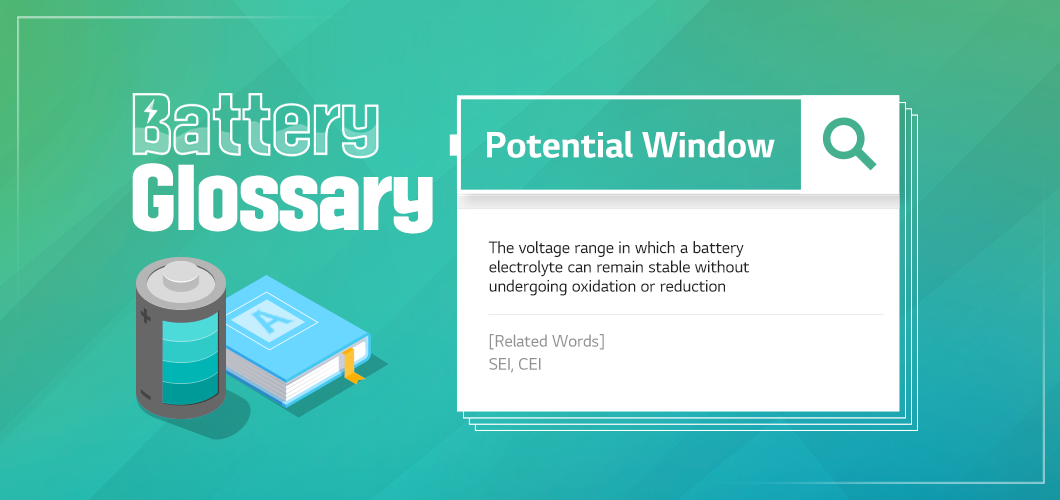
The potential window refers to the voltage range within which the battery electrolyte can remain stable without undergoing oxidation or reduction. This range can vary depending on a number of factors, including cathode and anode materials, additives, and temperature. What happens if it is exceeded? Side reactions can occur as the electrolyte decomposes through oxidation or reduction. In general, the electrolyte used in lithium-ion batteries remains relatively stable up to approximately 4.2–4.3 V, which is close to the upper voltage limit of its electrochemical stability.
Electric Potential and Voltage
To better understand the potential window, it helps to first understand the concepts of electric potential and voltage.
Electric potential refers to the electrical potential energy of a unit charge1 within an electric field and is measured in volts (V). Electric potential can be thought of as elevation. Just as water flows from a higher point to a lower point, electric charges move due to differences in electric potential.
In other words, when a potential difference (voltage) exists between two points with different electric potentials, charges move and electric current flows. This potential difference is what we commonly refer to as voltage (V). Just as a pressure difference causes water to flow rather than remain stagnant, a voltage (potential difference) is required for electric current to flow.
*View: Electrolytes for Lithium Ions Transport
Two Limits That Define the Potential Window
The potential window is primarily defined by two electric potential limits: the oxidation potential (anodic limit) and the reduction potential (cathodic limit).
The oxidation potential is the electric potential at which the electrolyte begins to oxidize by losing electrons, defining the upper limit of the potential window. Conversely, the reduction potential is the electric potential at which the electrolyte begins to reduce by gaining electrons, defining the lower limit.
Both limits are expressed in volts (V) and measured relative to a reference electrode such as lithium (Li/Li⁺), rather than absolute values.
| Category | Oxidation Potential (Upper Limit of the Potential Window) | Reduction Potential (Lower Limit of the Potential Window) |
|---|---|---|
| Meaning | The electric potential at which oxidation begins as the electrolyte loses electrons | The electric potential at which reduction begins as the electrolyte gains electrons |
| Application Area | Cathode | Anode |
| Operating Environment | High-voltage environment | Low-voltage environment |
| Effects of Exceeding the Limit | Electrolyte oxidative decomposition, gas generation, and excessive CEI growth | Electrolyte reductive decomposition and excessive SEI growth |
Why Battery Voltage is Set Within a Stable Range
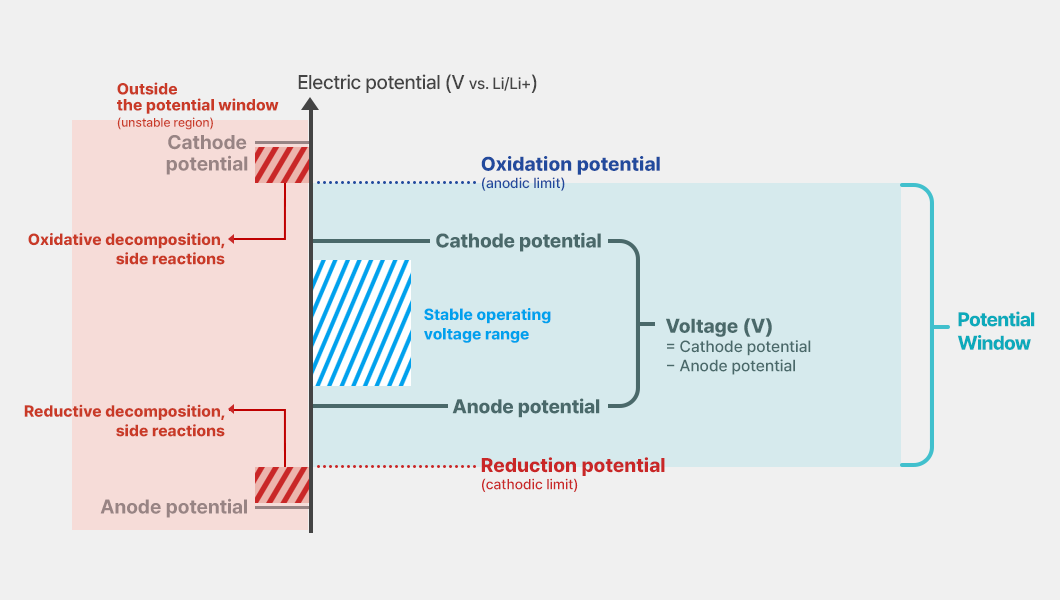
A battery operates through oxidation and reduction reactions, transferring electrons between the cathode and anode. During this process, the electrolyte must function as a pathway for lithium-ion transport and should not directly participate in these reactions. However, when the electrode potential moves outside the potential window, side reactions can occur in which the electrolyte itself undergoes oxidation or reduction.
At this stage, the organic solvents in the electrolyte decompose and generate gases such as carbon dioxide (CO₂) and carbon monoxide (CO). As these gases accumulate inside the battery, internal resistance increases and the cell begins to swell. Over time, these changes can negatively affect battery lifespan and durability.
In particular, at the anode, electrolyte reduction forms a layer known as the Solid Electrolyte Interphase (SEI)2 on the electrode surface. A stable SEI that forms during initial charging helps protect the electrode. However, when the voltage exceeds the potential window, this layer can continue to grow beyond what is necessary. This can increase internal resistance and reduce battery capacity.
Meanwhile, oxidation of the electrolyte at the cathode gives rise to an interfacial layer known as the Cathode Electrolyte Interphase (CEI)3. Under normal conditions, the CEI can help protect the cathode surface. However, in high-voltage environments beyond the potential window, or when highly reactive cathode materials are used, decomposition reactions become more active. As a result, the layer may thicken excessively and lose stability, increasing surface resistance and accelerating performance degradation.
In summary, when the voltage exceeds the potential window, electrolyte decomposition and structural changes at the electrode interface can occur inside the battery, potentially affecting internal resistance and overall performance.
For this reason, practical lithium-ion batteries are designed to operate within within a narrower voltage range than the theoretical limits of the potential window. This approach helps suppress excessive electrolyte decomposition and side reactions while maintaining stable battery operation.
*View: A Better Life with Batteries – Key Properties That Qualify Electrolytes to Serve as Lithium-Ion Pathways: Lithium Salts, Solvents, and Additives
*View: Battery Glossary – SEI (Solid Electrolyte Interphase)
*View: Battery Glossary – CEI (Cathode Electrolyte Interphase)
Why Expand the Potential Window?
An expanded potential window means that the electrolyte can remain stable without decomposing even at higher voltages. Increasing the operating voltage (V) allows the battery to store more energy (Wh) even when the battery capacity (Ah) remains the same.
Therefore, if the potential window can be expanded while maintaining the stability of electrode materials, batteries can operate safely at higher voltages. This enables lithium ions to react across a wider potential range, ultimately supporting high-voltage battery design and improved energy density.
However, increasing the voltage excessively can introduce challenges, as it may accelerate electrolyte decomposition and structural degradation of the electrodes. In the end, battery performance depends on how effectively this invisible boundary can be maintained. To address this challenge, battery researchers are actively developing next-generation electrolytes, highly stable electrode materials, and advanced additives capable of withstanding high-voltage environments.
Key Q&A
Q. What is a potential window?
A potential window is the voltage range within which the electrolyte can remain stable without decomposing.
Q. What happens when the potential window is exceeded?
The electrolyte undergoes oxidation and reduction, leading to decomposition and issues such as gas generation, increased internal resistance, and reduced battery lifespan.
Q. What is electric potential?
Electric potential refers to the electrical potential energy of a unit charge within an electric field and is expressed in volts (V).
Q. How is the potential window determined?
The potential window is defined by the oxidation and reduction potentials and can vary depending on materials, temperature, and electrolyte conditions.
In this Battery Glossary, we explored the concept of the potential window. As we have seen, when the electrolyte operates outside this stable voltage range, decomposition and side reactions can occur, potentially affecting battery performance and lifespan. We will continue to introduce the various important principles behind batteries in an easy-to-understand way.
- Unit Charge: A standard quantity of electric charge used in electricity and electronics. In the International System of Units (SI), electric charge is measured in coulombs (C). One coulomb represents the amount of electric charge transferred by a current of 1 ampere (A) flowing for 1 second. ↩︎
- Solid Electrolyte Interphase (SEI): A layer formed on the anode surface during the initial charging process of a battery. ↩︎
- Cathode Electrolyte Interphase (CEI): A thin interfacial layer formed between the cathode and the electrolyte. ↩︎