You may have heard of the Solid Electrolyte Interphase (SEI), the interfacial layer formed at the anode. But does a similar interfacial layer exist on the cathode as well? The answer is yes. A thin layer also develops on the cathode surface where it comes into contact with the electrolyte. This layer is called the Cathode Electrolyte Interphase (CEI). In this article, we’ll take a look at the CEI and how it differs from the SEI.
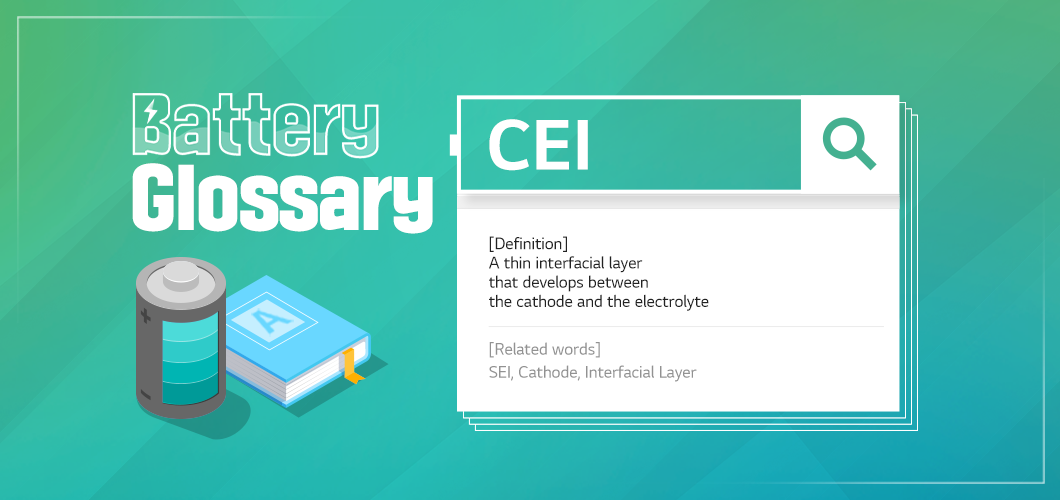
What is the CEI?
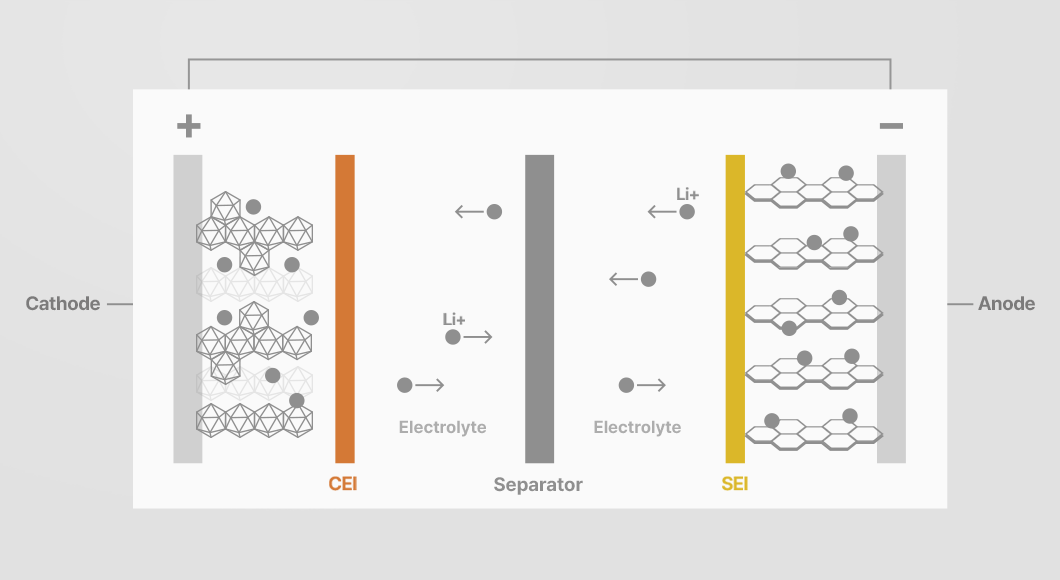
The CEI is not an intentionally coated layer. Rather, it is an interfacial layer that naturally forms through electrolyte decomposition reactions during battery operation. During the oxidation process at the cathode, electrolyte components such as solvents, lithium salts, and additives decompose. The resulting materials accumulate on the cathode surface, creating the CEI.
Differences Between the CEI and SEI
| Category | SEI | CEI |
|---|---|---|
| Formation Location | Anode | Cathode |
| Formation Mechanism | Reduction reactions at the anode | Oxidation reactions at the cathode |
| Research Trends | Extensively studied over time | Growing importance in high-energy-density systems |
In the past, research on the CEI was relatively limited compared to that on the SEI. Recently, however, its importance has grown rapidly. As research on high-energy-density and high-voltage batteries continues, the formation and stability of the CEI are increasingly recognized as key factors affecting battery life, capacity, and safety.
Both the SEI and CEI are interfacial layers created through electrochemical reactions between the electrodes and the electrolyte. However, they differ in how they form and function.
The SEI develops through reduction reactions at the anode. During the initial charging process, a thin layer forms on the anode surface. When a stable SEI is established, it suppresses further electrolyte decomposition and acts as a protective layer. For this reason, achieving an appropriate SEI composition and structure is essential.
In contrast, the CEI develops through oxidation reactions at the cathode. In particular, under high-voltage conditions above 4.5V or when highly reactive cathode materials are used, oxidative electrolyte decomposition becomes more active, accelerating CEI formation and growth. During this process, various decomposition products generated from the electrolyte and cathode surface accumulate at the interface, causing the composition and thickness of the CEI to vary depending on operating conditions.
What Roles Does the CEI Play?
The expected roles of the CEI are largely determined by the materials used in the battery and the characteristics of the battery itself. This is because its properties can be optimized to support and maximize the intended characteristics of the battery.
In general, an ideal CEI should function as an interfacial layer that blocks electron transport while allowing lithium ions to pass through. In other words, it should suppress continuous electrolyte decomposition without interfering with lithium-ion transport during charging and discharging.
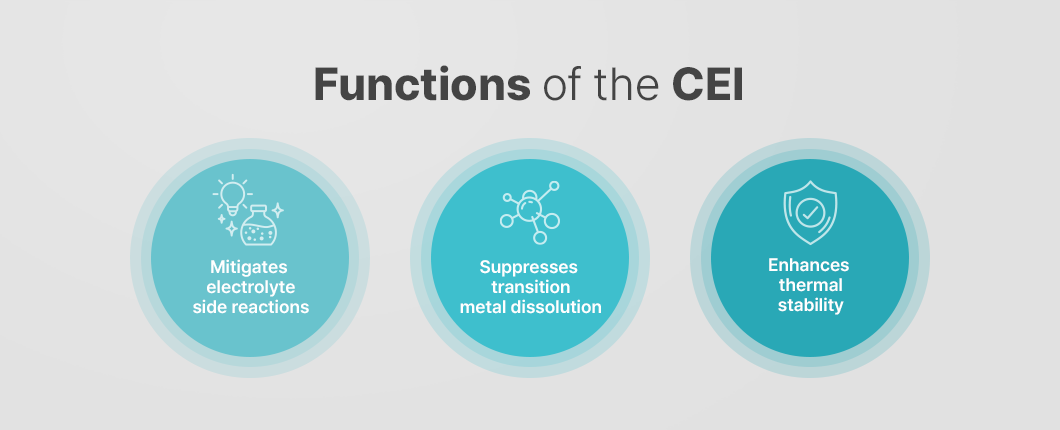
First, the CEI helps mitigate side reactions that can occur between the cathode and the electrolyte. During battery operation, the electrolyte can easily undergo oxidation and decomposition at the cathode surface. When a stable CEI forms, it can suppress these reactions, reducing electrolyte consumption and mitigating damage to the cathode surface.
The CEI also helps limit the dissolution of transition metals such as nickel (Ni), manganese (Mn), and cobalt (Co) into the electrolyte. When these metals dissolve from the cathode into the electrolyte, battery capacity can decrease. They may also deposit on the anode surface, causing additional performance degradation. In particular, in high-nickel cathodes, the cathode surface structure can gradually change during charging and discharging, making lithium-ion transport more difficult. A stable CEI can help mitigate these surface changes.
Lastly, the CEI contributes to the thermal stability of the battery. It consists of inorganic and organic components, with typical inorganic components including lithium fluoride (LiF) lithium carbonate (Li₂CO₃), and lithium oxide (Li₂O). A stable CEI rich in inorganic components can help delay oxygen release from the cathode lattice under high-temperature conditions.
So far, we have looked at the concept of the CEI, its formation mechanism, and its roles in battery performance. Although it is an interfacial layer that forms naturally between the electrode and the electrolyte during battery operation, the CEI has gained attention as an important factor affecting battery life and stability. We will continue introducing a variety of battery concepts and technologies in future articles.