Lithium-ion batteries generate electrical energy through the movement of lithium ions and chemical reactions. If lithium ions cannot move smoothly, even advanced battery performance cannot be fully realized. In this process, the electrolyte plays a critical role. An electrolyte is a medium that enables lithium ions to move between the cathode and anode inside a battery. Here, we take a closer look at the structure and role of electrolytes, a key material that supports lithium-ion movement.
The 3 Major Components of Electrolytes
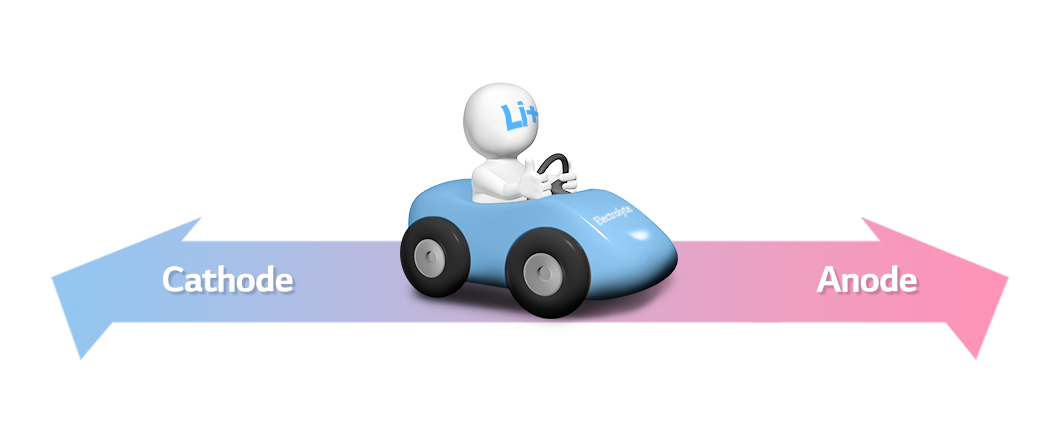
Lithium ions move between the cathode and anode through the electrolyte during the charge and discharge process of lithium-ion batteries. In simple terms, lithium ions use the electrolyte as a dedicated pathway for their daily “commute” between electrodes. Most electrolytes used in lithium-ion batteries are liquid with dissolved lithium salts, commonly referred to as an electrolyte solution. An electrolyte consists of lithium salts, organic solvents, and additives.

Lithium Salts
Lithium salts serve as pathways for lithium-ion movement. When dissolved in a solvent, lithium salts dissociate, allowing lithium ions to move within the electrolyte.
The most commonly used lithium salt in lithium-ion batteries is LiPF₆. It offers high ionic conductivity, excellent solubility, and chemical stability, and is widely used in small IT devices such as smartphones.
For EV batteries, LiPF₆ is used as a base lithium salt and is often combined with LiFSI, LiPO₂F₂, LiDFOP, and LiBOB to improve performance. These lithium salts help enhance battery lifespan, improve charge and discharge efficiency, and improve low-temperature performance. In particular, LiFSI is sometimes used to improve low-temperature performance due to its superior lithium-ion mobility in cold conditions.
Organic Solvent
The organic solvent helps lithium salts dissolve in the electrolyte and enables smooth movement of lithium ions. A good organic solvent should satisfy two key properties.
High permittivity allows lithium salts to dissociate effectively, enabling easier ion movement.
Low viscosity allows ions to move faster.
However, solvents with high permittivity tend to have high viscosity, while those with low viscosity tend to have low permittivity. For this reason, multiple solvents are mixed to achieve a balanced performance. Typically, cyclic carbonates and linear carbonates are combined to secure optimal ionic conductivity.
Additives
Additives are substances added in small amounts, typically less than 5 percent, to enhance battery lifespan, improve stability, and optimize performance.
Since the electrolyte comes into contact with both the cathode and anode, additives that act on the cathode and those that act on the anode can be used together.
Cathode additives help suppress heat generation and improve electrode stability. Anode additives form a protective layer on the anode surface, helping protect the electrode and extend battery life.
Although used in small amounts, additives play a crucial role in electrolyte performance. They are combined in appropriate ratios of organic and inorganic materials depending on the required battery performance. In particular, inorganic additives mainly act on the cathode, helping suppress gas formation inside the battery and reduce internal resistance.
The electrolyte, composed of lithium salts, organic solvents, and additives, is injected at the final stage of the battery manufacturing process. Once it sufficiently permeates the separator, cathode, and anode, an environment is formed where lithium ions can move freely.
Conditions for Good Electrolytes
To transport lithium ions stably, electrolytes must meet several important conditions.
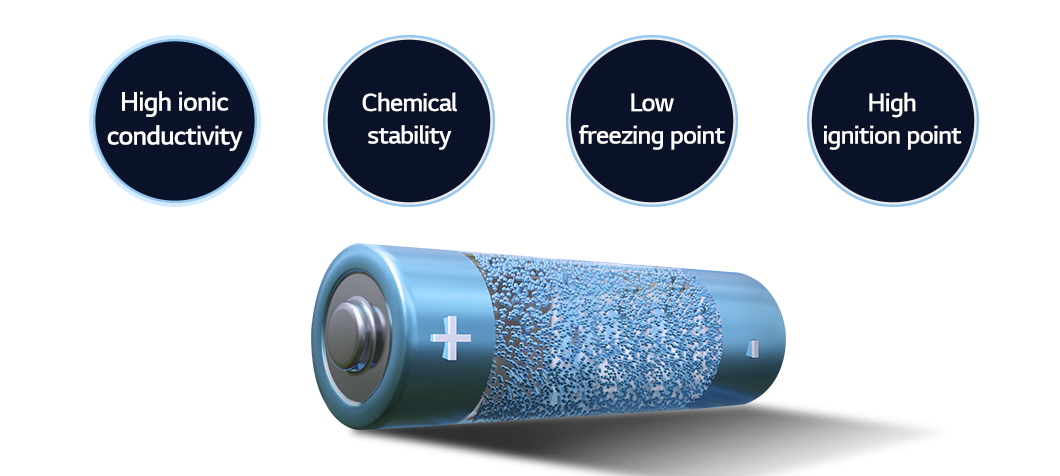
High ionic conductivity: Electrolytes should enable a large number of lithium ions to move in a short period of time. High ionic conductivity is essential to support fast charging performance.
High chemical stability: Electrolytes are continuously exposed to electrochemical reactions at the cathode and anode surfaces during battery operation. They must remain chemically stable without causing unwanted side reactions. To address this, various additives are being studied to improve electrolyte stability.
Temperature stability: As electrolytes are liquids, their performance can be affected by temperature changes. At low temperatures, molecular movement slows down, which can reduce ion mobility. Therefore, electrolytes should have a low freezing point and a high flash point to operate stably under various conditions.
Outlook for the Electrolyte Market
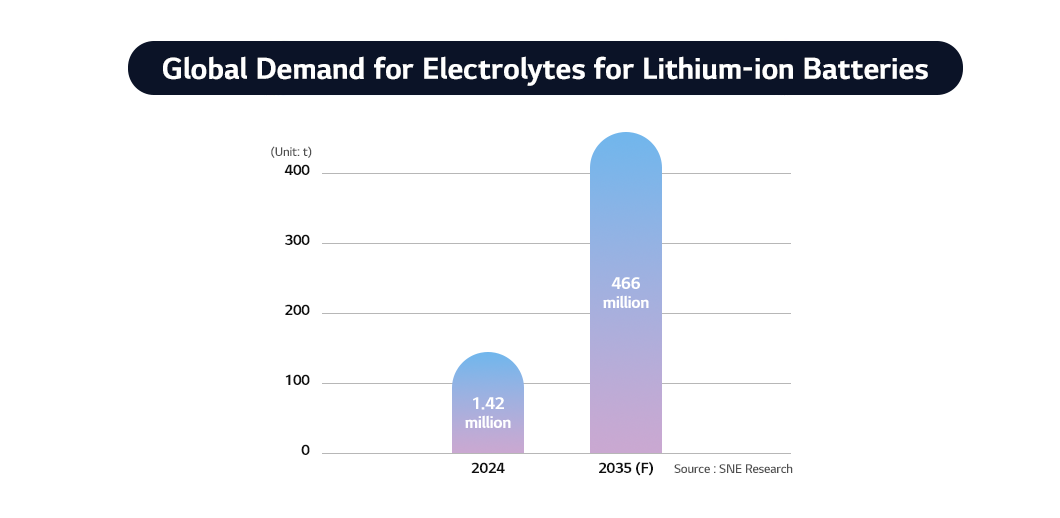
As the rechargeable battery market grows, demand for electrolytes is also increasing rapidly. According to market research, electrolyte demand used in battery production is expected to grow from approximately 1.42 million tons in 2024 to about 4.46 million tons by 2035. This represents an increase of more than 3 million tons.1
The Emerging Next-Generation Electrolyte, Solid-State Batteries
Recently, research on all-solid-state batteries using solid electrolytes has been actively conducted in the battery industry. Since solid-state batteries use solid electrolytes instead of liquid electrolytes, they can offer several structural advantages.
First, they have strengths in terms of safety, as solid electrolytes are more resistant to external impact and leakage compared to liquid electrolytes. In addition, they have the potential to achieve higher energy density. Some studies suggest that applying solid-state batteries could enable longer driving range compared to conventional batteries of the same size.
Key Q&A
Q. What is an electrolyte?
An electrolyte is a medium that enables lithium ions to move between the cathode and anode inside a battery.
Q. What are electrolytes composed of?
Electrolytes in lithium-ion batteries consist of lithium salts, organic solvents, and additives.
Q. What conditions are required for good electrolytes?
Good electrolytes should have high ionic conductivity, chemical stability, and temperature stability to ensure stable battery operation across various environments.
Electrolytes are a key element that enables the movement of lithium ions in lithium-ion batteries. Electrolyte technology continues to evolve to improve performance and safety, while research on solid electrolytes for all-solid-state batteries is also progressing rapidly.
As battery technology advances, electrolytes are expected to continue evolving in various forms and play a crucial role in determining battery performance.
- SNE Research. (2024). Electrolyte demand for secondary batteries is projected to reach 4.46 million tons by 2035. ↩︎