Lithium-ion batteries power a wide range of everyday products — electric vehicles (EVs), smartphones, power banks, laptops, and power tools. When used correctly, batteries make our everyday lives significantly more convenient. But misuse or exposure to risks like overcharging, high temperatures, external impact, or internal short circuits can lead to safety issues. That’s why understanding how to use your battery properly is important. Let’s learn how to use lithium-ion batteries safely.
The Basics of Lithium-ion Battery Safety
Lithium-ion batteries can be affected by how they’re used and maintained. Let’s start by looking at why battery issues occur and what warning signs to watch for.
Q. What causes lithium-ion battery fires?
When heat builds up abnormally inside a lithium-ion battery, a fire can occur. If that heat isn’t controlled and continues to increase, it can trigger thermal runaway — a chain reaction that raises the risk of overheating and ignition. There are four common causes behind this:
- Short circuits, where the positive and negative terminals connect abnormally
- Overcharging or overcurrent, especially without a protection circuit or when one is damaged
- Physical damage from external impact or unauthorized modification
- Prolonged exposure to high temperatures
Using a certified battery under normal conditions and following the manufacturer’s guidelines can significantly lower the risk of fire.
Q. What are the warning signs of a battery problem?
If you notice any of the following, stop using and charging the battery immediately, and contact the manufacturer:
- Smoke during charging
- Liquid leakage or an unusual smell from inside the battery
- Swelling, deformation, or discoloration of the battery
- The battery feels unusually hot
- Any other unusual behavior or condition
These signs can point to internal damage or a short circuit, so it’s important to stop using the battery right away.
Q. How can you tell if an EV battery has a problem?
EVs are equipped with a Battery Management System (BMS) that monitors the high-voltage battery’s voltage, current, temperature, and cell balancing. The BMS is designed to keep the battery operating within a safe range, and if it detects an abnormal condition, it typically alerts the driver through a warning light or an in-vehicle message.
However, specific warning signs and recommended actions can vary by manufacturer and vehicle model. If a battery warning appears, or if you notice anything unusual during driving or charging, don’t try to diagnose the issue yourself — refer to your vehicle manual and manufacturer guidance, and have it checked by a professional.
Lithium-ion Battery Safety Guidelines
Using a lithium-ion battery safely — and maximizing battery life — comes down to good everyday habits. Next, let’s walk through safety guidelines for charging, storage, and how to respond if something goes wrong.
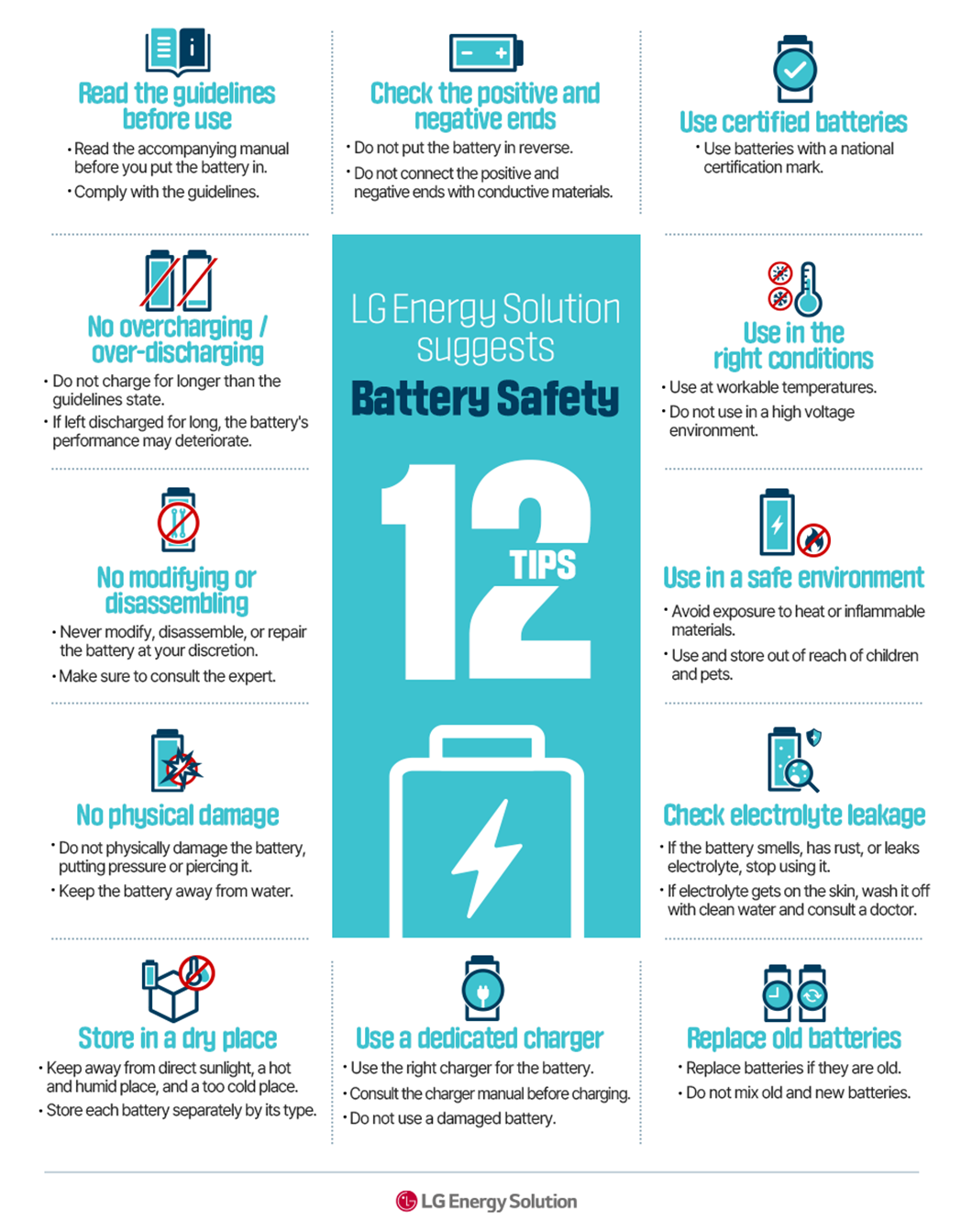
Q1. Why can’t you connect the cathode (+) and the anode (-) in reverse?
Reversing the connection between the cathode and anode can cause a short circuit, which may lead to overheating or fire – so care must be taken to avoid this. A battery is charged as lithium ions move from the cathode (+) to the anode (-), and it releases energy when they move in the opposite direction. If the connection is reversed, a short circuit occurs, a state in which excessive current flows with little or no electrical resistance — which can lead to safety issues such as overheating or fire. Therefore, when installing or replacing a battery, always check the (+) and (–) markings indicated on the product.
Q2. Why shouldn’t you connect the cathode (+) and anode (-) with conductive materials (such as metal or metal wires)?
If the cathode (+) and anode (-) are directly connected by conductive materials (such as metal or metal wires), excessive current can flow through a low-resistance path, generating heat. This can lead to a device malfunction and safety problems. Accordingly, you should avoid forcibly discharging a battery by connecting its terminals with a metal conductor, and unused batteries should have their terminals insulated.
Q3. Why do you have to buy batteries with a national certification mark?
A national certification mark indicates that a product has passed tests conducted by testing agencies, meaning that its quality and safety have been verified. In Korea, the Korea Certification (KC) Mark system evaluates and confirms safety and conformity of battery products used domestically. The distribution and sale of products without a KC mark are considered illegal under the Electrical Appliances and Household Products Safety Management Act. The Korean Agency for Technology and Standards (KATS) also publicly states a ban on the use of loose battery cells that do not have a KC mark.
Q4. What is the “protection circuit” of a battery and what does it do?
A protection circuit is a safety device for controlling and protecting a battery that is in an abnormal state caused by overcharge, over-discharge, or overcurrent. Using a battery without a protection circuit can cause safety problems such as a fire or an explosion as it cannot handle the heat generated by high current.
Nevertheless, the illegal sale and purchase of loose battery cells without protection circuits (such as 18650, 20700, and 21700) remain a global issue. In response, the U.S. Consumer Product Safety Commission warned against the use of loose 18650 battery cells that do not have protection circuits. Therefore, you should not buy batteries through unverified channels, whether domestic or overseas.
Q5. Why can’t individuals just disassemble, modify, or repair batteries?
Battery manufacturers discourage consumers from attempting to disassemble, modify or repair batteries at their discretion. If individuals without the necessary expertise or skills attempt to modify a battery, they may damage the protection circuit of the battery, which can lead to a fire or an explosion. Therefore, any repair or modification should be handled by a qualified professional. Above all, even in case the product is damaged or a safety accident happens as a result of such attempts, the manufacturer is not obliged to compensate the consumer because it is caused by the consumer’s fault. So, if a battery is suspected to be malfunctioning, do not handle it directly – follow the manufacturer’s guidelines and seek help from a qualified professional.
Q6. Why can’t batteries come into contact with water or be submerged?
Quality-certified batteries are waterproofed and sufficiently protected enough so that the risks of battery malfunction or an electrical injury are low even when they come into contact with water or are submerged. However, if a battery has been damaged by external impact, water exposure may pose a safety risk. Therefore, it is important to keep the battery away from water. If an electronic device has been submerged for a long time with batteries in it, the metal components may corrode, causing problems with the charging terminal or other internal components. In that case, you should first cut the power off and avoid direct contact with it.
Q7. Why can’t you overcharge or over-discharge batteries?
Quality-certified batteries can protect themselves from overcharge or over-discharge because they have protection circuits. If a battery has internal damage or has been used for a long time, repeated overcharging may make the battery unstable, reduce its capacity and lifespan, and cause safety risks such as overheating or a fire. It is better to remove the charging cable from the device when charging is completed. Over-discharging can also damage the battery. It may push the voltage down below the rated level, damaging the current collector and undermining the performance.
Q8. Why can’t you store or use batteries in an extremely cold environment?
At extremely low temperatures, the electrolyte and internal components of the battery can become cold, slowing the movement of lithium ions and reducing battery efficiency. Lithium ions in a battery that is discharged in cold temperature normally can recover their speed when put back in higher temperature. However, drastic temperature changes may damage the battery’s internal components and impact the battery’s performance and life. Therefore, it is important to avoid storing and using batteries in an extremely cold environment and to prepare for temperature changes.
Q9. Why can’t you store batteries in a hot or humid environment?
A battery exposed to a humid environment for a long time may corrode due to steam, which can lead to discharge or problems in battery contacts. This eventually can shorten the battery’s lifespan and undermine its performance. Also, exposure to a hot environment for a long time may gradually heat up the battery, damaging the internal structure of the battery and causing safety issues such as a fire or an explosion. For long-term storage, batteries need to be stored in a cool, dry environment.
Q10. Why do you have to check electrolyte leakage?
Electrolyte leakage from a battery can cause irritation or harm to the human body. The electrolyte in a lithium-ion battery consists of lithium salts, organic solvents, additives, and other components, and is corrosive. Contact with the skin or eyes may cause irritation or inflammation, while inhalation or ingestion may cause symptoms such as headaches, nausea, or shortness of breath.
Therefore, if you notice liquid leaking from a battery or an unusual odor, do not touch the battery directly and stop using it. If electrolyte comes into contact with your skin or eyes, immediately rinse the affected area thoroughly with clean water and seek medical attention.
Q11. Why can’t you mix old and new batteries??
Old batteries lose capacity with time and come to have unstable voltage. When used with new batteries, the old batteries may leak electrolyte because the capacity and voltage are different, and that can damage the device. For electronic devices, users are advised to replace batteries when the maximum capacity goes down below 80%. Also, they are recommended to use batteries of the same type and capacity for safe and proper battery use.
Q12. Why do you have to use a dedicated charger for a battery-powered product?
A dedicated charger is designed and verified by the manufacturer to provide the voltage and current required for the battery in the product. Therefore, using a dedicated charger allows the battery to be charged more safely. On the other hand, using a charger that does not meet the required specifications can cause overcharging, overcurrent, overheating, or charging failure, which may shorten battery life or damage the product.
When charging, use a dedicated charger and charge the battery within its operating temperature range. Avoid using non-genuine or unverified chargers, as damage to the product caused by such chargers may make it difficult to receive warranty coverage from the manufacturer.
Key Takeaways for Safe Lithium-Ion Battery Use
To use lithium-ion batteries safely, it’s important to choose officially certified products and to charge, store, and use them according to the manufacturer’s guidelines. In particular, following the basic rules below can help lower the risk of safety issues such as overheating or ignition.
● Use products that carry an official certification mark, such as KC certification.
● Connect the battery’s cathode (+) and anode (–) in the correct direction.
● Do not directly connect the battery terminals with a metal object.
● Do not use uncertified single cells that lack a protection circuit.
● Do not disassemble, modify, or repair the battery on your own.
● If a product gets wet or submerged, cut off the power and avoid direct contact.
● Once charging is complete, disconnect the charging cable, and do not leave the battery fully discharged for extended periods.
● Store batteries in a cool, dry place, avoiding locations that are hot and humid or extremely cold.
● If you notice smoke, odor, leakage, swelling, deformation, or overheating, stop using and charging the battery immediately.
● Use only the dedicated charger recommended by the manufacturer for products with built-in batteries.
For the safe and right use of batteries, the most important things are to purchase safe batteries with an official certification mark and to check the instructions and guidelines of the manufacturer before using the batteries. Make sure to remember the two points!