What if your battery appears to charge normally, but runtime continues to decrease and performance drops when high power output is required? One possible cause is internal resistance, which gradually increases inside the battery.
Internal resistance affects battery power output, efficiency, and safety, and is also used as an indicator of battery aging. In this Battery Glossary, we will take a closer look at internal resistance.
What is Internal Resistance?
Internal resistance refers to the sum of all resistances that interfere with the flow of current inside a battery and is a key indicator influencing battery power output and efficiency. It consists of electronic resistance and ionic resistance.
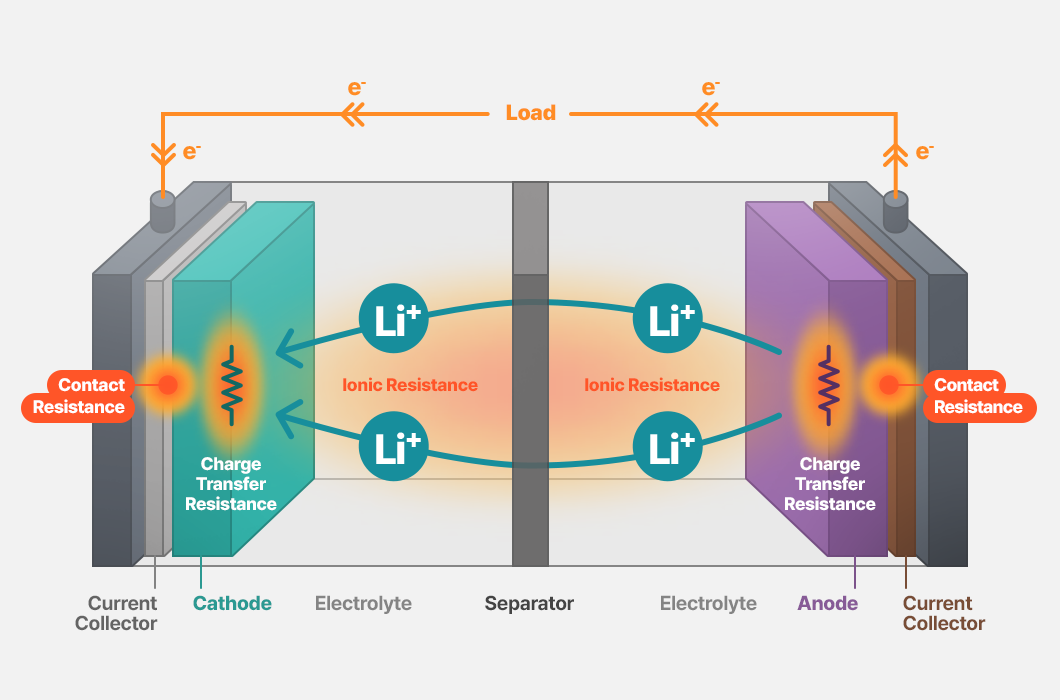
Internal resistance arises as current flows through various components inside the battery. Resistance occurs throughout the battery system, including electrode materials, electrolytes, cell structures, and electrical contact points. Rather than originating from a single component, internal resistance results from the combined effects of multiple factors.
In other words, internal resistance is not limited to certain areas of the battery but represents the combined resistance throughout the entire battery structure.
DC-IR and AC-IR, Measuring Internal Resistance
Internal resistance measurements serve different purposes depending on the method used. The two most common methods are DC-IR (Direct Current internal resistance) and AC-IR (Alternating Current internal resistance).
DC-IR estimates internal resistance by measuring voltage changes that occur when current is applied for a short period of time. It can measure internal resistance under actual charge and discharge conditions. However, continuous measurement is difficult, making it less suitable for real-time monitoring.
AC-IR measures resistance by applying a small high-frequency alternating current (typically around 1 kHz) and analyzing the response difference between voltage and current. Because it can be measured quickly with minimal impact on the battery, it is commonly used to conveniently assess battery condition.
In summary, DC-IR better reflects actual charge and discharge conditions, while AC-IR is primarily used for rapid battery condition assessment.
Why is Internal Resistance Important?
Internal resistance is also an important criterion for evaluating battery condition. It is considered one of the key indicators used to assess battery condition, along with State of Charge (SoC) and State of Health (SoH).
*View: Battery Glossary – SoC (State of Charge)
*View: Battery Glossary – SoH (State of Health)
There are two primary reasons why internal resistance is important.
First, internal resistance is directly related to battery power output. As resistance increases, the amount of power the battery can deliver instantaneously decreases. In particular, when the increase in internal resistance remains within approximately 20%, power output tends to decrease at a similar rate.
Second, internal resistance also affects energy efficiency. As resistance increases, a portion of energy is dissipated as heat during charging and discharging, reducing Round-Trip Efficiency (RTE). This impact is relatively smaller than its effect on power output. Under typical charge and discharge conditions, even if internal resistance increases by approximately 50%, the reduction in RTE is generally around 2–6%. However, because RTE is influenced by multiple factors, efficiency does not decrease at a fixed rate simply because internal resistance increases.
The importance of internal resistance is reflected in the EU Battery Regulation, which requires the disclosure of battery internal resistance and its rate of increase.
As internal resistance increases, power output decreases, energy loss increases, and heat generation rises, directly affecting battery performance and lifespan.
Effects of Increasing Internal Resistance
Repeated battery use leads to the accumulation of chemical and physical changes inside the battery, causing internal resistance to gradually increase. So, what happens when internal resistance becomes higher?
① Reduced Power Output: As internal resistance increases, the power output the battery can deliver tends to decrease.
② Increased Heat Generation: When current passes through higher resistance, more heat is generated. This can reduce battery efficiency and contribute to additional heat buildup.
③ Reduced Usable Capacity: When internal resistance exceeds a certain level, battery voltage reaches its operating limits more quickly during charging and discharging, reducing the amount of usable capacity. This phenomenon is more pronounced in lithium-ion battery systems. Under certain conditions, capacity loss may suddenly accelerate, and because the timing of these changes is not consistent, they can be difficult to predict.
④ Increased Cell Imbalance: The internal resistance of cells connected in series within a battery pack increases at different rates. As these differences accumulate, some cells may be exposed to overcharging or over-discharging conditions, ultimately shortening the lifespan of the entire pack.
In summary, increased internal resistance can lead to various forms of performance degradation, including reduced power output, increased heat generation, reduced capacity, and greater cell imbalance.
How Can Internal Resistance Be Managed?
The rate at which internal resistance increases can be slowed depending on operating conditions and management practices. Key management factors include the following.
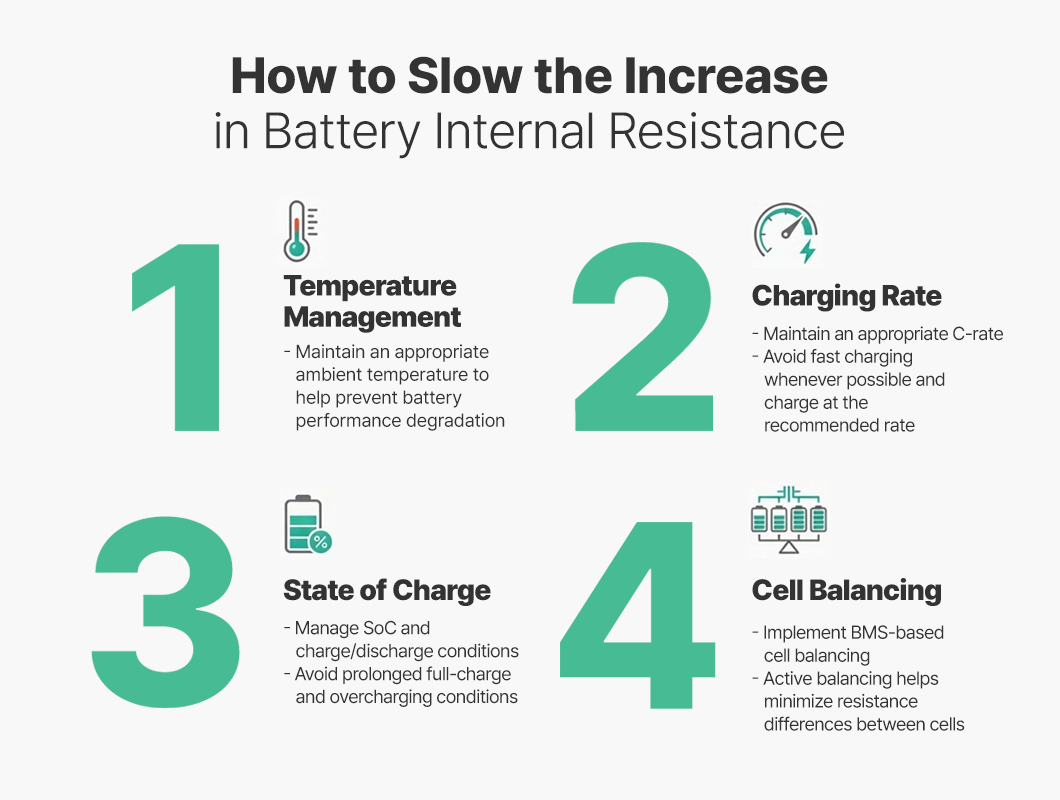
① Temperature Management: Lithium-ion batteries degrade most slowly at moderate temperatures (15–35 °C). At high temperatures, growth of the Solid Electrolyte Interphase (SEI) and electrolyte decomposition accelerate. At low temperatures, lithium plating, in which lithium accumulates on the electrode surface in metallic form, can occur and increase resistance. Therefore, avoiding extreme temperature environments and maintaining an appropriate temperature range is important.
② Maintaining an Appropriate C-rate*: Maintaining a charge and discharge rate of approximately 0.5–1C (equivalent to a full charge or discharge in about one to two hours) helps minimize resistance growth. High-rate charging and discharging can trigger overvoltage-related side reactions. Conversely, excessively slow charging can keep the battery at a high state of charge for extended periods, increasing time-dependent degradation. For this reason, excessively fast charging and discharging should be avoided whenever possible, and stable operating rates should be maintained.
③ SoC and Charge/Discharge Management: Maintaining a high SoC for extended periods or repeatedly operating across excessive charge and discharge ranges can accelerate battery degradation and contribute to long-term increases in internal resistance. Rather than keeping the battery fully charged for long periods, ensuring an appropriate charge level and avoiding deep discharge cycles whenever possible is recommended.
④ BMS-Based Cell Balancing: Minimizing resistance differences between cells through active balancing by the Battery Management System (BMS) is an effective way to manage the overall internal resistance of a battery pack.
*View: Battery Glossary – SEI
*View: Battery Glossary – C-rate
*View: A Better Life with Batteries – Achieving Energy Balance through Cell Balancing
*View: Battery Glossary – BMS
To slow the increase of internal resistance, operating within an appropriate temperature range, managing charge and discharge rates, avoiding excessive charging conditions, and implementing BMS-based cell balancing are all important.
Key Q&A
Q. What is Battery Internal Resistance?
Internal resistance is the sum of resistances that interfere with the flow of current inside a battery and is a key indicator that affects power output and efficiency.
Q. Why is Internal Resistance Important?
Because it directly reduces power output and increases energy loss.
Q. What Happens When Internal Resistance Increases?
Reduced power output, increased heat generation, and reduced usable capacity may occur, potentially shortening battery lifespan.
Q. How Can the Increase in Internal Resistance Be Reduced?
Operating within an appropriate temperature range, maintaining stable charging and discharging conditions, and avoiding excessive charging are important. BMS-based management is also necessary.
Internal resistance may not be visible, but it is a critical factor that simultaneously affects battery power output, efficiency, heat generation, and lifespan. Because the rate of increase varies depending on operating conditions and management practices, it serves as an important indicator for understanding and managing battery condition.
We will continue to make key battery concepts easy to understand through the Battery Glossary series.