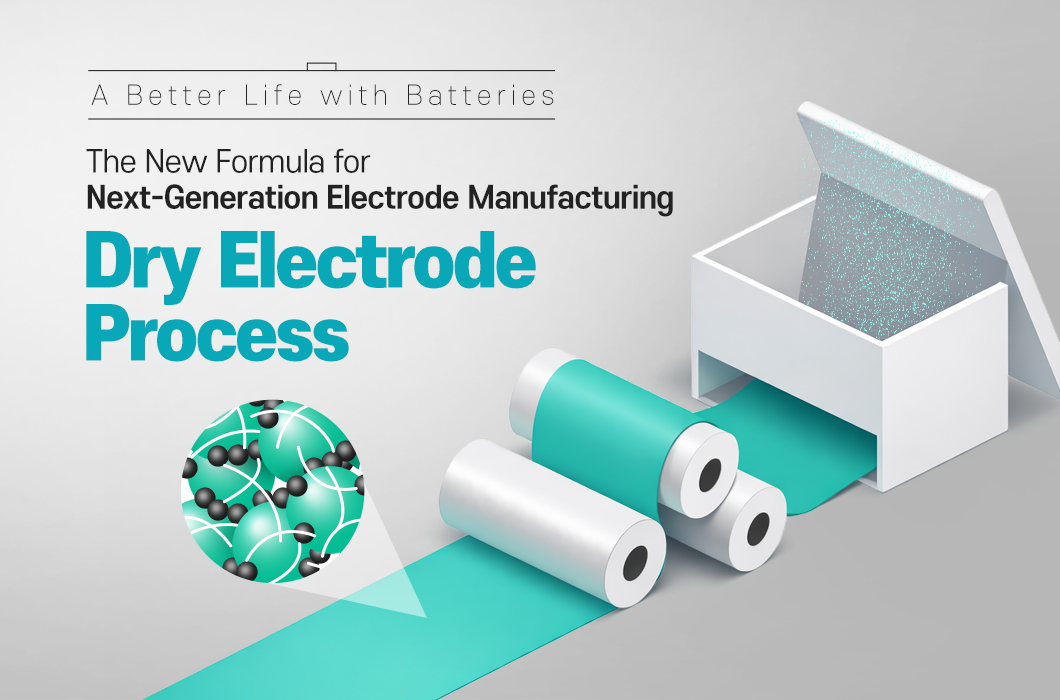
Battery performance is influenced not only by the materials used in electrodes, but also by how those electrodes are designed and manufactured. Even with identical cathode and anode materials, differences in electrode design and processing can lead to variations in safety, energy density, and production efficiency. At the same time, global demand for more sustainable manufacturing methods continues to grow.
In response, the battery industry is turning to new electrode manufacturing approaches that simplify processes, improve quality, and reduce environmental impact. One such approach is the dry electrode process, which produces electrodes without using solvents.
What is the Dry Electrode Process?
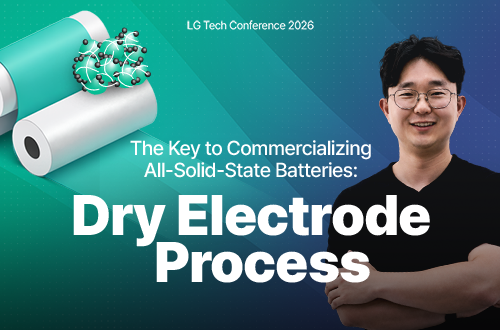
The dry electrode process1 refers to a manufacturing method that eliminates the use of solvents during the mixing and coating stages of electrode production. The key to this process is mixing active materials2, conductive additives, and binders without solvents to form a solid-state powder. It begins with uniformly mixing raw materials, followed by forming them into a solid powder. The resulting powder is then evenly applied onto the current collector, and the process is completed through roll pressing to produce a thin and flat electrode.
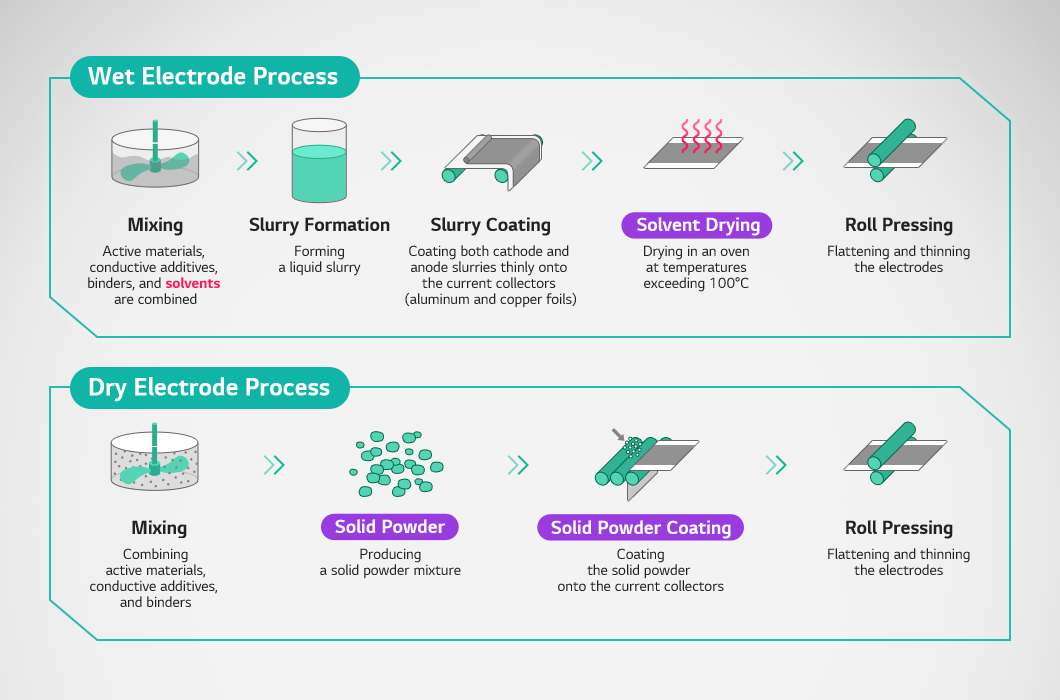
To better understand this process, it helps to compare it with the wet electrode process. The wet process is the most widely used method today and involves mixing cathode or anode active materials, conductive additives, and binders with a solvent to form a liquid slurry. This slurry is coated onto the current collector and subsequently dried. The electrode is then completed through the same roll-pressing process.
*View: A Better Life with Batteries – How to Make a Battery Step.1 Electrode Manufacturing: Mixing
*View: A Better Life with Batteries – How to Make a Battery Step.1 Electrode Manufacturing: Coating
*View: (Infographics #22) Slurry Components and Their Roles: Active Material, Conductive Additive, and Binder
Why is the Dry Electrode Process Needed?
If the wet process is already widely used, what has driven the emergence of the dry electrode process?
First, the wet process requires large-scale drying because it uses liquid organic solvents. This step consumes significant energy and extends the overall production process. In fact, solvent drying and recovery account for nearly 40 percent of total battery manufacturing costs.
In addition, solvents such as NMP (N-Methyl-2-pyrrolidone)3 require strict handling due to their toxicity, along with additional treatment before disposal. This increases costs and creates challenges in meeting increasingly stringent environmental regulations.
There are also technical limitations. To increase energy density, electrodes must be made thicker. However, in the wet process, thick coatings can lead to binder migration during drying, where the binder moves toward the surface. This reduces internal cohesion and adhesion to the current collector, which can lower yield and capacity.
To address these challenges. the dry electrode process eliminates the need for solvents and drying steps, positioning it as a promising next-generation electrode manufacturing technology.
Key Characteristics of Dry Electrodes
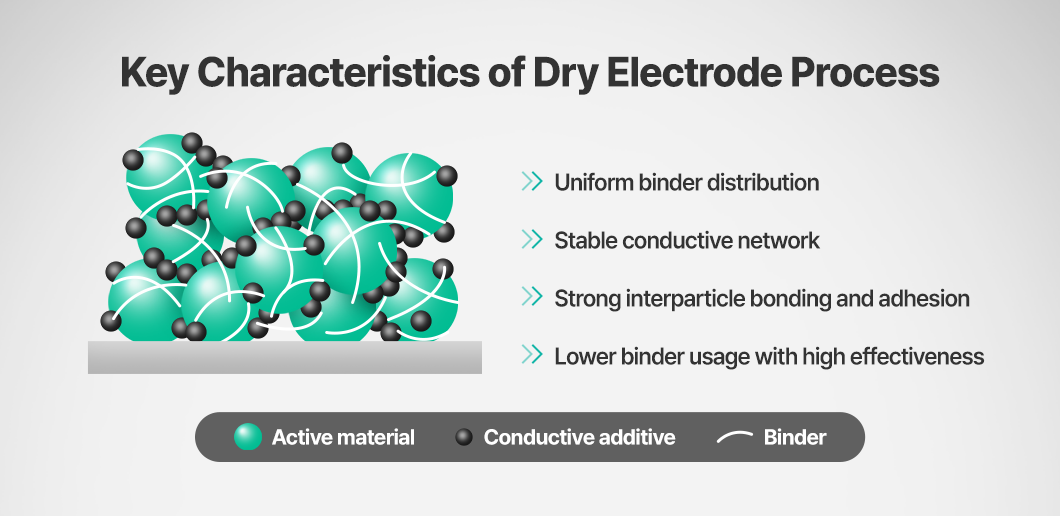
Because the dry process does not use solvents, there is no drying step, which fundamentally prevents the binder migration observed in the wet process. As a result, active materials, conductive additives, and binders can be distributed more uniformly within the electrode.
In this approach, the binder is not dissolved in a solution but exists in a solid or fibrillated form. For example, non-aqueous polymer binders such as PTFE4 undergo fibrillation during mixing and compression, forming a continuous network that connects active material and conductive additive particles. This fibrillated binder acts as a bridging structure, improving cohesion within the electrode and adhesion to the current collector while maintaining pathways for ion and electron transport. Consequently, even with reduced binder content, the electrode can maintain structural stability and performance. It also enables the design of thicker, high-capacity electrodes with reduced risk of delamination.
Expected Benefits of the Dry Electrode Process
What changes can the dry electrode process bring to battery manufacturing?
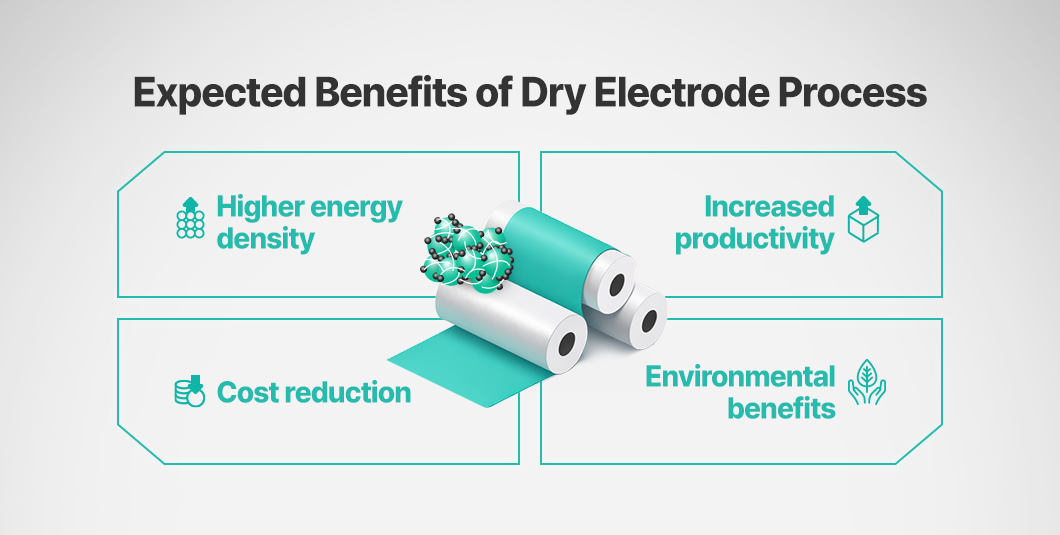
1) Higher energy density
The dry process supports stable electrode structures by eliminating the use of solvents and allowing higher active material loading. This means more active material can be packed into a given volume, enabling thicker electrode designs and increasing both capacity and energy density.
2) Improved productivity
Since the process uses solid powder, it removes the drying step. As drying typically accounts for more than 90% of total electrode processing time, this significantly shortens overall production lead time.
3) Cost reduction
Removing large-scale drying equipment reduces capital and operational costs. The wet process requires drying systems that can reach up to 100 meters in length, whereas the dry process eliminates this requirement. It also removes solvent recovery systems and reduces costs associated with long processing times. Overall, the adoption of the dry electrode process is expected to lower battery manufacturing costs by approximately 17 to 30 percent.
4) Environmental benefits
The dry process is considered a safer and more sustainable manufacturing approach. The wet process typically uses organic solvents such as NMP to dissolve binders. While effective for electrode performance, these solvents pose toxicity concerns. By contrast, the dry process does not use organic solvents, eliminating drying and solvent recovery steps. This reduces energy consumption and lowers carbon emissions.
LG Energy Solution Accelerates Dry Electrode Commercialization with a Decade of Technology
LG Energy Solution has been developing dry electrode technology for about a decade and is now accelerating efforts toward mass production and commercialization. In parallel, the company is strengthening its intellectual property portfolio, focusing on key technologies such as fibrillation optimization and tensile strength improvement, which are critical to process stability.
The dry electrode process under development can be applied to both cathodes and anodes regardless of particle size. Based on continuous R&D and accumulated expertise, LG Energy Solution is advancing the technology toward greater maturity.
The company has already established a pilot line at the Ochang Energy Plant, with full-scale commercialization targeted for 2028. It plans to expand the application of the process across its global production sites while continuing development for various active materials and all-solid-state batteries.
The dry electrode process is emerging as a core technology for next-generation battery manufacturing, with strong potential for broader applications in future battery systems. LG Energy Solution will continue to enhance both technological capabilities and readiness for commercialization in this field.
- Electrode process: The manufacturing process for cathodes and anodes, proceeding in the sequence of mixing, coating, roll pressing, and slitting and notching ↩︎
- Active material: A material in cathodes and anodes that undergoes electrochemical reactions to generate electrical energy. It is referred to as cathode active material in the cathode and anode active material in the anode ↩︎
- NMP (N-Methyl-2-pyrrolidone): A type of organic solvent used in electrode manufacturing to dissolve binders and form a slurry ↩︎
- PTFE (Polytetrafluoroethylene): A fluoropolymer composed of carbon and fluorine bonds throughout its molecular structure, providing excellent thermal and chemical stability ↩︎