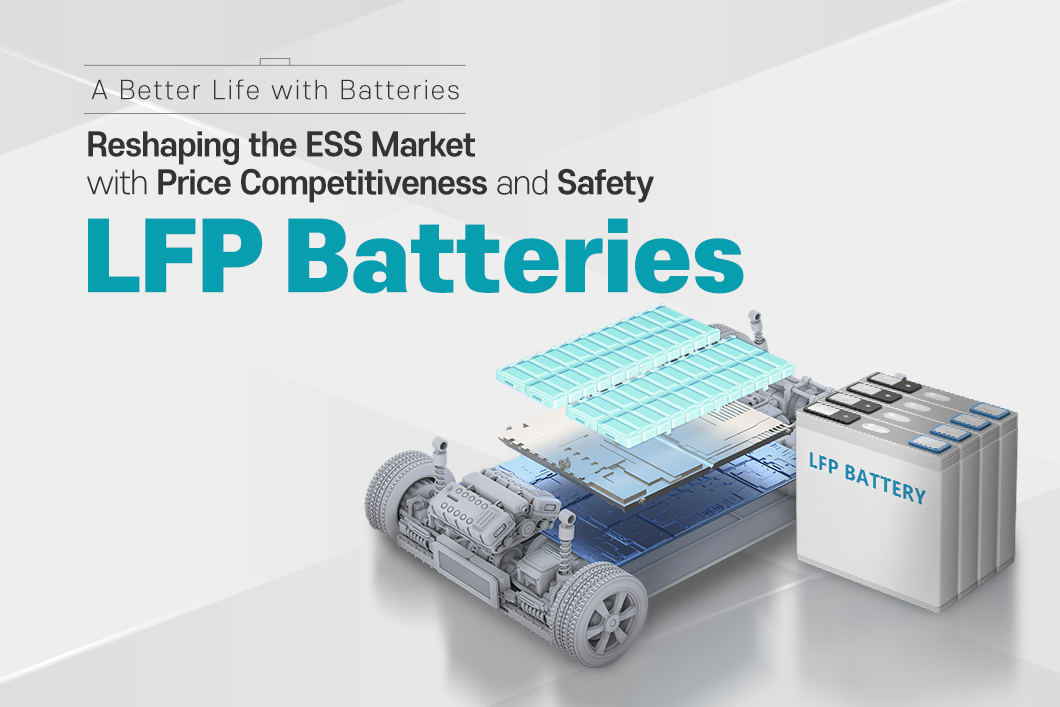
One of the most prominent keywords in the battery industry recently is “Lithium Iron Phosphate (LFP) batteries.” These batteries are considered cost-competitive as they use iron instead of expensive rare metals, and they are also recognized for their high safety, with a low risk of fire. Thanks to these characteristics, they are being applied not only to EVs but also to Energy Storage Systems (ESS), reshaping the overall direction of the battery market.
In this article of Battery Inside, we will take a closer look at the structure and characteristics of LFP batteries, which have established themselves as a major industry trend.
What is an LFP battery?
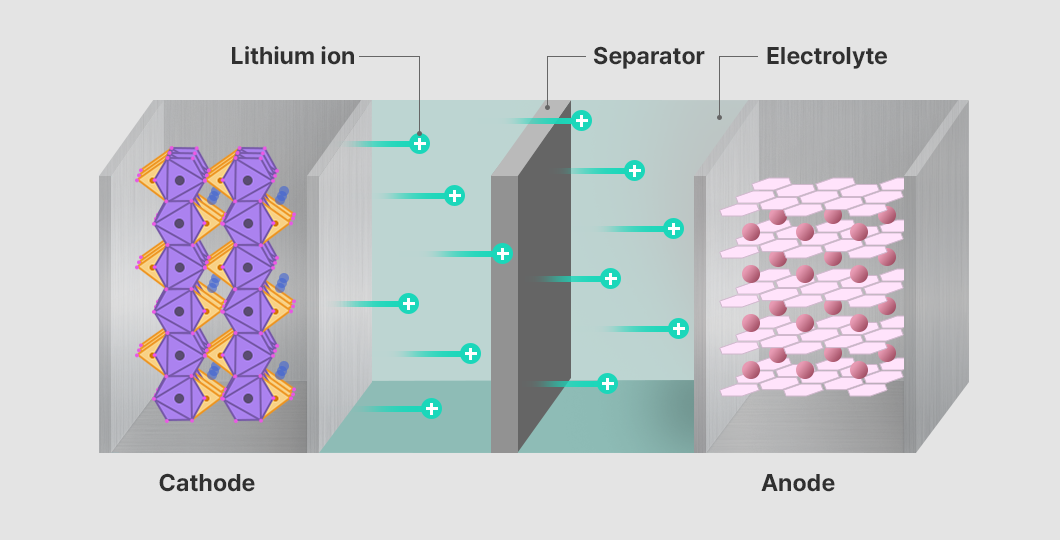
LFP batteries are a type of lithium-ion battery that uses lithium iron phosphate (LiFePO₄) as the cathode material. Unlike commonly known ternary batteries such as NCM (nickel, cobalt, manganese) or NCA (nickel, cobalt, aluminum), which use nickel and cobalt as their main materials, LFP batteries are composed of lithium (Li), iron (Fe), and phosphorus (P).
LFP batteries with a robust olivine structure
As the name lithium iron phosphate suggests, LFP batteries have a structure in which lithium, iron, and phosphorus are intricately bonded with oxygen (O). This structure is called the olivine structure.
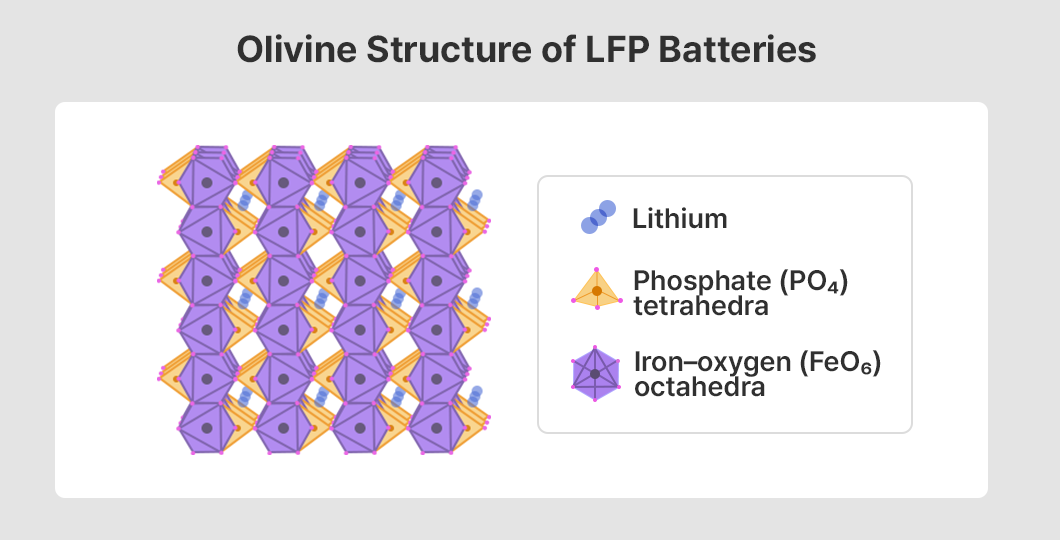
At the center of the LFP battery structure is the bonding between phosphorus and oxygen. One phosphorus atom forms a “phosphate tetrahedron” by bonding with four oxygen atoms, creating a strong bond through electron sharing.
Lithium and iron are then incorporated into this structure. Each is surrounded by six oxygen atoms to form octahedral structures. These octahedra are not isolated but interconnected, contributing to the strong and stable structure.
Focusing first on the lithium-containing octahedra, these structures are connected to one another in a continuous arrangement along a specific direction. This connectivity creates a dedicated pathway through which lithium ions move inside the battery. As a result, lithium ions in LFP batteries move along a one-dimensional pathway rather than freely in multiple directions.
On the other hand, iron-containing octahedra are connected in a slightly different way. These structures share their corners with each other, forming a rigid, zigzag-shaped layer. The iron octahedral layers connect with the phosphate tetrahedra and stack vertically, which further stabilizes the overall structure.
*View (Infographics #14) Structures of Cathode Materials
What are the advantages of LFP batteries?
These structural characteristics directly affect the overall performance of LFP batteries. The crystal lattice, strongly bonded through the olivine structure, creates the distinct features of LFP batteries across multiple aspects, including thermal stability, lifespan, and cost competitiveness.
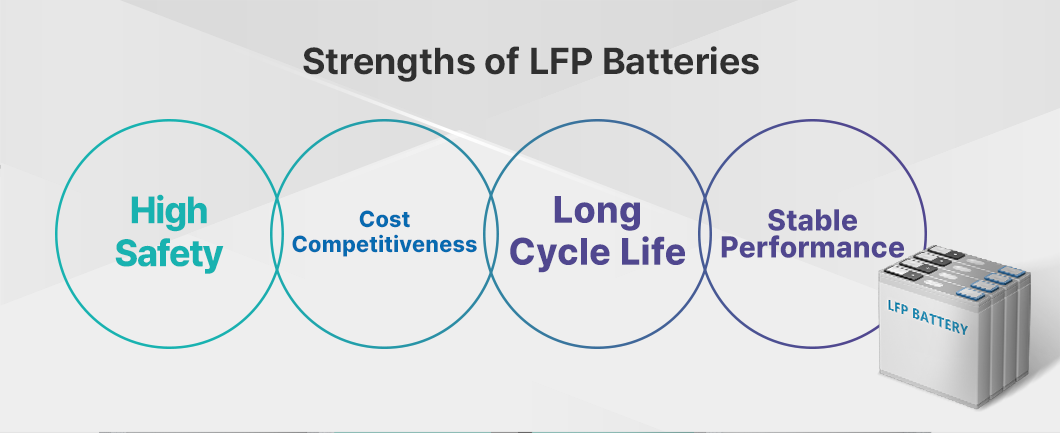
① High safety: LFP batteries exhibit very high thermal stability due to the phosphate bonding structure. The crystal structure, in which phosphorus and oxygen are strongly bonded, does not easily collapse even in high-temperature environments, limiting temperature rise even when heat is generated. As a result, the internal decomposition temperature of LFP batteries reaches approximately 500–600°C, and even in the event of a fire, the maximum temperature is known to remain around 400°C.
② Cost competitiveness: Instead of using rare and expensive materials such as cobalt and nickel, LFP batteries use relatively low-cost materials such as lithium, phosphate, and iron, enabling lower manufacturing costs. This material structure provides stronger cost competitiveness compared to conventional cathode materials and makes them highly economical, especially in the ESS market where large-scale systems are required.
③ Extended lifespan: LFP batteries have a high charge–discharge cycle life of over 10,000 cycles. This is because iron and lithium maintain structural stability within the lattice. Even as lithium ions move during battery operation, iron maintains its position while repeatedly undergoing redox reactions.
During this process, the oxidation state of iron changes from +2 to +3, maintaining electrical balance. At the same time, lithium ions remain in a small and stable state, moving efficiently within the crystal structure without damaging the lattice. Thanks to this structural stability, this inherent structural stability allows LFP batteries to maintain a long lifespan even with repeated use.
Challenges to Be Addressed in LFP Batteries
Although LFP batteries offer many advantages, there are also several technical challenges that need to be addressed to further improve performance. These include hysteresis, low-temperature performance, and low electrical conductivity and diffusion speed.

First, hysteresis arises from the structural characteristics of LFP batteries. In the olivine structure, lithium-ion pathways form one-dimensional channels, meaning that lithium ions move in a single direction during charge and discharge. Due to this constraint, lithium-containing particles (LFP) and lithium-depleted particles (FP) tend to separate rather than mix easily. As a result, different states of charge (SoC) can appear even at the same voltage. However, this characteristic does not directly affect safety or lifespan but is better considered a factor requiring additional management in terms of state estimation and control.
Second, performance degrades in low-temperature environments. As temperature decreases, the viscosity of the electrolyte increases and ion movement slows down, leading to increased internal resistance. Under these conditions, LFP batteries, which already have limited lithium-ion pathways, are more affected by this increase in resistance. Therefore, additional management is required under low-temperature conditions.
Third, there are limitations in electrical conductivity and lithium-ion diffusion speed. LFP batteries have relatively low electronic conductivity as a cathode material compared to ternary cathodes. In addition, since lithium-ion pathways are clearly defined within the crystal structure, impurities or structural defects inside the particles can easily hinder ion movement.
Lastly, LFP batteries have relatively low energy density, which reduces driving range when applied to electric vehicles. With an energy density of approximately 90–170 Wh/kg, lower than that of ternary batteries, various approaches are being studied to address this limitation.
To overcome these challenges, the battery industry continues to pursue various technological approaches. These include coating the surface with carbon materials, applying conductive additives to facilitate charge transport, and using carbon nanotubes (CNTs) to enhance electrode conductivity. Additionally, research is underway to reduce particle size to the nanoscale, shortening lithium-ion diffusion distances and improving output performance.
LG Energy Solution’s LFP battery strategy
LFP batteries, which offer both cost competitiveness and safety, are rapidly becoming a dominant battery solution, particularly in the global ESS market. According to battery industry sources and market research institutions, as of 2025, more than 90% of the global ESS market is analyzed to be based on LFP batteries, and this share is expected to increase further.
In line with this market trend, LG Energy Solution has identified LFP batteries as a core solution for the ESS market and has proactively advanced both technology development and production. Starting from its Nanjing plant in China and expanding to its Michigan plant in the United States, the company has established a global production system for ESS LFP batteries.
In addition, LG Energy Solution plans to establish an LFP battery production line at its Ochang Energy Plant in Korea, with plans extending from the end of 2025 and full-scale operation scheduled to begin in 2027. The initial production capacity will be 1 GWh and is expected to expand step by step depending on demand.
Another key differentiator of LG Energy Solution’s LFP batteries is their ability to achieve both large-scale mass production and high safety. Among global battery manufacturers, LG Energy Solution is regarded as the only company to have established a system capable of mass-producing ESS LFP batteries at scale in the United States.
Furthermore, LG Energy Solution’s LFP batteries meet the UL9540A standard and have demonstrated safety under real ESS conditions through large-scale fire testing. According to NFPC 607 test results, even under thermal runaway conditions, only smoke was observed without flames, and no propagation to adjacent modules occurred. Hazardous gas generation and explosion risks were also minimized.
These safety performances are not only due to the inherent characteristics of LFP cells but also the result of LG Energy Solution’s proprietary Battery Management System (BMS) and its module and pack design technologies. In this way, LG Energy Solution meets the reliability requirements of the ESS market through its design capabilities spanning from cell to system level.
In particular, LG Energy Solution has the strength of providing a total solution covering the entire project, including battery manufacturing, system integration (SI), remote monitoring, and maintenance. Through this, customers can receive services from a single provider from the beginning to the end of the project, improving operational continuity. In addition, during operation, customers can utilize real-time operational data and energy management systems provided through LG Energy Solution’s ESS software solution, AEROS™ Suite, to optimize ESS performance.
Efforts are also ongoing to overcome the limitations of LFP batteries in terms of energy density. LG Energy Solution has applied a Cell to Pack (CTP) process solution to pouch-type LFP batteries for the first time, achieving improvements in both energy efficiency and space utilization.
So far, we have examined the structural characteristics and technical features of LFP batteries, as well as the reasons behind their growing adoption in the ESS market. Based on their structural advantages in safety and cost efficiency, LFP batteries are proving to be an excellent solution in the ESS market, where stable operation is critical.
Building on its diverse battery portfolio, LG Energy Solution plans to strategically expand LFP batteries optimized for the ESS market. Stay tuned as the company continues to strengthen its competitiveness in this area.