Lithium-ion batteries are classified by the material used in the cathode, and their characteristics vary accordingly. Common examples include ternary batteries, which use nickel, cobalt, and manganese; quaternary batteries (NCMA), which combine nickel, cobalt, manganese, and aluminum; and LFP (LiFePO₄) batteries, which use lithium iron phosphate as the cathode material. Short for Lithium Iron Phosphate, LFP batteries are distinguished from ternary and quaternary batteries by using only lithium, iron, and phosphate in the cathode without relying on cobalt or nickel.
Recently, LFP batteries have regained attention in the energy storage system (ESS) market. Their price competitiveness, safety, and long cycle life have made them an increasingly attractive option for ESS applications.
In this article, we will take a closer look at the characteristics and advantages of LFP batteries and explore how LG Energy Solution is expanding its presence in the LFP battery market.
Q. What are LFP batteries?
LFP batteries are lithium-ion batteries that use lithium iron phosphate as the cathode material. The cathode is a key component that determines a battery’s capacity, power, lifespan, and safety, and LFP batteries use an iron phosphate-based compound for this material.
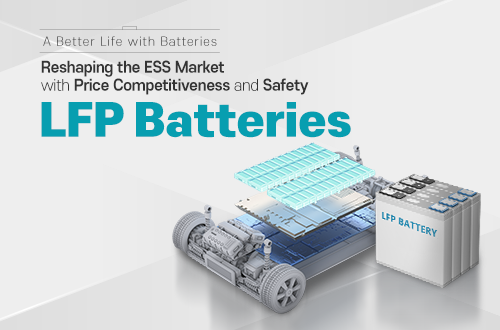
One of the defining characteristics of LFP batteries is their price competitiveness and thermal stability. Because they do not rely on expensive nickel or cobalt, they can reduce raw material costs. In addition, LFP batteries have a stable olivine crystal structure*, which helps lower the risk of accidents caused by overcharging or over-discharging while reducing battery cell degradation and extending battery life.
Q. Why are LFP batteries drawing attention?
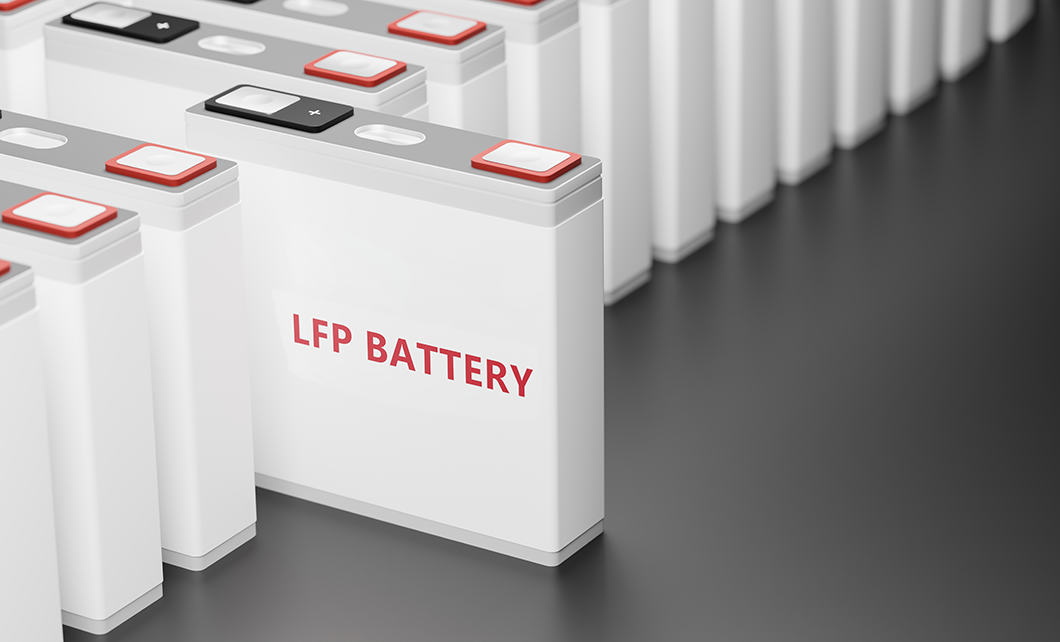
First, LFP batteries do not use nickel or cobalt, helping reduce raw material costs. Instead, they use cathodes based on iron and phosphate, making them less vulnerable to fluctuations in the prices of critical materials. This gives them a competitive advantage in markets where cost is a key consideration.
Second, LFP batteries offer excellent thermal stability. Lithium iron phosphate cathodes are structurally stable, making them well suited for maintaining safety even under high temperatures or external impacts. As a result, LFP batteries are increasingly being considered in applications where stability is a top priority.
Third, LFP batteries are known for their long cycle life and durability under repeated charging and discharging. Since cycle life is essential for batteries intended for long-term use, the structural stability of LFP chemistry makes it well suited not only for electric vehicles but also for energy storage systems (ESS).
Despite these advantages, LFP batteries still face certain challenges. Compared with ternary cathode batteries, they have lower energy density, meaning they store relatively less energy within the same weight or volume.
To address this limitation, the industry is actively exploring next-generation materials and manufacturing technologies such as Cell-to-Pack (CTP)* to improve the energy density of LFP batteries. As a result, LFP batteries are expanding beyond ESS applications and are increasingly being adopted in markets where affordability and safety are especially important, including mass-market electric vehicles and commercial vehicles.
*View: A Better Life with Batteries – LFP Batteries Reshaping the Market with Cost Competitiveness and Safety
*View: [Battery Pioneer] Innovative Cell-to-Pack Technology that Eliminates Modules
Q. How influential are LFP batteries in the ESS market?
LFP batteries are experiencing remarkable growth in the global ESS market. According to the International Energy Agency (IEA), 108 GW of new Battery Energy Storage System (BESS) capacity was installed worldwide in 2025, representing a 40% increase from the previous year. Cumulative installed capacity has also grown elevenfold compared with 2021 levels. Of this newly installed capacity, LFP batteries accounted for approximately 90%.1
So, how is the LFP battery market evolving across major countries and regions?
In China, the adoption of LFP batteries has increased significantly, driven by intense price competition in the EV market, a stable battery supply chain, and the strategies of domestic automakers. In North America, the value of LFP batteries continues to rise as local manufacturing expands alongside growing demand for both electric vehicles and ESS applications. In Europe, interest in LFP batteries remains strong amid increasing price competition in the EV market and the ongoing energy transition. In 2025, LFP batteries accounted for more than 10% of EV battery demand in the European Union, maintaining a level similar to that of 2024.
Q. How is LG Energy Solution expanding its LFP battery business?
LG Energy Solution is expanding its LFP battery portfolio as a key part of its strategy to address the growing ESS market.
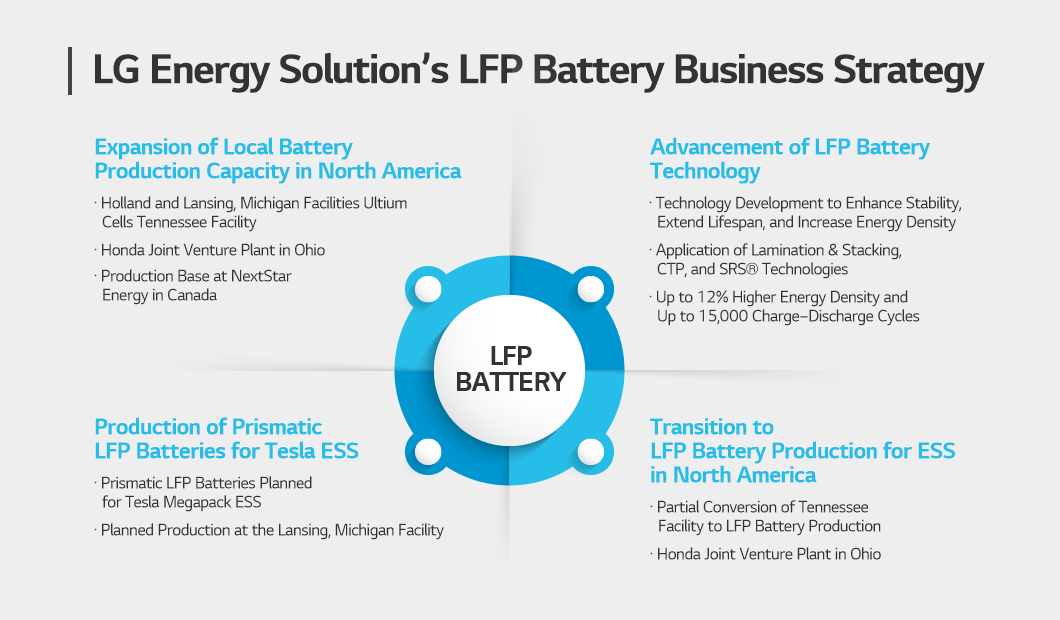
From a manufacturing perspective, the company is focused on strengthening its local production capabilities in North America. It is operating or building ESS production bases across the region, including facilities in Holland and Lansing, Michigan; NextStar Energy in Canada; Ultium Cells in Tennessee; and the Honda joint venture plant in Ohio. In particular, the Tennessee facility is diversifying its product portfolio by converting part of its production lines to manufacture LFP batteries for ESS.
LG Energy Solution’s ESS partnership with Tesla demonstrates the competitiveness of its LFP battery business. Beginning in 2027, the company plans to produce prismatic LFP batteries for Tesla’s Megapack 3 energy storage system at its Lansing, Michigan facility, further strengthening its local supply capabilities for ESS projects.
On the technology front, LG Energy Solution continues to enhance the safety, lifespan, and energy density of its LFP batteries. Its pouch-type LFP batteries incorporate the Lamination & Stacking process, increasing energy density by up to 12% compared with previous designs while delivering a long cycle life of up to 15,000 charge and discharge cycles. The company is also applying Cell-to-Pack (CTP) technology and its Safety Reinforced Separator (SRS®) technology to improve both the efficiency and safety of ESS systems.
Key Takeaways
● LFP batteries are lithium-ion batteries that use lithium iron phosphate as the cathode material.
● Thanks to their thermal stability and long cycle life, they are emerging as a leading choice for ESS applications that require long-term operation.
● Globally, LFP batteries are experiencing particularly strong growth in the ESS market.
● LG Energy Solution is strengthening its LFP battery production capabilities and expanding its product portfolio, with a focus on the North American ESS market.
We’ve explored why LFP batteries are drawing attention and how LG Energy Solution is expanding its LFP battery business. With their price competitiveness, thermal stability, and long cycle life, LFP batteries continue to strengthen their presence in the battery market. As advances in materials and manufacturing technologies continue, their applications are expected to expand further across a wide range of sectors, including EVs and ESSs.
LG Energy Solution will continue to strengthen the competitiveness of its LFP battery portfolio and its global manufacturing capabilities, while proactively responding to the evolving battery market.
- IEA. (2026). Global EV Outlook 2026. Electric vehicle batteries ↩︎