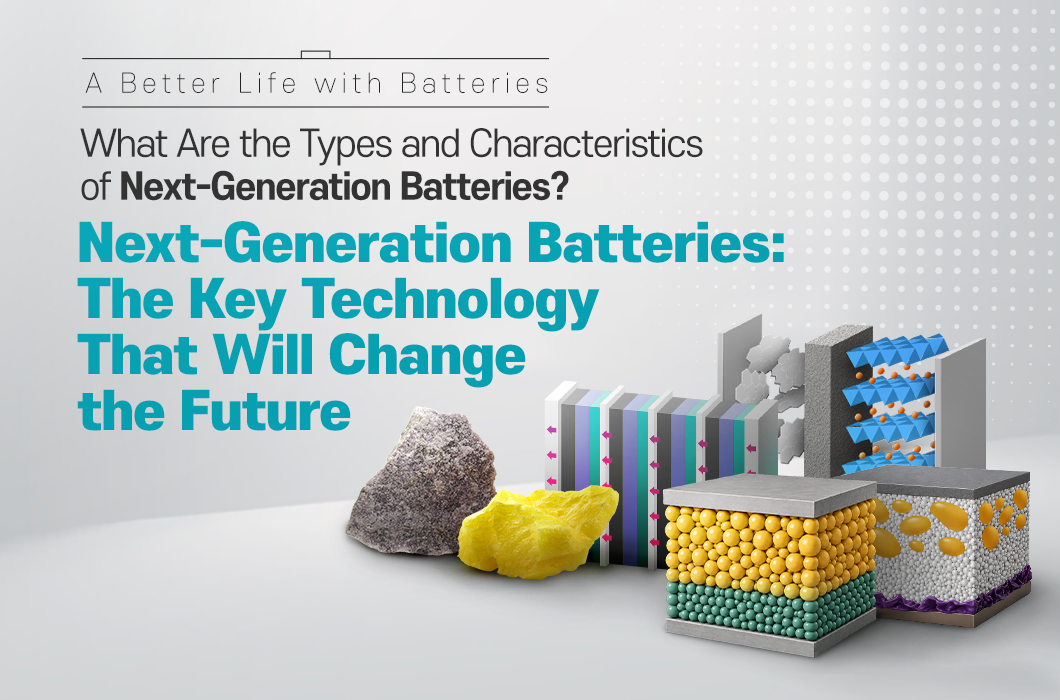
Longer-lasting, faster, and safer. Next-generation batteries, often called the “dream battery,” come with high expectations.
Extensive research is underway to realize these advanced capabilities. Some approaches involve changing materials to improve energy density and safety, while others involve redesigning battery structures to enhance space efficiency and power output. This is also why lithium-sulfur batteries, solid-state batteries, sodium-ion batteries, anodeless batteries, and bipolar batteries are drawing so much attention.
We’ll examine the types and characteristics of next-generation batteries, and explore where each one can be applied.
Lithium-Sulfur Batteries: Lightweight by Design
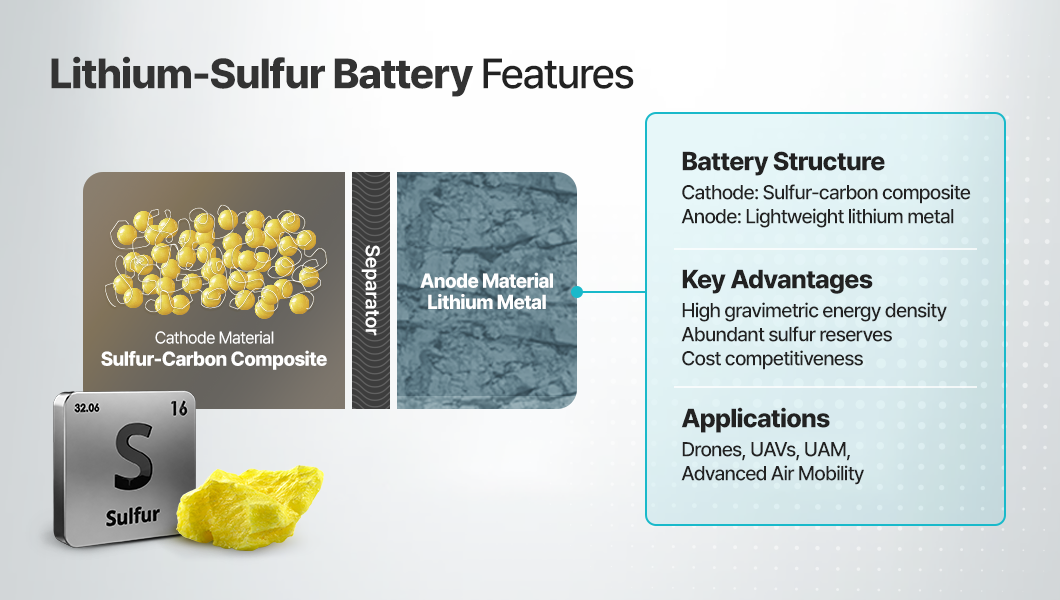
A lithium-sulfur battery is a next-generation battery that uses a sulfur-carbon (S/C) composite material for the cathode and lightweight lithium metal for the anode. Unlike conventional lithium-ion batteries, it is characterized by the use of relatively lightweight electrode materials.
The main strengths of lithium-sulfur batteries are their high gravimetric energy density and cost competitiveness. Sulfur has a theoretical capacity of about 1,675 mAh/g, higher than that of NCM cathode materials, and the lithium metal used for the anode also offers a much greater capacity per unit weight than graphite. These characteristics allow more energy to be stored at the same weight. Sulfur is also a relatively abundant element on Earth, providing advantages in both material sourcing and cost competitiveness.
Lithium-sulfur batteries are drawing attention in aviation applications such as drones, unmanned aerial vehicles (UAVs), and Urban Air Mobility (UAM), where battery weight has a major impact on performance. Being able to store the same amount of energy at a lower weight can help extend flight time and range.
LG Energy Solution has also been pursuing research into lithium-sulfur batteries, recognizing their potential. In particular, research on its sulfur-based solid electrolyte technology, conducted jointly with the research team of Professor Shirley Meng at the University of Chicago, was published in Nature Communications, a leading international journal in the energy field, in February 2026. The research proposed an approach to prevent the conditions that lead to polysulfide dissolution—one of the key challenges facing lithium-sulfur batteries—while improving performance stability. A key achievement of the study was the formation of a highly ion-conductive interphase on the surface of sulfur particles and the precise control of particle size, demonstrating improvements in both cycle stability and power characteristics.
*View: Battery Pioneer – Lighter-weight and Longer-lasting Lithium-Sulfur Battery!
Solid-State Batteries: Enhanced Safety with a Solid Electrolyte
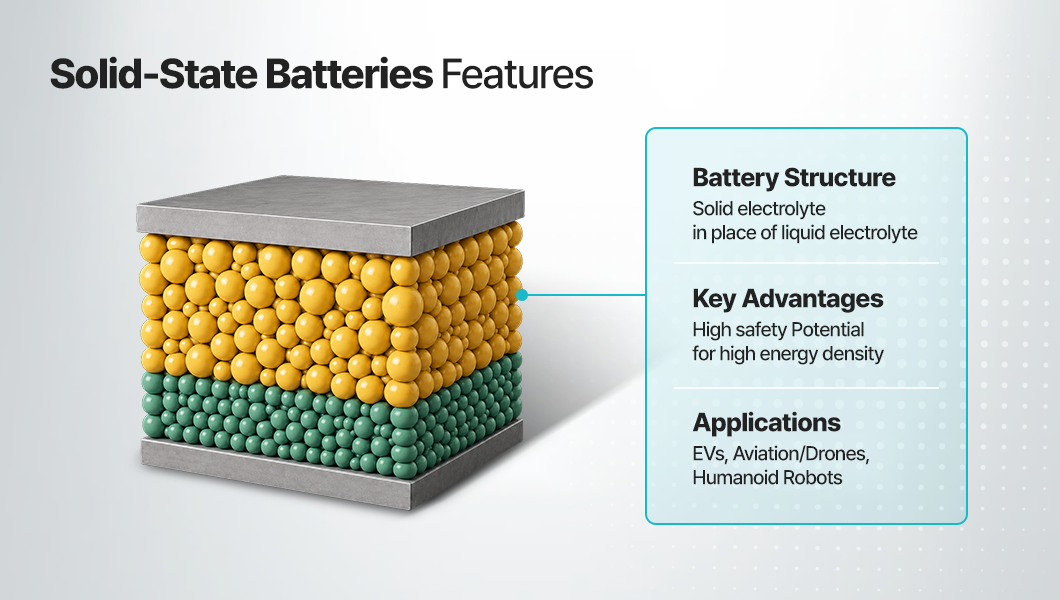
A solid-state battery is a next-generation battery that uses a solid electrolyte instead of a liquid one. The solid electrolyte serves as a pathway for lithium-ion transport while also functioning as a separator that prevents direct contact between the cathode and anode.
The main advantage of solid-state batteries is safety. Because the electrolyte is solid, the risk of electrolyte leakage due to external impact is reduced, and thermal stability is improved. This is why solid-state batteries are gaining attention across a range of applications where safety is critical, including EVs, aviation and drones, and humanoid robots.
Solid-state batteries can also achieve higher energy density than conventional batteries. Since the solid electrolyte also serves as the separator, internal space within the battery can be used more efficiently. This structural advantage can be combined with high-energy-density anode materials such as lithium metal anodes or silicon anodes.
LG Energy Solution continues to develop long-life solid-state battery technology that combines a sulfide-based solid electrolyte with a silicon anode. Research conducted jointly with the University of California San Diego confirmed the potential to achieve fast charging at room temperature and high energy density. LG Energy Solution is also advancing research into the application of an anodeless structure to solid-state batteries, while planning to apply a dry electrode process* to enable the reliable production of moisture-sensitive sulfide-based solid electrolytes.
*View: Battery Pioneer – All-Solid-State Battery, the Ultimate Battery That Delivers Higher Safety and Density with Solid Electrolytes
*View: Why the Dry Electrode Process Is Critical to the Commercialization of All-Solid-State Batteries
Sodium-Ion Batteries: Cost Competitiveness Through Abundant Resources
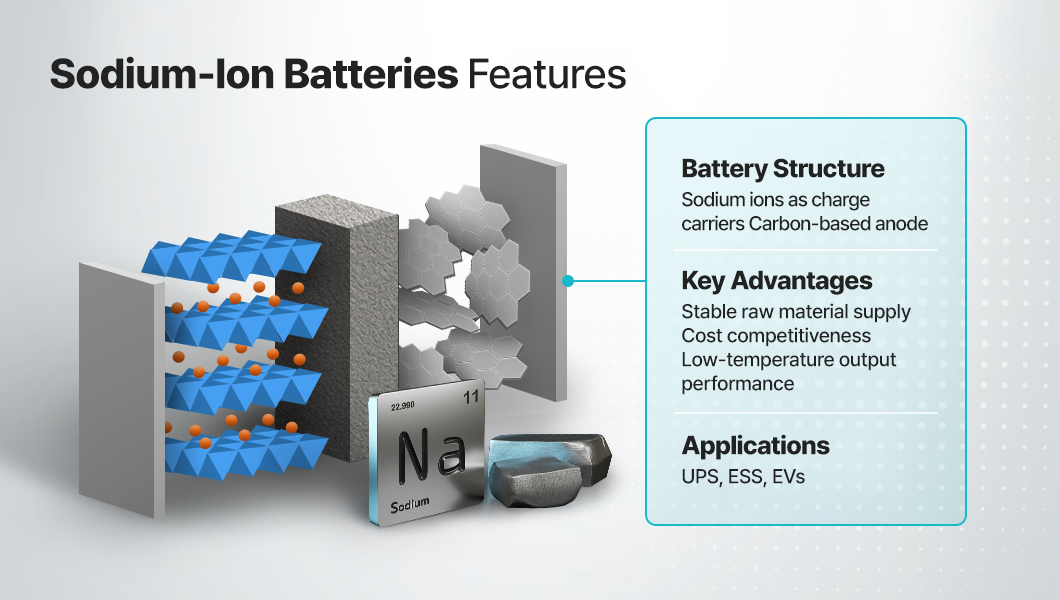
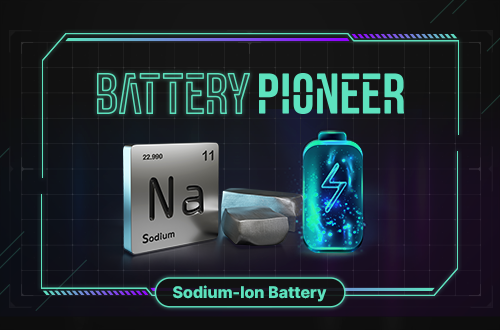
A sodium-ion battery is a next-generation battery that employs sodium ions instead of lithium ions as the charge carriers during charging and discharging. Sodium transition metal oxides and Prussian blue analogues are commonly used for the cathode, while carbon-based materials such as hard carbon and soft carbon are mainly used for the anode.
The basic operating principle of sodium-ion batteries is similar to that of lithium-ion batteries. The difference is that sodium ions, rather than lithium ions, move back and forth between the cathode and anode during repeated charge and discharge cycles.
Sodium-ion batteries stand out for their cost competitiveness, as sodium, the key raw material, is the fifth most abundant element on Earth. Unlike in lithium-ion batteries, aluminum can be used as the anode current collector because sodium does not react with it, which further supports cost competitiveness. Sodium-ion batteries can also maintain stable performance at low temperatures. This means that when applied to EVs, they could help minimize performance degradation during winter.
LG Energy Solution unveiled its sodium-ion battery roadmap at InterBattery 2025. The first-generation sodium-ion battery targets applications such as lead-acid battery replacement, 12/24V automotive electronics, and backup power for uninterruptible power supply (UPS)* systems. The second-generation sodium-ion battery is being developed for EV applications, with a focus on achieving an energy density of around 450 Wh/L and introducing a dry electrode process to improve both production efficiency and cost competitiveness.
*View: Sodium-Ion Batteries: Delivering Cost Competitiveness and Strong Low-Temperature Performance as an Alternative to Lithium
*View: Battery Glossary – UPS
Anodeless Batteries: Higher Energy Density by Eliminating the Anode Active Material
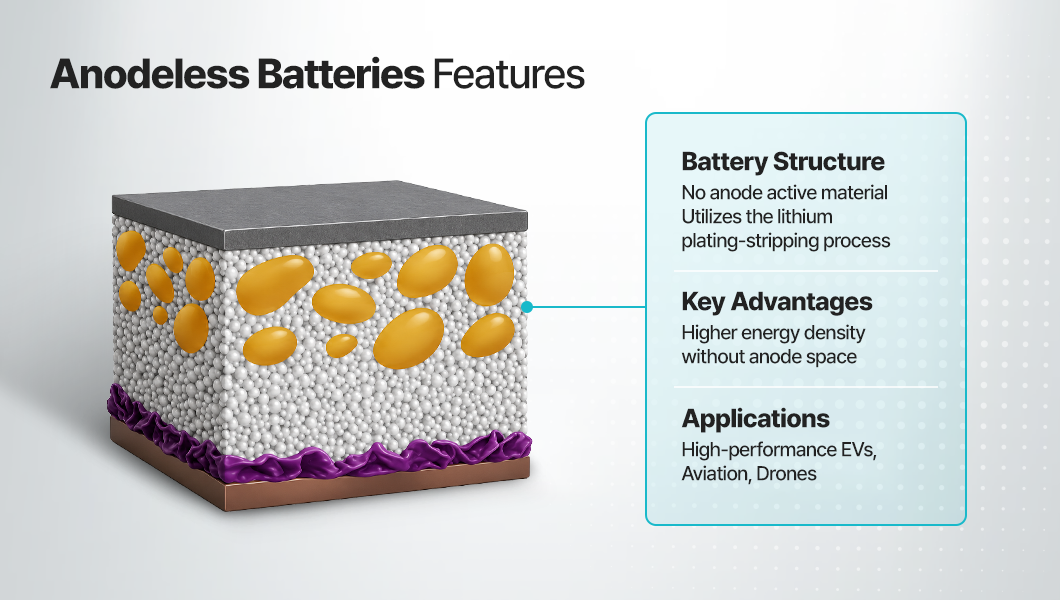
An anodeless battery is a next-generation battery that does not use a separate anode active material. While conventional lithium-ion batteries use graphite or silicon-based materials for the anode, anodeless batteries work differently: during charging, lithium ions that move from the cathode meet electrons and are plated as lithium metal onto the anode current collector. In simple terms, the anode is formed during the charging process.
This structure offers anodeless batteries an advantage in achieving higher energy density. Because the space previously occupied by the anode active material is now available, more energy can be stored within the same volume. Thanks to this characteristic, anodeless batteries are considered a next-generation battery technology well-suited to high-performance EVs and aviation and drone applications.
Achieving a stable anodeless battery requires precise control over the lithium plating and stripping process. For this reason, research is underway to combine anodeless technology with solid-state batteries, which help reduce side reactions and support the formation of a stable interface. Combining the two technologies increases the potential to achieve high energy density and safety at the same time.
LG Energy Solution is also developing anodeless batteries in combination with solid-state battery technology. The company continues to advance its technology by securing a range of patents related to anodeless batteries, with the goal of commercialization by 2029.
Bipolar Batteries: Improved Space Efficiency Through Simplified Cell Structure
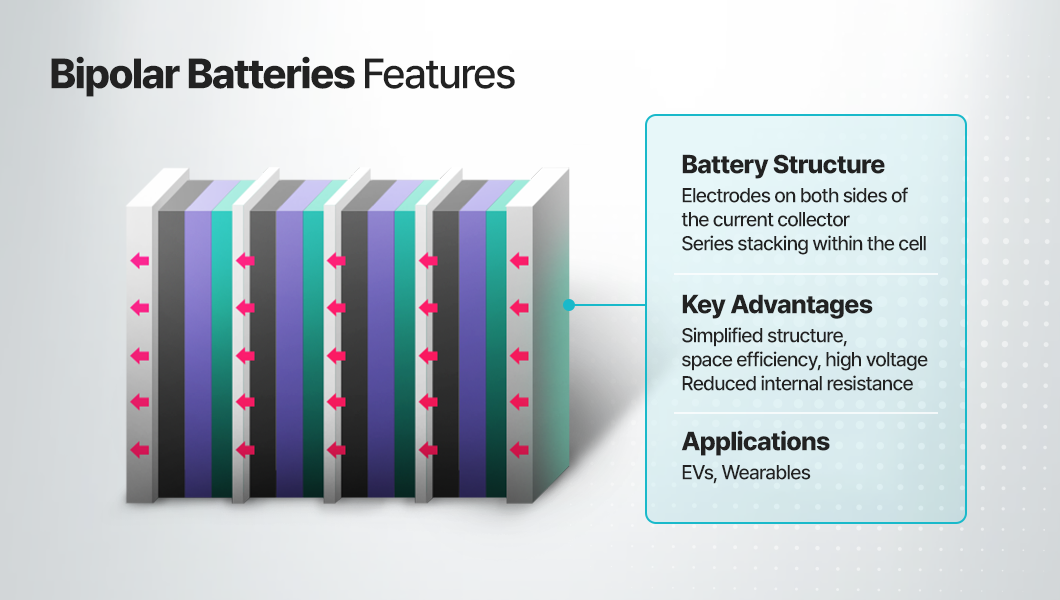
A bipolar battery is a next-generation battery technology that employs a redesigned electrode and cell connection structure to achieve high voltage and improved space efficiency. In the monopolar structure widely used today, individual cells with a parallel configuration are connected in series using external connecting components. A bipolar battery, by contrast, places the cathode and anode on either side of a single current collector and stacks the electrodes layer by layer—achieving series connection within the cell.
The main advantage of bipolar batteries is their simplified structure. High voltage can be achieved simply by stacking electrodes, reducing the need for separate external wiring or components. This improves space utilization within the battery pack and simplifies both pack structure and the manufacturing process. Because of these advantages, the wearable market, where space efficiency is particularly important, is taking note of bipolar batteries. In addition, bipolar batteries have a vertical electron transfer structure, which helps reduce internal resistance and manage heat generation more evenly.
LG Energy Solution is researching ways to implement solid-state batteries in a bipolar structure. Through bipolar battery technology, the company is advancing its next-generation battery technology to simplify pack structure and improve space utilization while strengthening cost competitiveness and the ability to support high-voltage systems.
Next-Generation Batteries at a Glance
Each of the next-generation batteries we have covered has distinct characteristics. Some excel at reducing weight, while others focus on improving safety, cost competitiveness, or space efficiency. Because each battery has different strengths, the applications they are best suited for also differ.
| Battery Type | Description | Key Advantages | Key Applications |
|---|---|---|---|
| Lithium-Sulfur Battery | Sulfur-carbon composite cathode paired with a lightweight lithium-metal anode | High gravimetric energy density, cost competitiveness from sulfur’s abundant reserves | Drones, UAVs, UAM, Advanced Air Mobility |
| Solid-State Battery | Solid electrolyte in place of liquid electrolyte | High safety, potential for high energy density | EVs, Aviation, Drones, Humanoid Robots |
| Sodium-Ion Battery | Sodium ions as charge carriers, carbon-based anode | Stable raw material supply, cost competitiveness, low-temperature output performance | UPS, ESS, EVs |
| Anodeless Battery | Anode(lithium) forms during charging, without a separate anode active material | Higher energy density without anode space and weight | High-performance EVs, Aviation, Drones |
| Bipolar Battery | Electrodes on both sides of the current collector, series stacking within the cell | Simplified structure, space efficiency, high voltage, reduced internal resistance | EVs, Wearables |
Key Q&A
Q. What is a lithium-sulfur battery?
A lithium-sulfur battery uses a sulfur-carbon composite cathode and a lithium metal anode to increase the amount of energy stored per unit of weight.
Q. What is a solid-state battery?
A solid-state battery uses a solid electrolyte instead of a liquid one to enhance safety.
Q. What is a sodium-ion battery?
A sodium-ion battery uses sodium ions instead of lithium ions as charge carriers during charging and discharging.
Q. What is an anodeless battery?
An anodeless battery has no separate anode active material. Instead, it utilizes the lithium plating and stripping process, forming a lithium metal anode during charging.
Q. What is a bipolar battery?
A bipolar battery is a design that achieves series connection within the cell, simplifying the structure and improving space efficiency.
We’ve covered next-generation batteries. As we’ve seen, lithium-sulfur, solid-state, sodium-ion, anodeless, and bipolar batteries each have distinct strengths. Keep an eye on how these next-generation batteries are put to use across fields like EVs, ESS, UPS, and aviation mobility!