The leading player in the current battery market is undoubtedly the lithium-ion battery. Since its commercialization in 1991, lithium-ion batteries have been widely used for a variety of applications, including electric vehicles and IT devices. However, as diverse battery needs emerged, people came to want batteries whose performance surpass that of lithium-ion batteries. Hence the battery industry’s continuous research to develop successors to lithium-ion batteries.
In the Game Changer Battery series, we will introduce the batteries that are expected to revolutionize the future battery market. In this session, we will look in-depth at the lithium-sulfur battery, one of the most promising next-generation batteries.
What Is a Lithium-Sulfur Battery?
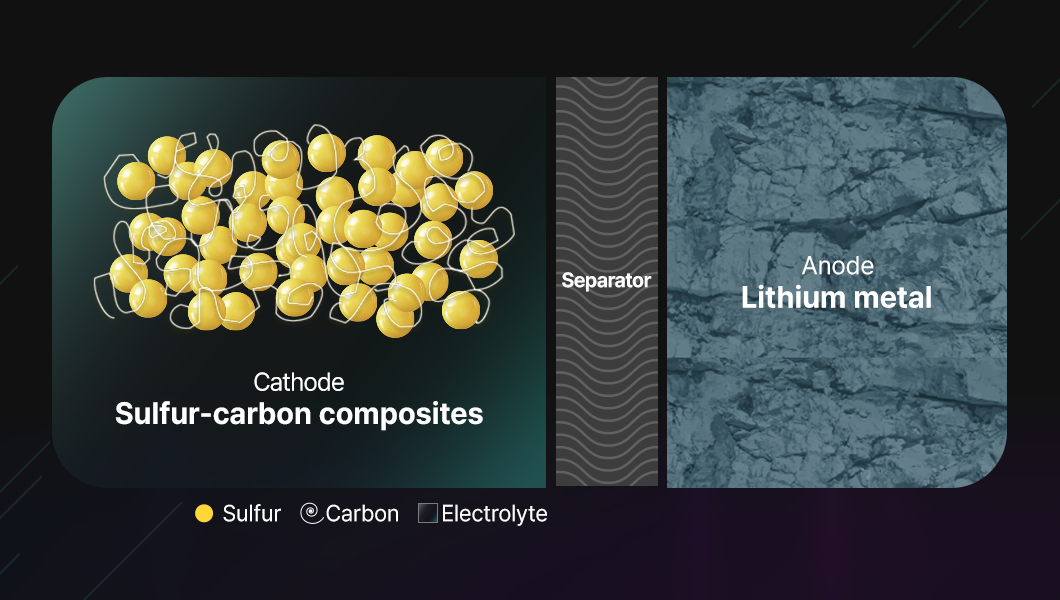
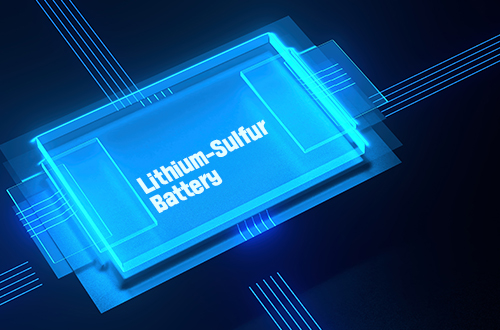
A lithium-ion battery utilizes metal oxides (such as LCO, NMC, NCA, and LFP) for the cathode and graphite and silicon for the anode. And a lithium-sulfur (Li-S) battery uses a sulfur-carbon composite for the cathode and lightweight lithium metal for the anode.
In fact, the development of lithium-sulfur batteries predates that of lithium-ion batteries. In 1962, American scientists Herbert Danuta and Ulam Juliusz patented the first primary cell that had sulfur for the cathode and lithium for the anode. This marked the emergence of lithium-sulfur batteries. The subsequent introduction of lithium nitrate (LiNO3) enabled this battery to function as secondary (rechargeable) cells.
While lithium-ion batteries generate electrical energy through the redox reactions of electrons separated from lithium ions, lithium-sulfur batteries produce electrical energy through the stepwise conversion of sulfur.
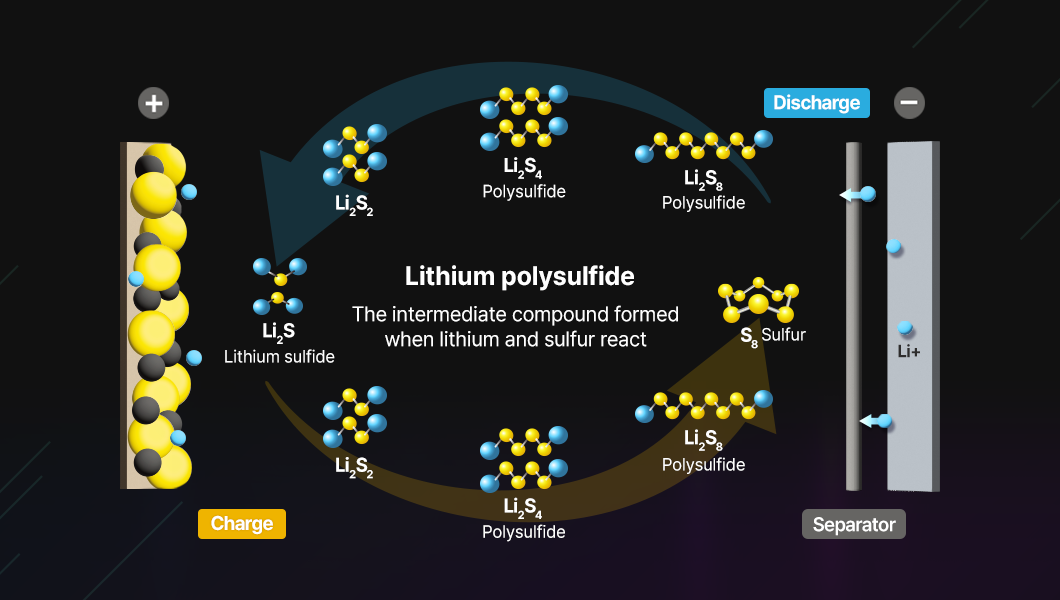
As for the structure, sulfur is composed of rings of eight atoms (S8). During the discharge process of lithium-sulfur batteries, sulfur (S8) molecules undergo a series of successive reduction reactions and transform into linear-structured lithium polysulfide, an intermediate compound formed when lithium and sulfur react. As the reduction reactions continue, the polysulfide ultimately turns into lithium sulfide (Li₂S), an insoluble substance, which generates electrical energy in the process.
Characteristics of Lithium-Sulfur Batteries, a Cornerstone of Next-Generation Batteries
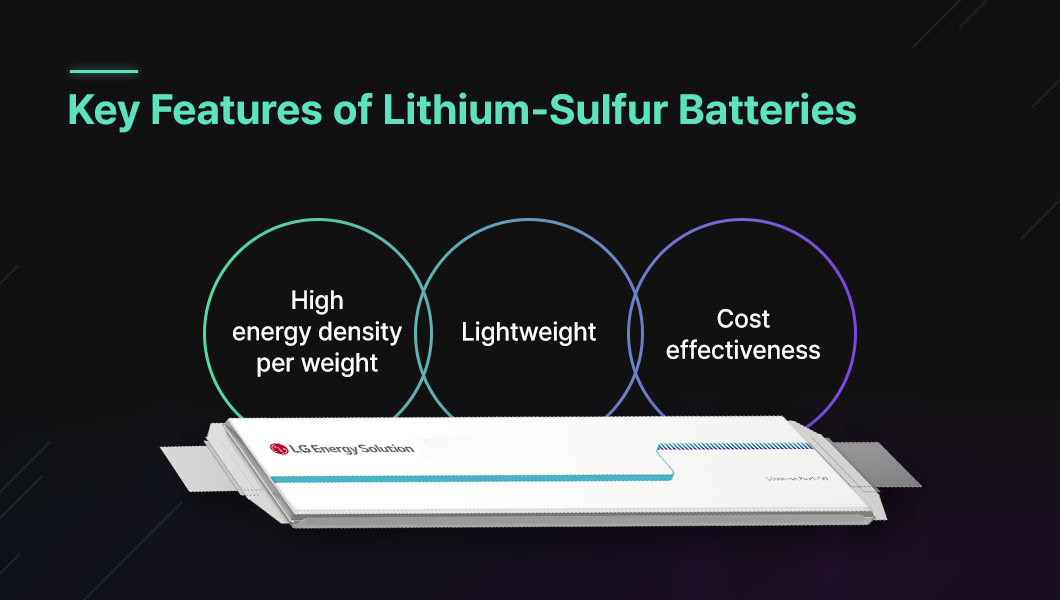
Lithium-sulfur batteries possess distinct characteristics that differentiate them from lithium-ion batteries. One of the features is their high gravimetric energy density. The sulfur-carbon composite used for the cathode and the lithium metal used for the anode have low densities, resulting in a high capacity per unit weight. Consequently, the gravimetric energy density of lithium-sulfur batteries is more than 1.5 times higher than that of lithium-ion batteries.
*Gravimetric Energy Density (Wh/kg): Energy stored in the battery (Wh) / Weight of the battery (kg)
To put it simply, lithium-sulfur batteries are lightweight. While lithium-ion batteries use metallic elements like nickel and cobalt for the cathode, lithium-sulfur batteries utilize lighter materials such as sulfur and lithium, reducing their overall weight. The weight of a battery is a crucial factor because it determines how much capacity can be generated per gram of active materials.
The sulfur used for the cathode of lithium-sulfur batteries can achieve a capacity of 1,675 mAh/g, whereas the NCM (nickel-cobalt-manganese) in lithium-ion batteries typically makes about 200 mAh/g. This means that lithium-sulfur batteries are approximately eight times lighter than lithium-ion batteries. Additionally, the lithium anode in lithium-sulfur batteries has a capacity of 3,500 mAh/g, compared to the 350 mAh/g the graphite anode produces in lithium-ion batteries.
Furthermore, sulfur is the 17th most abundant element on Earth, making it relatively easy to obtain and accordingly, very inexpensive. Therefore, replacing lithium with sulfur for the cathode would provide a significant cost advantage.
Lithium-sulfur batteries are gaining significant attention in the aviation sector, especially for use in drones, unmanned aerial vehicles (UAVs), and Urban Air Mobility (UAM) systems. A lightweight design is crucial for aerospace equipment, and the light weight of lithium-sulfur batteries can improve fuel efficiency. Additionally, with their high energy density relative to weight, these batteries are expected to enable longer flight times and greater distances compared to lithium-ion batteries.
LG Energy Solution Expands the Potential of Lithium-Sulfur Batteries
With their many advantages, lithium-sulfur batteries are considered one of the most promising next-generation battery technologies. LG Energy Solution recognized the potential of lithium-sulfur batteries early on and has continued to advance related research. One notable example is its solid-state electrolyte (SSE) technology that utilizes sulfur.
Through this technology, LG Energy Solution has fundamentally eliminated the conditions that lead to polysulfide dissolution, one of the key challenges facing lithium-sulfur batteries, opening up new possibilities for next-generation high-capacity batteries. This research was conducted in collaboration with the research team of Professor Shirley Meng at the University of Chicago, a globally recognized expert in the field of all-solid-state batteries. The study is particularly meaningful because it demonstrated high energy storage performance by applying sulfur as a cathode material.
So how was the performance of lithium-sulfur batteries improved? The research team adopted a High Energy Synthesis approach. By forming a specialized interphase with high ionic conductivity on the surface of sulfur particles and precisely controlling the particle size of sulfur at the micrometer (μm) scale, the team was able to improve both cycle stability and power performance. As a result, the technology improved both cycle stability and power characteristics. It also achieved a high areal capacity of up to 11 mAh/cm² while maintaining stable charge and discharge performance under room-temperature conditions of 25 °C.
The study also presented a variety of high-energy-density cell architectures. In particular, the researchers demonstrated a lithium sulfide (Li₂S)-based anode-free cell in a pouch format that operated smoothly even under a low pressure of 10 MPa (megapascals), further validating its potential for battery applications.
Building on these achievements, LG Energy Solution plans to further accelerate the development of next-generation battery technologies that combine safety, energy density, and cost competitiveness.
We have explored the features of lithium-sulfur batteries, a next-generation battery technology often regarded as a game changer, as well as LG Energy Solution’s research achievements that have helped bring commercialization one step closer. With their lightweight design and high gravimetric energy density, lithium-sulfur batteries continue to attract attention as a promising next-generation battery technology. We look forward to LG Energy Solution’s continued progress toward the goal of commercialization.