Have you ever noticed your smartphone battery seeming to drain more quickly on a cold day, or heard that electric vehicles (EVs) tend to have a shorter driving range during the winter? This happens because lower temperatures slow the movement of lithium ions inside the battery and increase its internal resistance, which can temporarily affect battery performance. Fortunately, this effect usually partially recovers once temperatures rise again, and a few simple battery care habits can help minimize its impact. In this post, we’ll take a closer look at what happens to batteries in cold weather and how you can better care for your battery and EV during the winter months.
Q. Do Batteries Really Drain Faster in Cold Weather?
Yes. Batteries can indeed drain more quickly in cold weather. Lithium-ion batteries operate stably at temperatures between 20°C and 60°C. However, as temperatures drop below freezing, their performance begins to decline. Even batteries designed to perform well in low-temperature environments can continue operating at -40°C, but their available capacity may decrease to around 12%.
Q. Why Does Battery Performance Decline at Low Temperatures?
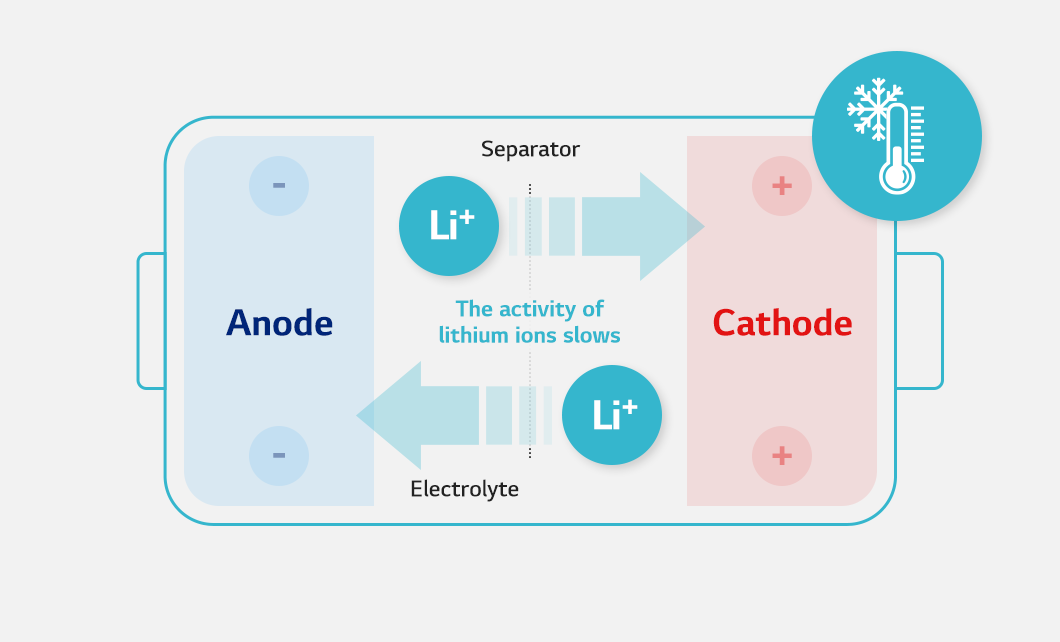
To understand why battery performance decreases in cold weather, it first helps to understand how a lithium-ion battery works. Lithium-ion batteries charge and discharge as lithium ions travel between the cathode and anode through the electrolyte. During charging, lithium ions move from the cathode to the anode. During discharging, they move back from the anode to the cathode.
However, when temperatures fall, the movement of lithium ions slows, and the electrochemical reactions inside the battery become less active. As a result, battery performance is affected for four main reasons.
1. Increased Electrolyte Viscosity: The electrolyte serves as the pathway through which lithium ions travel. As temperatures drop, the electrolyte becomes more viscous, making it more difficult for lithium ions to move freely.
2. Increased Internal Resistance: As lithium ions move more slowly, the battery’s internal resistance increases. At low temperatures, lithium ions also have greater difficulty passing through the thin protective layers that form on the electrode surfaces, known as the SEI (Solid Electrolyte Interphase)* and CEI (Cathode Electrolyte Interphase)*. During charging, higher overpotential can cause the SEI layer to grow thicker or increase interfacial resistance. Consequently, more energy is required for lithium ions to move within the battery, reducing the voltage and energy the battery can deliver.
3. Slower Electrochemical Reactions: Lower temperatures also change the physical properties of the electrolyte, further limiting the movement of lithium ions between the electrodes. This, in turn, slows the electrochemical reactions required for charging and discharging, making it more difficult for the battery to deliver its normal level of performance.
Together, these four factors make it more difficult for batteries to perform at their full potential in cold weather.
*View: Battery Glossary – SEI (Solid Electrolyte Interphase)
*View: Battery Glossary – CEI (Cathode Electrolyte Interphase)
Q. How Does Cold Weather Affect EVs?
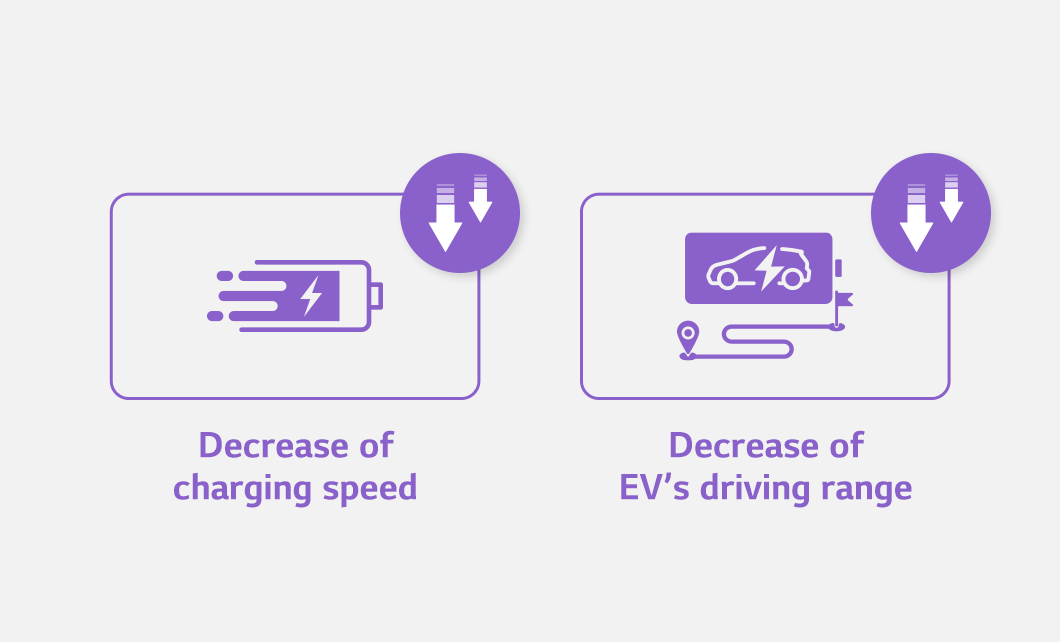
The changes EV drivers notice most during the winter are slower charging speeds and reduced driving range.
1. Slower Charging Speeds: Charging a battery too aggressively at low temperatures can lead to lithium plating, a phenomenon in which metallic lithium deposits form on the anode. This can shorten battery life and may also affect battery safety. As a result, EVs intentionally reduce charging power in cold weather. The lower the battery temperature, the more the initial charging power is limited, resulting in a longer time to reach the desired state of charge.
2. Reduced Driving Range: The Norwegian Automobile Federation (NAF) has also confirmed reduced EV driving range in winter through its annual El Prix test. In the 2026 winter test, conducted in temperatures as low as -32°C, the vehicles traveled 38% less on average than their certified driving range.
Q. How Can You Minimize Battery Performance Loss in Cold Weather?
When battery performance temporarily declines due to cold weather, it generally recovers as temperatures rise and lithium ions regain their normal mobility. However, rapid temperature changes can damage battery materials and affect long-term performance, making proper battery care especially important.
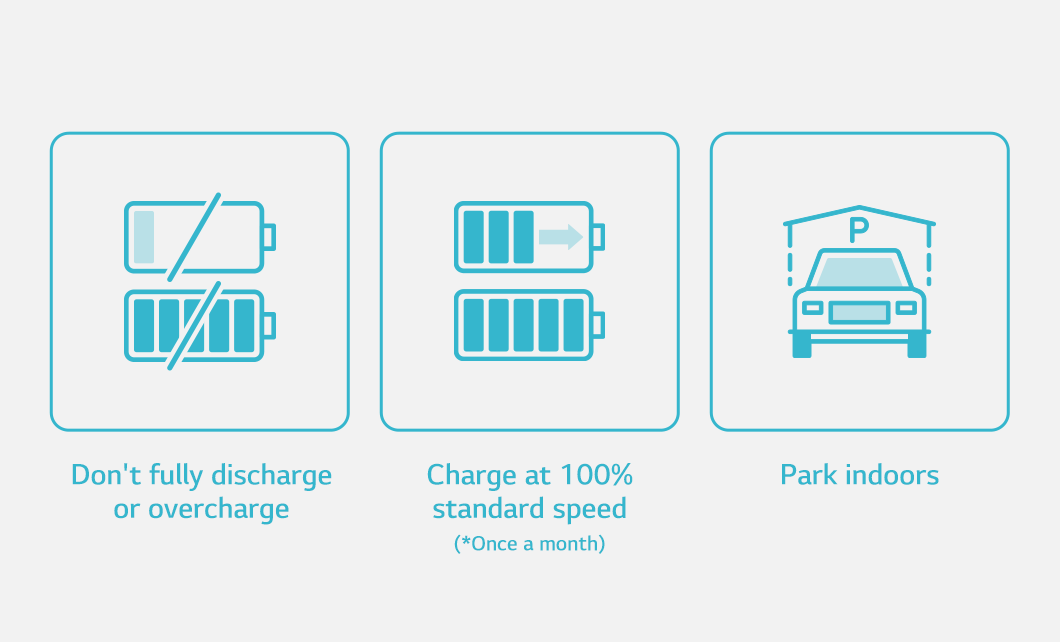
1. Avoid Overdischarging and Overcharging, and Keep the Battery Charged to Around 80–90%
Repeated overdischarging and overcharging can shorten the lifespan of lithium-ion batteries. Overdischarging may damage the battery’s current collector, leading to performance degradation. Meanwhile, keeping a battery at a high state of charge for extended periods can reduce its capacity and lifespan while increasing the risk of battery failure. In general, lowering the maximum charging voltage reduces stress on the battery and helps extend its cycle life. It is widely known that lowering the maximum charging voltage by 0.10 V per cell from the standard 4.20 V per cell can help increase cycle life.
For this reason, it is recommended to avoid fully discharging lithium-ion batteries and to keep electronic devices and EVs charged to around 80–90% whenever possible. EVs also use a Battery Management System (BMS) to help prevent overcharging.
2. Use Standard Charging from Time to Time
Although DC fast charging is convenient, relying on it too frequently can place additional stress on the battery. Charging an EV to 100% using standard charging from time to time can help with cell balancing, which equalizes the voltage across battery cells, and State of Charge (SoC) gauge calibration, which helps maintain more accurate battery management.
3. Park Indoors and Precondition Your EV Before Driving
Whenever possible, park your EV indoors during the winter. Extremely low temperatures increase the battery’s internal resistance, which can temporarily reduce both battery performance and driving range. Parking indoors helps prevent the battery from becoming excessively cold, minimizing the loss of driving range in winter.
The way you use your vehicle’s heating system also matters. Running the cabin heater for extended periods increases energy consumption, which can further reduce driving range. Preconditioning your vehicle while it is still plugged in helps warm the cabin before driving. During your trip, using the heated seats and heated steering wheel instead of relying solely on the cabin heater can also help reduce energy consumption.
Key Takeaways
● In cold weather, the chemical reactions inside a battery slow down, causing it to drain more quickly than usual.
● At low temperatures, increased electrolyte viscosity, reduced lithium-ion mobility, and higher internal resistance can temporarily reduce battery performance.
● During the winter, EVs may take longer to charge and have a shorter driving range due to charging power limitations and increased energy use for cabin heating.
● To help extend battery life, avoid overdischarging and overcharging, and keep the battery charged to around 80–90% whenever possible.
● Charging your EV to 100% using standard charging from time to time can help with cell balancing and State of Charge (SoC) gauge calibration.
● During the winter, parking indoors, preconditioning your vehicle before driving, and using heated seats and the heated steering wheel can help reduce the impact of cold weather.
A temporary decline in battery performance during cold weather is a natural result of the structure and operating principles of lithium-ion batteries. However, you can help minimize its impact by avoiding overdischarging and overcharging, parking indoors during the winter, preconditioning your vehicle before driving, and warming the battery before fast charging whenever possible.
At the same time, research continues to overcome the limitations of lithium-ion batteries under varying temperature conditions. Researchers are exploring a variety of approaches, including optimizing electrolyte viscosity by adjusting solvent compositions, developing advanced materials and electrolyte technologies that enable stable lithium-ion movement even at low temperatures, and accelerating the development of all-solid-state batteries. As these technologies continue to advance, batteries are expected to deliver even more stable and reliable performance, even in cold environments.