As the spread of AI services and high-performance computing continues, interest is growing in data center power demand and the power infrastructure needed to support it. Because data centers consume large amounts of power around the clock, a stable power supply and flexible power management are becoming increasingly important as demand changes.
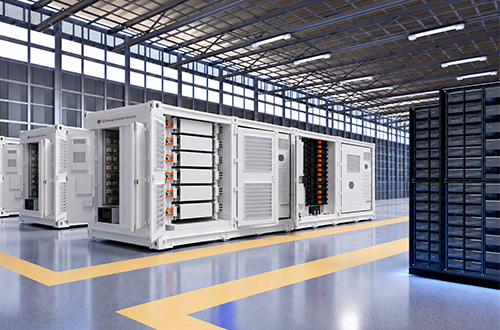
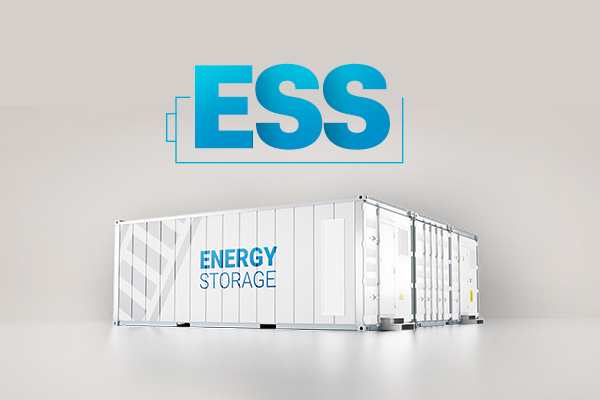
One piece of equipment drawing attention in this environment is the BESS (Battery Energy Storage System). ESS (Energy Storage System) refers to a system that stores power for later use, while BESS specifically refers to an energy storage system that uses batteries. So what role can BESS play in responding to the power demand of AI data centers? Let’s take a look at the background behind rising data center power demand in the U.S., the main ways BESS is used, real-world examples at AI data centers in North America, and LG Energy Solution’s response.
How Much Is U.S. Data Center Power Demand Growing?
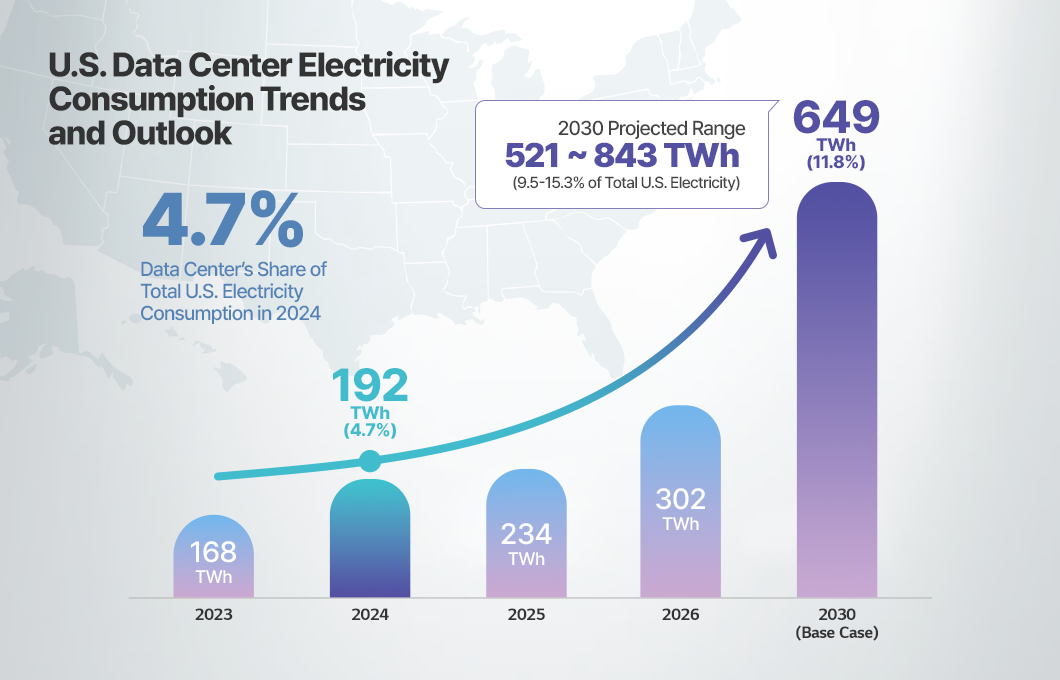
According to the “United States Data Center Energy Usage Report: 2025 Update,” published by Lawrence Berkeley National Laboratory (LBNL) in 2026, U.S. data center electricity consumption in 2024 was estimated at approximately 192 TWh. This accounts for about 4.7% of total U.S. electricity consumption.
In its base case, LBNL projects that U.S. data center electricity consumption will rise to 649 TWh by 2030, or 11.8% of total U.S. electricity. However, actual consumption may vary depending on factors such as the volume of IT equipment installed in data centers and the power usage characteristics of that equipment, so LBNL also presents a range of 521–843 TWh (9.5–15.3% of total U.S. electricity).
These figures are estimates for all U.S. data centers, not for AI data centers alone. Even so, AI matters because of the basis for the projections. LBNL factored AI-related variables into its analysis, including the spread of AI-accelerated servers, the volume of installed AI chips, and server utilization rates. AI adoption is therefore an important factor behind the projection that data center electricity consumption will more than triple over six years.
As data center power demand rises with the spread of AI, it is becoming important not only to increase generation but also to have power systems that can reliably supply power when needed and respond flexibly to large, fluctuating demand. The U.S. Department of Energy (DOE) also identifies on-site generation1 and demand flexibility enabled by energy storage as potential ways to address rising electricity demand driven by data centers and AI adoption.
Why Is BESS Gaining Attention as Data Center Power Infrastructure?
As power demand at AI data centers grows, considerations extend beyond generation facilities to the capacity of transmission and distribution networks, the grid interconnection of large loads, and operating approaches that respond to changes in demand. In this environment, BESS is drawing attention as one means of increasing the flexibility of power supply.
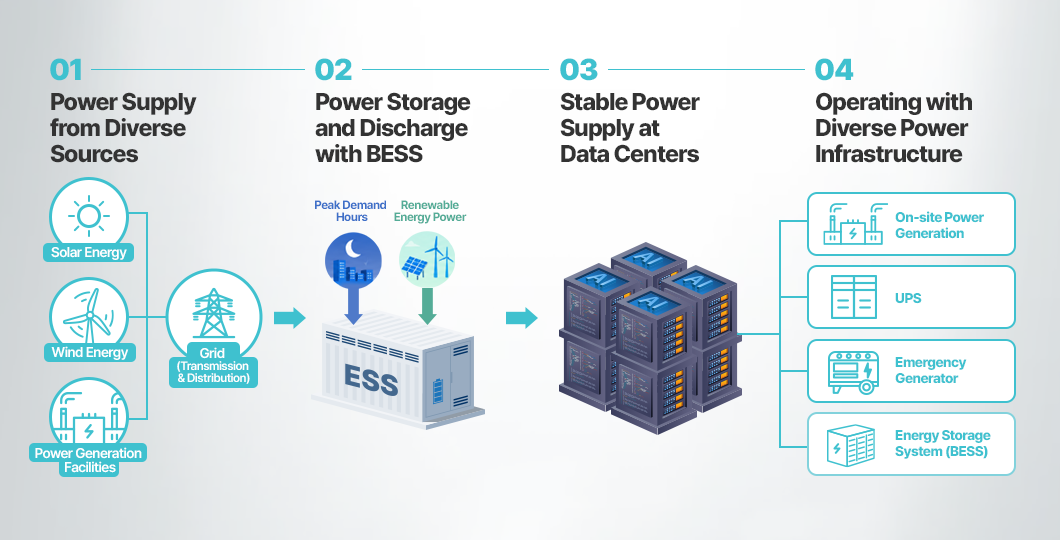
BESS is an energy storage system that stores power in batteries and discharges it when needed to meet power demand. It can draw on stored power during peak demand hours, and it can also store power generated from renewable energy sources such as solar and wind for use when needed. This helps bridge the timing gap between power demand and generation, and it can also be used for demand response and power balancing.
That said, BESS is only one of the several types of infrastructure that make up a data center’s power supply. For a stable power supply, data centers need to consider a range of power infrastructure, including generation facilities and the grid, as well as UPS, emergency generators, and energy storage systems. The configuration and role of each depend on the data center’s scale, grid environment, and operating approach.
How Is BESS Used in Data Centers?
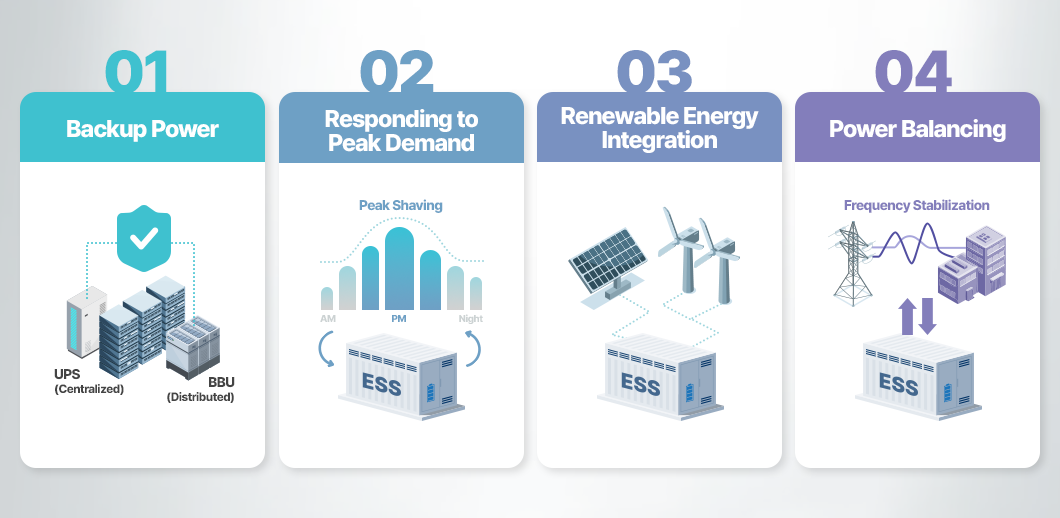
In 2026, Uptime Institute, a data center specialist organization, grouped BESS applications in data centers into four categories: UPS, demand response and peak shaving, renewable energy time-shifting, and power balancing.2 However, the four areas differ in maturity of adoption. Outside of UPS and the storage and use of renewable energy, many applications are still at the pilot-project and early-deployment stage.
① Backup Power
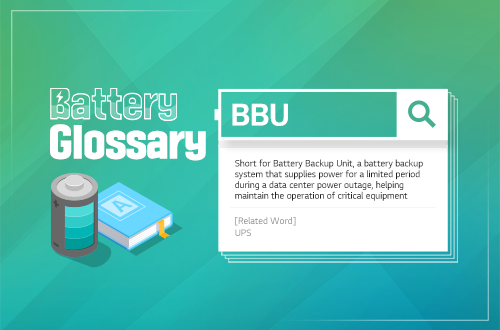
To keep a data center running reliably, a backup system is needed that can continue supplying power to critical IT equipment even when a power supply problem occurs. Battery-based backup systems such as UPS (Uninterruptible Power Supply) and BBU (Battery Backup Unit) can be used for this purpose. A UPS is a power protection system that supplies uninterruptible power to a data center’s critical loads, while a BBU is a distributed battery backup unit installed close to server racks or equipment that supplies power for a short period of time. The two systems differ in installation location and role, and together with emergency generators and other equipment, they support a stable power supply for data centers.
*View: Battery Glossary – Battery Backup Unit (BBU)
② Responding to Peak Demand (Peak Shaving)
During hours of high power demand, power stored in BESS can be discharged to lower the peak in power drawn from the grid. This makes it possible to regulate power during periods when demand is concentrated, but actual application methods and economics may vary depending on the power market, rate structures, and facility configuration.
③ Renewable Energy Integration
Data centers sometimes use renewable energy as a power source. However, solar and wind output varies with time and weather conditions, so it does not always match power demand. With BESS, power generated from renewable energy can be stored and used when it is needed, bridging the timing gap between renewable generation and power consumption. Uptime Institute describes renewable energy time-shifting of about two to four hours as one of the main use cases for BESS.
④ Power Balancing
BESS can support not only power operations inside a data center but also stable grid operations. By discharging stored power or adjusting charging as needed, it can respond to rising power demand or help adjust grid frequency. However, supporting the grid in this way with a data center’s battery storage is still at the research and early-deployment stage, and practical application requires considering secure backup power for the data center and economic feasibility together.
AI Data Centers and BESS: What Are Some Real-World Examples?
As power demand at AI data centers grows, projects are moving forward in North America to build renewable energy and BESS together or to connect battery storage to the grid.
① Amazon / AWS
Amazon is working with the utility NV Energy to supply power to its data centers in the Reno area of Nevada.3 According to a plan announced in 2026, 100 MW of geothermal generation, 600 MW of solar generation, and 600 MW of battery storage will be added to the grid. By storing power generated during hours of high solar output in batteries and discharging it when needed, Amazon plans to use solar power even after daylight hours and support the power supply required by its data centers.
② Meta
In Wyoming, Meta is moving forward with the Cowboy Project together with Enbridge, a North American energy infrastructure company.4 The Cowboy Project is an Enbridge project near Cheyenne, Wyoming, that combines solar power generation with BESS. Phase 1, announced in May 2026, includes 365 MW of solar generation and a 200 MW/1,600 MWh BESS, with operations targeted to begin by the end of 2027. The project is designed so that power generated by solar can be stored in the BESS and supplied to the grid when needed. This is intended to increase the use of renewable energy while supporting the power supply required by Meta’s data centers and stable grid operations.
③ Oracle / DTE Energy
In Saline Township, Michigan, a Stargate data center campus involving Oracle, OpenAI, and others is under construction.5 Oracle is also directly investing in the power infrastructure the Stargate campus requires. While making use of existing high-voltage power lines, it is building new transmission lines, a dedicated substation, and battery storage systems, with power supplied by the local utility, DTE Energy.
DTE Energy is expanding its battery storage capacity to respond to rising power demand, including from data centers. In May 2026, it signed an agreement with LG Energy Solution Vertech to supply a total of 6 GWh of ESS batteries. Under this agreement, a total of 1.5 GW of battery storage capacity will be built across eight ESS projects in Michigan.
How Is LG Energy Solution Responding to the AI Data Center Market?
As AI infrastructure expands, data center power demand is rising, and with it the demand for ESS that supports a stable power supply for both the grid and data centers. To respond to these market changes, LG Energy Solution is strengthening its ESS business while also introducing power backup solutions for data centers, such as UPS and BBU.
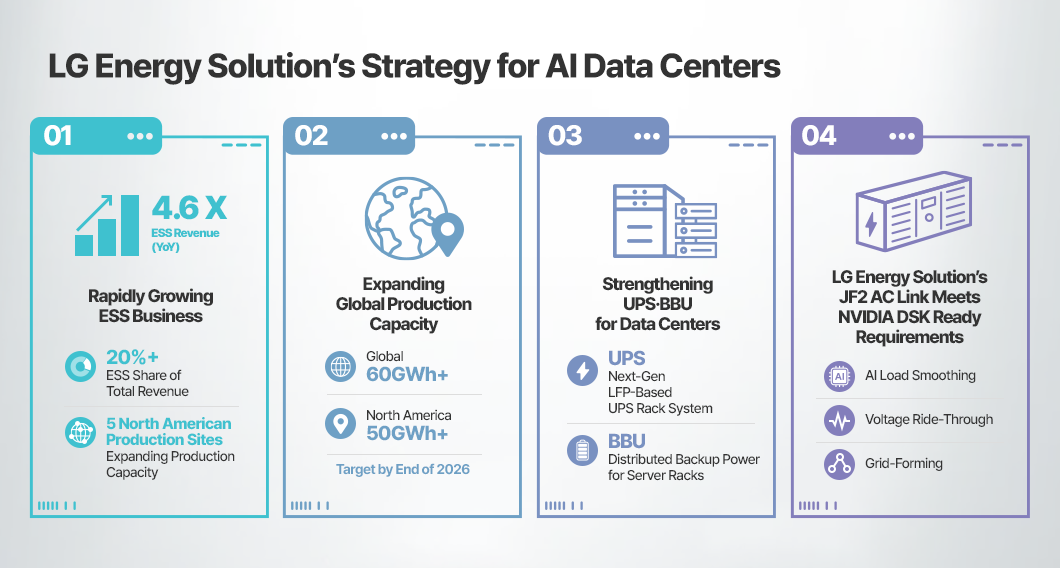
The ESS business is showing growth as well. In the first half of 2026, LG Energy Solution’s ESS revenue increased 4.6X year over year, and its share of total revenue rose to the high-20% range.
To meet this ESS demand, LG Energy Solution plans to secure global ESS production capacity of more than 60 GWh, including more than 50 GWh in North America, by the end of 2026. In North America in particular, it is responding to local demand with five ESS production sites, including its plants in Lansing and Holland, Michigan, and the NextStar Energy plant in Canada.
In the backup power area discussed earlier, the company is also developing concrete solutions for data centers. At InterBattery 2026, it unveiled a BBU solution using high-power cylindrical batteries and a next-generation LFP-based UPS rack system. As it strengthens its ESS production base, LG Energy Solution is also addressing growing demand for data center power backup through its UPS and BBU solutions.
The product competitiveness of its BESS for AI data centers is also being recognized. In September 2026, LG Energy Solution’s JF2 AC Link met the BESS category requirements in NVIDIA’s newly launched DSX Ready program. DSX Ready is a qualification program that verifies whether partner products used to build AI factories meet the applicable requirements, and at the program’s launch, BESS solutions from only three companies worldwide had qualified. LG Energy Solution was the only Korean battery manufacturer among them. JF2 AC Link features AI Load Smoothing, which adjusts charging and discharging to match the abrupt load changes of AI servers, along with Voltage Ride-Through and Grid-Forming functions, supporting stable power operations at AI data centers, including in the power balancing area discussed earlier.
Key Q&A
Q. How much is U.S. data center electricity consumption growing?
A. U.S. data center electricity consumption was estimated at about 192 TWh in 2024. In its base case, Lawrence Berkeley National Laboratory (LBNL) projects that consumption will rise to 649 TWh by 2030, and it presents a range of 521–843 TWh to reflect uncertainty.
Q. Why do AI data centers need BESS?
A. As the spread of AI services and high-performance computing increases data center power demand, power infrastructure that can reliably supply large loads and respond to changing power demand is becoming more important. By storing power and supplying it when needed, BESS can support stable and flexible power operations at data centers.
Q. What role does BESS play in data centers?
A. In data centers, BESS can be used for responding to peak demand, renewable energy time-shifting, and supporting stable grid operations. It addresses the timing gap between power demand and generation by discharging stored power during high-demand hours or by storing power generated from renewable energy and using it when needed.
Q. How do UPS and BESS differ in data centers?
A. A UPS is a power protection system that supplies uninterruptible power to critical loads in the event of a power anomaly or outage. A BESS, on the other hand, is a battery-based energy storage system that stores power in batteries and charges and discharges as needed, and it can be used for a variety of purposes, such as responding to peak demand and renewable energy integration. BESS and UPS differ in purpose and configuration, and data centers can use them together according to their respective roles.
Q. How do BBU and UPS differ?
A. A BBU (Battery Backup Unit) is a distributed battery backup unit installed close to server racks or equipment that supplies power locally for a short period of time. A UPS (Uninterruptible Power Supply), on the other hand, is a power protection system that supplies uninterruptible power to critical loads in the event of a power anomaly.
Q. How is BESS being used at AI data centers in North America?
A. Amazon plans to add 600 MW of solar generation and 600 MW of battery storage to the grid to supply power to its data centers in the Reno area of Nevada. Power generated by solar is stored in batteries and discharged when needed, extending the hours during which solar power can be used.
Meta is moving forward with the Cowboy Project with Enbridge in Wyoming. Phase 1 includes 365 MW of solar generation and a 200 MW/1,600 MWh BESS. By combining solar and BESS, the project is designed to support flexible power supply, grid stability, and renewable energy integration.
In addition, DTE Energy signed an agreement with LG Energy Solution Vertech to supply a total of 6 GWh of ESS batteries, under which a total of 1.5 GW of battery storage capacity will be built across eight ESS projects in Michigan. The projects include energy storage systems for Oracle’s data center campus in Saline Township.
Q. How is LG Energy Solution responding to the AI data center market?
A. LG Energy Solution is addressing the power storage and backup demand driven by the expansion of AI infrastructure through a range of battery solutions, including BESS for the grid and UPS and BBU for data centers. In the first half of 2026, its ESS revenue increased 4.6X year over year, and its share of total revenue rose to the high-20% range. To meet growing ESS demand, it also plans to secure global ESS production capacity of more than 60 GWh, including more than 50 GWh in North America, by the end of 2026. In data center power backup, it unveiled a BBU solution using high-power cylindrical batteries and a next-generation LFP-based UPS rack system at InterBattery 2026. In September 2026, its BESS solution JF2 AC Link met the BESS category requirements in NVIDIA DSX Ready.
The spread of AI data centers is presenting new challenges not only for data processing technology but also for the power infrastructure that supports it. Reliable power supply for large loads and flexible power management that accommodates changing demand and fluctuations in renewable energy generation are becoming increasingly important.
As we have seen, BESS can support peak shaving, renewable energy integration, and flexible power management. Its specific applications depend on the configuration of the data center and the grid. Going forward, LG Energy Solution will expand its ESS production capacity in North America while strengthening power backup solutions for data centers, such as UPS and BBU, to respond to changing power demand.
- A method of generating power through generation facilities installed at the site that needs the power and supplying it to that site. It can be used to reduce dependence on the external grid and improve the reliability of power supply. ↩︎
- Uptime Institute. (2026). BESS in data centers: use cases and technologies ↩︎
- Amazon. (2026). How Amazon is preparing for the energy needs of the future ↩︎
- Enbridge. (2026). Enbridge and Meta expand partnership with Cowboy Project ↩︎
- Oracle. (2026). Oracle, Related Digital, Blackstone, OpenAI, Walbridge and Governor Whitmer Celebrate Construction of Stargate Campus in Saline Township ↩︎