As AI computing and high-performance computing continue to expand, data centers are experiencing rapid growth in both power consumption and system complexity. Because even brief power disruptions can lead to service interruptions, ensuring a stable power supply has become more important than ever.
A Battery Backup Unit (BBU) is a distributed battery backup system that supplies power for a short period from a location close to individual equipment, such as servers and storage devices. By providing localized backup power at the equipment level, BBUs help improve power stability within data centers.
In this article of the Battery Glossary, we’ll explore what a BBU is, its role, how it differs from an Uninterruptible Power Supply (UPS), and how it is used in data centers.
What is a BBU?
A BBU is a distributed power backup system that supplies power for a limited period during a power outage, ensuring the uninterrupted operation of critical equipment such as servers and storage systems in a data center.
BBUs are integrated into server racks1 or equipment cabinets, or installed nearby, enabling rapid response at the point of disruption. Rather than serving as a centralized system that supports an entire facility, BBUs provide localized backup power where it is needed.
With this architecture, BBUs help protect data from power interruptions, minimize system downtime, and support stable data center operations.
How is a BBU Different from a UPS?
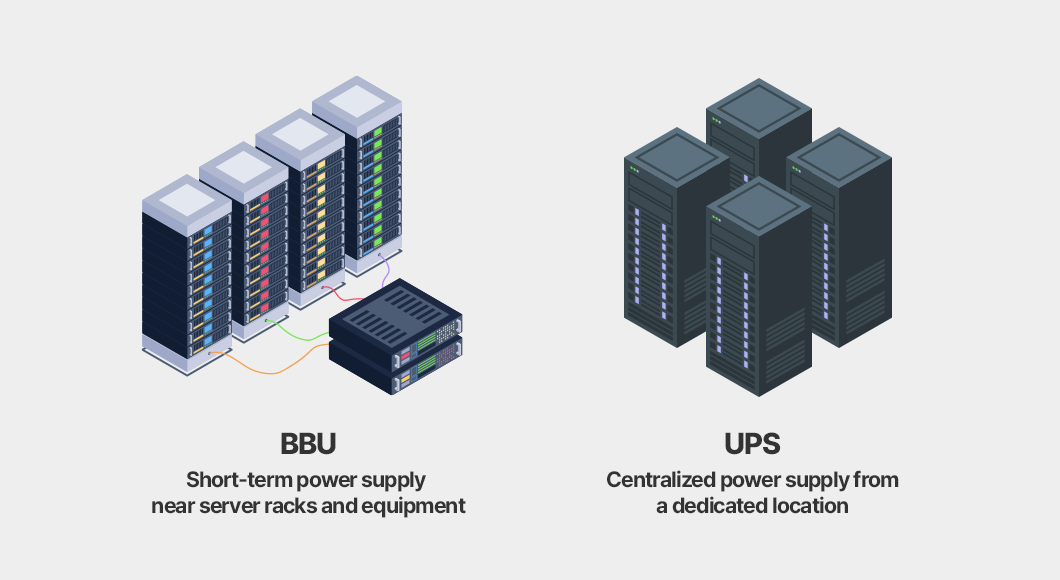
When discussing power stability in data centers, the UPS is another key system commonly mentioned alongside a BBU. While both provide backup power during an outage, they differ in their architecture, operating method, and application.
The first difference lies in system architecture. A BBU is a distributed system that provides backup power at the rack or equipment level, allowing it to be deployed flexibly according to the requirements of a data center. A UPS, by contrast, is a centralized system installed in a dedicated location to supply backup power to the entire data center, making it well suited for large-scale operations.
The second difference is how electrical power is processed. A UPS uses a double-conversion architecture that converts AC power to DC and then back to AC. A BBU, on the other hand, stores and supplies DC power while adjusting voltage through DC-to-DC conversion. This relatively simple conversion process helps reduce energy loss.
The third difference lies in backup duration. A BBU is typically designed to supply power for about four minutes, whereas UPS systems can maintain power for the entire system for approximately 10 to 15 minutes. Although a UPS provides longer backup times overall, a BBU reduces power loss by supplying power close to the equipment during short-duration outages. Meanwhile, a UPS provides consistent backup power to the entire data center from a centralized location over a longer period.
Together, BBUs and UPS systems serve complementary roles at different stages of the backup power process. While BBUs provide short-term localized backup near the equipment, the centralized UPS maintains power for the overall system until emergency power sources, such as generators, take over. This multi-layered power protection architecture is becoming increasingly important in AI data centers, where rack-level power density continues to increase.
BBU (Equipment Level, Short-term Response) → UPS (System-wide, Mid-term Response) → Generator (Long-term Power Supply)
| Category | BBU (Battery Backup Unit) | UPS (Uninterruptible Power Supply) |
|---|---|---|
| System Architecture | Installed near server racks or equipment (distributed) | Installed in a dedicated location (centralized) |
| Power Conversion | DC-based | AC → DC → AC conversion |
| Backup Duration | Approx. 4 minutes | Approx. 10–15 minutes |
| Backup Characteristics | Localized backup near the load | Stable power for the entire system |
What Performance is Required for BBU Batteries?
Because BBUs can quickly supply power where it is needed, they play a vital role in data center operations. Their importance continues to grow as AI computing and high-performance computing drive power demand.
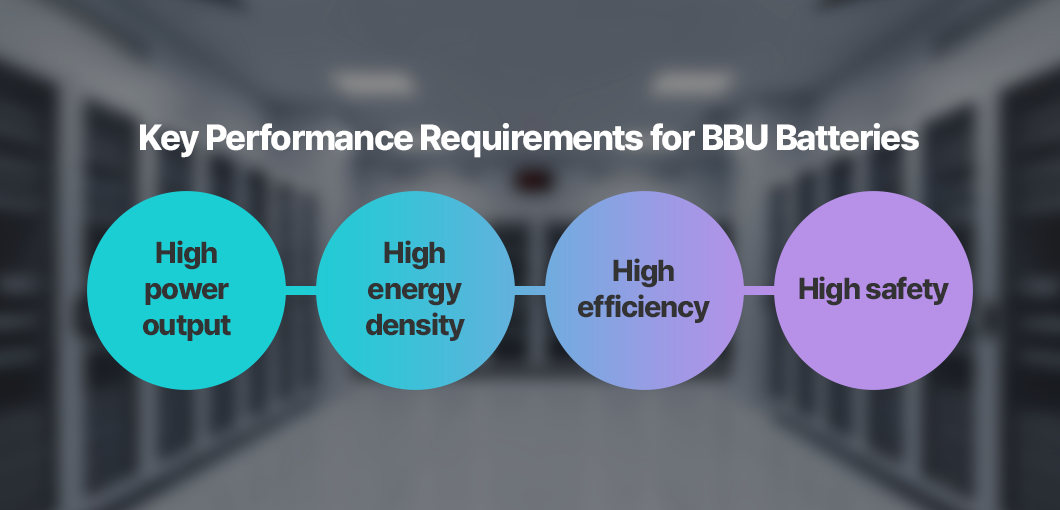
To perform effectively in data centers, the battery system inside a BBU must meet demanding performance requirements. Since BBUs must provide sufficient power within limited installation space, their batteries need to balance high power output, high energy density, high efficiency, and safety.
① High Power Output: Power density at the rack level is increasing rapidly in AI data centers, making it essential to maintain stable system operations even during brief power interruptions. As a result, BBU batteries must be capable of delivering high power within a very short period of time.
② High Energy Density: Because BBUs are installed within the limited space available inside server racks¹, high energy density is essential for storing more energy within the same footprint.
③ High Efficiency: Power demand in data centers can change rapidly over short periods. To maximize the use of stored energy, high efficiency—which minimizes energy loss during power conversion—is a critical requirement for BBU batteries.
④ Safety: Under high-power and fast-response operating conditions, heat generation inside the battery can increase significantly. If the temperature continues to rise, it can affect both performance and operational stability. Therefore, BBU batteries should provide a high level of thermal safety to ensure reliable operation under these conditions.
LG Energy Solution’s BBU Strategy
LG Energy Solution continues to expand battery applications beyond electric vehicles (EVs) and energy storage systems (ESS) into emerging sectors such as Urban Air Mobility (UAM) and Battery Backup Units (BBUs). Among these, BBUs represent a key application in the company’s technology roadmap, reflecting its proactive efforts to prepare for the rapidly growing AI infrastructure market.
This strategy was demonstrated at InterBattery 2026, where LG Energy Solution introduced new products for AI data centers. The company unveiled Korea’s first BBU solution powered by high-power cylindrical batteries, alongside a next-generation LFP-based rack system for UPS applications.
Key Q&A
Q. What is a Battery Backup Unit (BBU)?
A BBU is a battery backup system that supplies power for a limited period during a sudden power outage, helping maintain critical equipment operation and protect data in a data center.
Q. How is a BBU different from a UPS?
A BBU is a distributed system that provides localized backup power near equipment such as server racks, whereas a UPS is a centralized system installed separately to provide backup power for an entire data center.
Q. Why are BBUs becoming more important in AI data centers?
As AI computing increases server power consumption and rack-level power density, the need for localized backup power provided by BBUs continues to grow.
Q. What performance is important for BBU batteries?
BBU batteries should provide high power output for short-duration backup, high energy density to maximize the use of limited space, high efficiency to minimize energy loss, and a high level of safety.
We’ve explored the concept of Battery Backup Units (BBUs), the role they play, and how they are used in data centers. As we’ve seen, BBUs help maintain power continuity by providing localized backup power close to critical equipment.
To meet these evolving demands, LG Energy Solution is expanding its energy infrastructure portfolio with solutions ranging from BBUs and UPS systems for AI data centers to ESS for power grids. We will continue introducing battery technologies shaping the future of energy in an easy-to-understand way.
- Server Rack: A standardized framework designed to house servers, networking equipment, and other IT hardware, enabling efficient installation and management within a data center. ↩︎