When tens of thousands of GPUs start and stop computing at the same time, power has to keep pace.
AI data center power demand is growing in both overall scale and variability. According to BloombergNEF (BNEF), U.S. data center electricity consumption is projected to more than double, from 180 TWh in 2025 to 391 TWh in 2030.1 And it’s not just the amount of power that is growing: demand at AI data centers also fluctuates sharply within very short periods. A key solution for buffering such rapid changes in power demand is the battery energy storage system (BESS*).
In the BESS sector, battery manufacturer LG Energy Solution and AI computing company NVIDIA have come together. LG Energy Solution has joined NVIDIA’s newly launched DSX Ready program as a BESS partner. The product that met the DSX Ready requirements is LG Energy Solution’s JF2 AC Link. At the program’s launch, BESS solutions from only three companies worldwide had qualified, and LG Energy Solution was the only Korean battery manufacturer among them.
Let’s take a look at why AI data centers need BESS, the key specifications and technologies of JF2 AC Link, what joining NVIDIA DSX Ready means, and LG Energy Solution’s local production in North America and system integration capabilities.
Why Do AI Data Centers Need BESS?
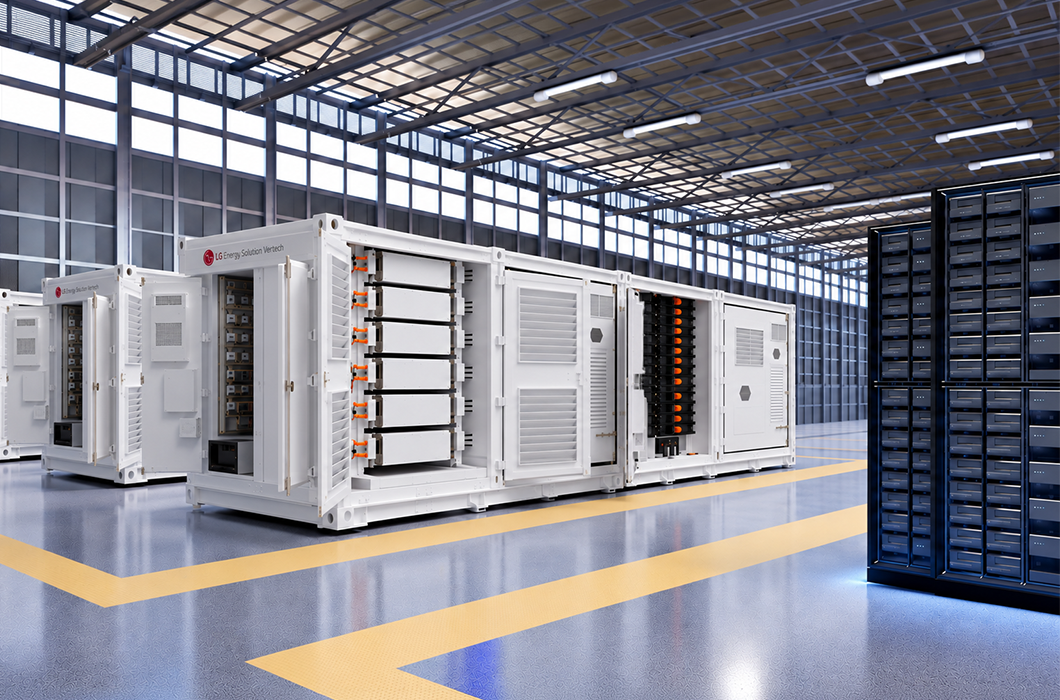
BESS is gaining attention as more than just an energy storage system. It is infrastructure that supports stable operations at AI data centers. When large-scale AI model training begins or service usage changes, the power consumption of Graphics Processing Units (GPUs) and servers can shift dramatically within a short time. If such large fluctuations in demand are transmitted directly to the grid, they can affect voltage stability, depending on grid conditions. This is because the grid and power generation equipment cannot always respond at the same speed as instantaneous changes in GPU loads.
This is where BESS works as a buffer between the grid and the data center. When power demand from AI servers surges, it discharges stored energy. When the load drops, it recharges, easing the sudden strain on the grid. That is why rapid response to changes in power demand and precise power control are important capabilities for BESS used in AI data centers.
Keeping an AI data center running reliably depends not only on power control, but on how well compute, networking, cooling, facilities, and software work together as a single system. Improving only one element simply shifts the bottleneck elsewhere. This makes it necessary to ensure that the various types of power equipment are suitable for the overall design.
What Is LG Energy Solution’s JF2 AC Link, a BESS Solution That Meets DSX Ready Requirements?
NVIDIA’s DSX Ready is a qualification program that verifies whether partner products used to build AI factories meet the applicable requirements. For BESS, a key aspect is the scope of evaluation. DSX Ready defines the qualification boundary at the AC terminals, including the Power Conversion System (PCS*).2 In technical testing, the focus is less on battery capacity or cell chemistry than on whether the system delivers the power control performance required at the AC terminals, the point where it actually connects to the grid.
What matters most about this qualification is that LG Energy Solution’s JF2 AC Link has met the applicable DSX Ready requirements for BESS used in AI factories. This highlights LG Energy Solution’s competitiveness not only in battery manufacturing but also in power control capabilities.
So what kind of solution is JF2 AC Link, the product that meets these requirements?
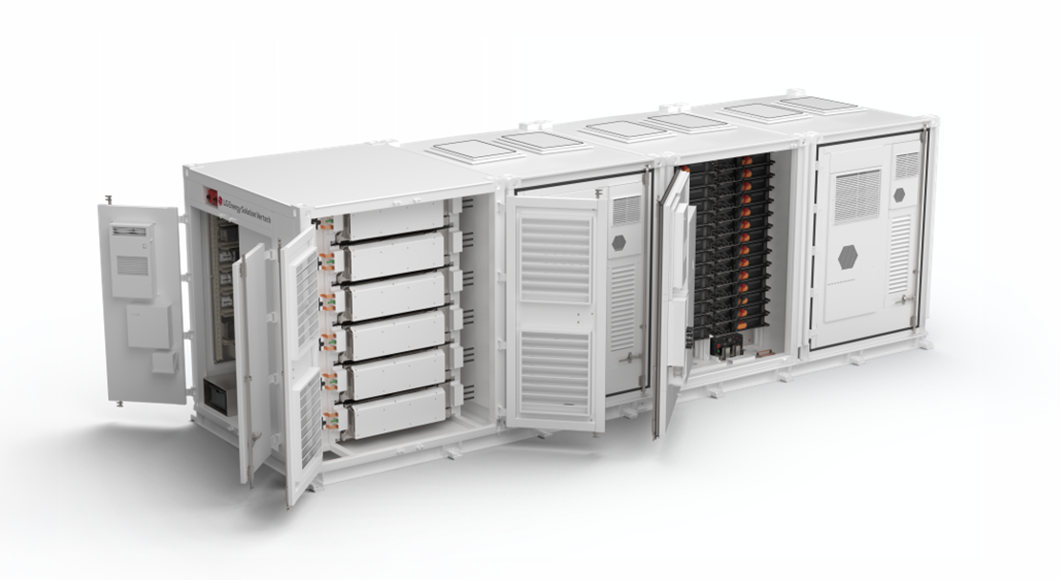
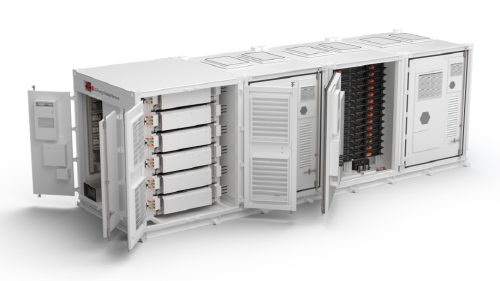
JF2 AC Link is a BESS solution that integrates high-capacity lithium iron phosphate (LFP) batteries, a PCS, a liquid cooling system, and an Energy Management System (EMS). It packages the key components for power storage, conversion, thermal management, and system control into a single product.
Each JF2 AC Link block stores 5.1 MWh of energy and can deliver 2.5 MW of rated power for approximately two hours. Battery heat is managed through liquid cooling, and the system is designed to operate at temperatures ranging from -30°C to 50°C. Its control software, AEROS EMS, monitors the system’s operating status and controls charging and discharging. The design also protects internal equipment from dust and water and takes seismic conditions into account.
What Are LG Energy Solution’s Competitive Strengths in the AI Data Center BESS Market?
Competitiveness in the AI data center BESS market is not determined by a product’s power control performance alone. It also requires business capabilities to deliver the volumes needed on schedule for large-scale projects and to keep systems running reliably after deployment. In other words, a product must not only perform well but also be supported by the capabilities needed to supply and operate it at scale. LG Energy Solution responds to diverse requirements by combining JF2 AC Link’s technology with its accumulated know-how in the ESS business, a solid local production base in North America, and its system integration and operations capabilities.
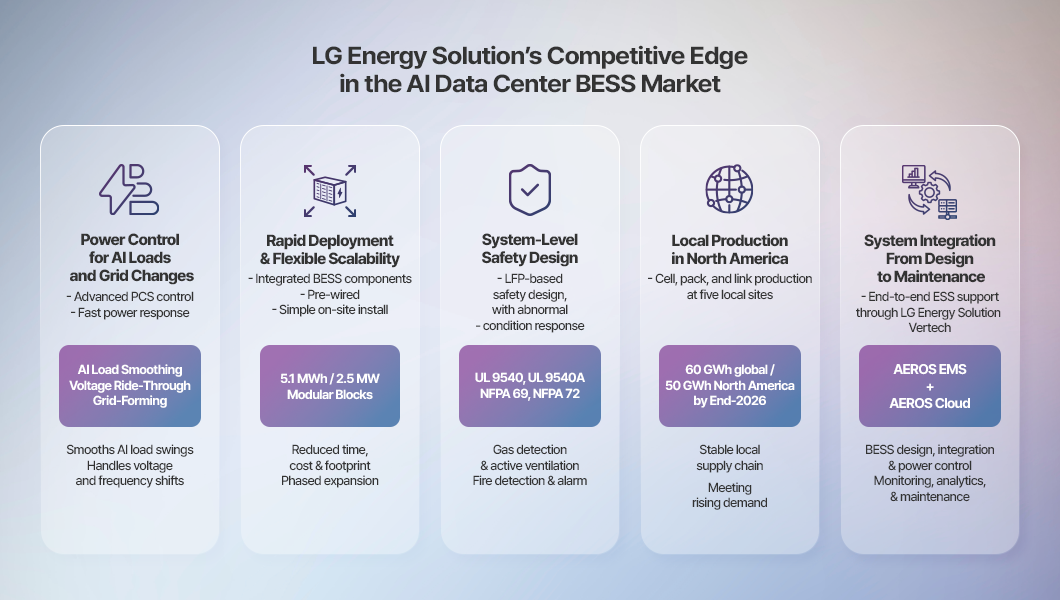
1) Power Control That Responds to AI Loads and Grid Changes
JF2 AC Link’s power control capability starts with its architecture, in which the batteries and PCS are integrated into a single system. Direct current (DC) power stored in the battery racks passes through the PCS and is converted into alternating current (AC) power that can be supplied to the data center. With advanced PCS control technology and fast response capabilities, JF2 AC Link responds to load changes from AI servers as well as voltage and frequency changes on the grid. This integrated architecture and power control performance have provided an important foundation for meeting the applicable DSX Ready requirements.
AI Load Smoothing: When large-scale training jobs start or AI service usage changes, a data center’s power demand can fluctuate sharply within a short time. JF2 AC Link smooths these fluctuations by regulating battery charging and discharging, helping manage the data center’s power flow.
Voltage Ride-Through: Sudden sags or surges in grid voltage can affect the reliable operation of a data center. JF2 AC Link supports a stable power supply through such abrupt voltage changes.
Grid-Forming: Grid-forming is a control technology that enables inverter-based resources to establish their own voltage and frequency reference. Through its grid-forming function, JF2 AC Link helps maintain power supply even when the grid is unstable.
2) Rapid Deployment and Flexible Scalability
In a typical BESS project, multiple components, including batteries, PCS, cooling units, and EMS, must be connected and integrated on site. JF2 AC Link integrates the key components into a single system, with some wiring completed in advance to simplify on-site installation. This reduces installation time, cost, and footprint for large-scale BESS deployments.
The scale of an AI data center, in particular, can continue to grow as servers and GPUs are added. JF2 AC Link has a modular architecture built from 5.1 MWh / 2.5 MW blocks. Systems can be added block by block to match a data center’s initial power demand and future expansion plans, allowing power infrastructure to be scaled up in phases as needed.
3) System-Level Safety Design
For a BESS that stores large amounts of energy, system-wide safety design is critical alongside cell characteristics. JF2 AC Link uses LFP cells and is designed with relevant safety standards, including UL 9540, in mind. It has also undergone UL 9540A testing and large-scale fire testing. UL 9540A evaluates the thermal runaway and fire propagation characteristics of battery energy storage systems.
The design also includes gas detection and active ventilation systems, along with fire detection and alarm systems. Taking relevant standards such as NFPA 69 and NFPA 72 into account, the safety design enables detection and response to abnormal conditions.
4) Reliable Supply Backed by Local Production in North America
For large-scale infrastructure projects such as AI data centers, product performance is not the only consideration; having a production base capable of delivering the required volumes on schedule is also essential. LG Energy Solution operates or is building five production sites in North America: Lansing and Holland in Michigan, NextStar Energy in Ontario (Canada), Ultium Cells in Tennessee, and L-H Battery Company in Ohio. Building on this footprint, the company is expanding its local production network across the ESS product range in North America, from LFP cells to packs to links.
LG Energy Solution plans to expand its global ESS production capacity to more than 60 GWh by the end of 2026, with more than 50 GWh of that located in North America. This production network provides a foundation for responding promptly to fast-growing demand from AI data centers and the ESS market and for strengthening supply chain stability.
5) System Integration and Operations Capabilities, from Design to Maintenance
A BESS solution involves more than connecting key equipment such as batteries and PCS. It requires designing the system to fit the site and controlling it reliably, then continuously monitoring and managing its operating status after deployment. Through Vertech, its U.S. subsidiary, LG Energy Solution supports the ESS business end to end, spanning system design, power control, monitoring, data analytics, and maintenance. Vertech’s system integration and operations capabilities provide a foundation for operating BESS reliably at AI data centers, where power demand changes rapidly.
AEROS software is used throughout the BESS operations phase. AEROS EMS provides on-site control, monitoring the operating status of the ESS and controlling equipment, while AEROS Cloud, a cloud-based analytics tool, analyzes accumulated data to support system operations.
Key Q&A
Q. Why do AI data centers need BESS?
A. BESS adjusts charging and discharging to match sharp fluctuations in AI server power consumption and responds to changes in grid voltage and frequency, supporting stable operation of AI data centers.
Q. What is NVIDIA DSX Ready?
A. NVIDIA DSX Ready is a qualification program that verifies whether partners’ products and solutions meet the applicable requirements for NVIDIA’s DSX AI factories.
Q. In which category is LG Energy Solution participating in DSX Ready?
A. LG Energy Solution’s JF2 AC Link met the applicable DSX Ready requirements in the BESS category, with LG Energy Solution joining the program as a partner. At the program’s launch, BESS solutions from only three companies worldwide had qualified, and LG Energy Solution was the only Korean battery manufacturer among them.
Q. What is LG Energy Solution’s JF2 AC Link?
A. JF2 AC Link is a BESS solution that integrates LFP batteries, a PCS, a liquid cooling system, and an EMS. Each block stores 5.1 MWh and can deliver 2.5 MW of rated power for approximately two hours.
Q. What gives LG Energy Solution an edge in the AI data center BESS market?
A. LG Energy Solution supplies JF2 AC Link, which combines power control capabilities that respond to load changes with a robust safety design. Its integrated, modular architecture supports rapid deployment and phased expansion, and its local production base in North America and Vertech’s system design and operations capabilities allow the company to support customers from product supply through post-deployment management.
We’ve now explored why AI data centers need BESS, the technology behind JF2 AC Link, and LG Energy Solution’s business capabilities. As power and cooling begin to be treated as core design considerations alongside compute in AI infrastructure, power infrastructure, including BESS, is becoming increasingly important.
Joining NVIDIA DSX Ready also demonstrates LG Energy Solution’s competitiveness in meeting the power infrastructure needs of AI data centers through JF2 AC Link’s technology, its local production capabilities in North America, and its system integration and operations capabilities.
Going forward, LG Energy Solution will continue to advance JF2 AC Link’s integrated design and power control technology and further enhance its safety while expanding collaboration with global customers, leveraging its differentiated local production and system integration capabilities. Through these efforts, the company plans to identify new business opportunities in the fast-growing AI data center BESS market and further accelerate the growth of its North American ESS business.