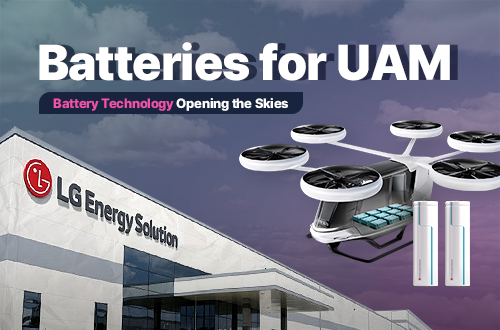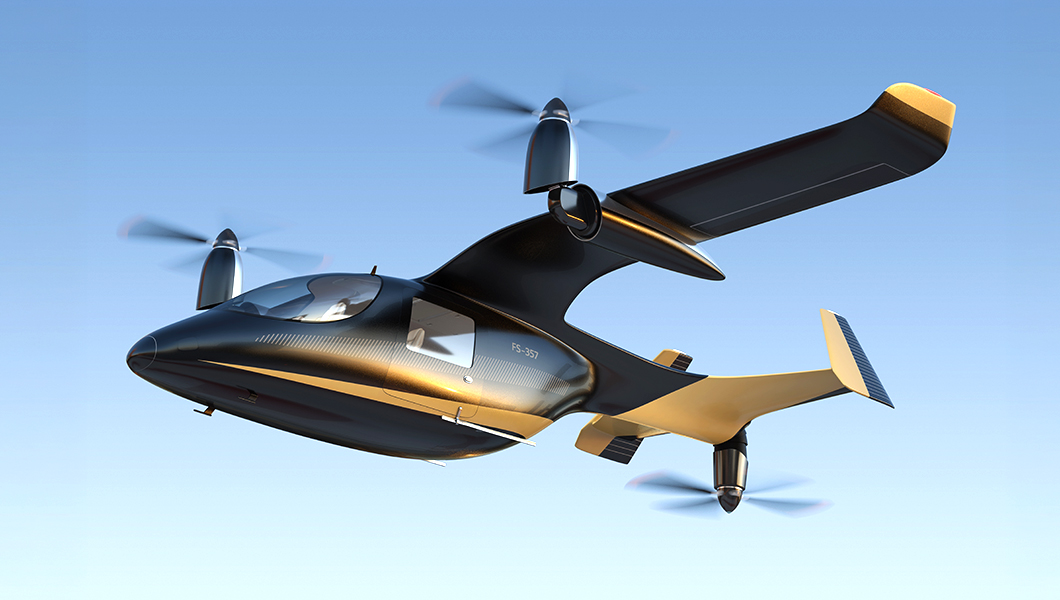
Urban Air Mobility (UAM) is a next-generation transportation system that carries passengers and cargo through low-altitude urban airspace. It is gaining attention as a new mobility solution designed to alleviate traffic congestion on the ground. Because UAM operates in the air, its commercialization depends on batteries that can simultaneously provide sufficient flight range, operational safety, and the high power required for vertical takeoff and landing.
In this article, we’ll explore the battery technologies driving UAM commercialization and take a look at LG Energy Solution’s battery solutions for UAM applications.
*View: Batteries Flying in the Skies: All About Urban Air Mobility (UAM) Batteries
What Is the Outlook for the Global UAM Market?
The UAM market is entering the early stages of commercialization and is widely recognized as a rapidly growing aviation mobility sector centered on electric Vertical Take-Off and Landing (eVTOL) aircraft.
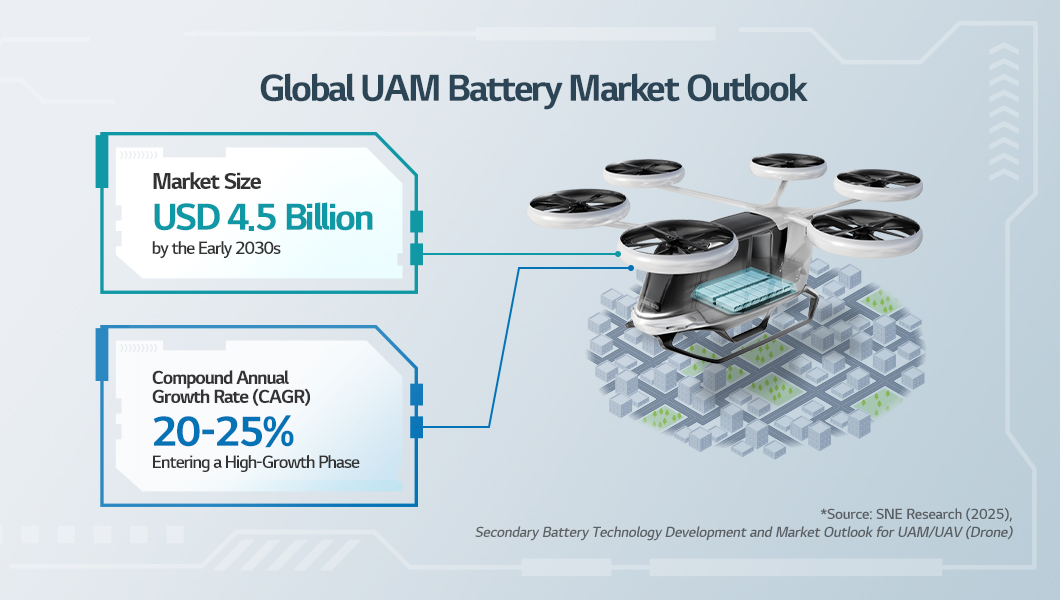
According to global market research firm SNE Research, the battery market for eVTOL aircraft is expected to grow from approximately USD 500 million in 2024 to around USD 4.5 billion in the early 2030s, representing an estimated compound annual growth rate (CAGR) of 20–25%.1
As the market continues to expand, countries are advancing not only aircraft development but also certification frameworks and regulatory systems for urban flight operations.
The United States is building the regulatory foundation needed to accelerate UAM commercialization. Since 2021, Congress and the administration have promoted the development of an Advanced Air Mobility (AAM) ecosystem. In June 2025, an executive order was issued to support the development of unmanned aircraft and eVTOL technologies. The Federal Aviation Administration (FAA) has subsequently launched the eVTOL Integration Pilot Program (eIPP), while the U.S. Department of Transportation (DOT) has outlined national policy directions through its AAM strategy. In 2026, the FAA selected eight eIPP projects, expanding operational demonstrations of eVTOL aircraft and AAM services across the nation.
China views UAM as a key component of its Low-Altitude Economy, a strategic initiative that promotes services such as transportation, logistics, tourism, and emergency response using eVTOL aircraft and drones operating in low-altitude airspace. After designating the Low-Altitude Economy as a strategic emerging industry in 2023, China incorporated related initiatives into its 2024 Government Work Report, further strengthening national support for the sector. Meanwhile, the Civil Aviation Administration of China (CAAC) is accelerating the establishment of the regulatory framework for UAM commercialization by advancing the issuance of Type Certificates (TC), Production Certificates (PC), and Airworthiness Certificates (AC) for eVTOL aircraft.
In South Korea, the commercialization of K-UAM is targeted for 2028, with efforts focused on building the initial market and establishing the necessary regulatory framework. The Ministry of Land, Infrastructure and Transport and UAM Team Korea are revising operational guidelines to expand beyond urban passenger transportation and include applications with strong early commercialization potential, such as emergency medical services and regional tourism. Looking ahead to expanded urban operations post-2032, the government has also identified 145 key technologies, including AI-based traffic management, next-generation communication and navigation systems, batteries, and components. In addition, the K-UAM Grand Challenge and nationwide testbeds will be used to validate integrated operational technologies, including flight operations, traffic management, and vertiport2 operations, to solidify the foundation for commercialization.
What Are the Key Characteristics of Batteries for UAM?
UAM aircraft are powered by batteries, making battery technology one of the key factors determining both their performance and safety. Batteries for UAM applications must simultaneously deliver △safety, △high gravimetric energy density (Wh/kg), and △high power output.
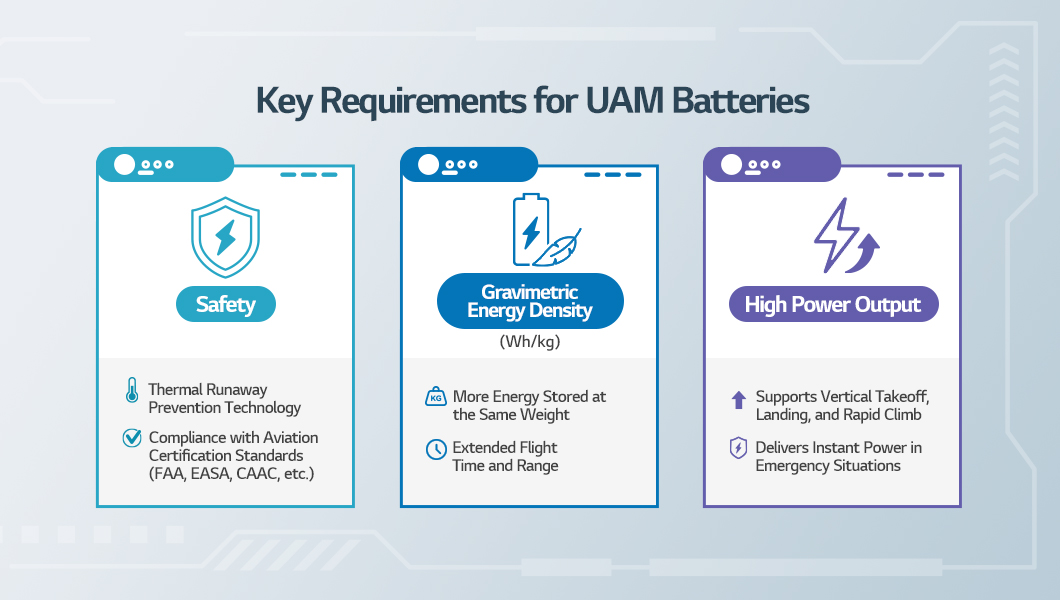
1) Safety: Safety is the most critical requirement for batteries used in UAM applications. During flight, aircraft are exposed to a wide range of environmental conditions, including changes in temperature and air pressure. Moreover, responding to unexpected issues while airborne is inherently more challenging. To ensure the safe transport of passengers and cargo, UAM batteries must therefore provide a high level of safety under various operating conditions.
As a result, UAM batteries require advanced safety features at both the cell and pack levels and must comply with certification standards established by recognized aviation authorities, including the FAA in the United States, the European Union Aviation Safety Agency (EASA), and the Civil Aviation Administration of China (CAAC).
One of the most important aspects of UAM battery safety is preventing thermal propagation. Even if thermal runaway occurs in a single battery cell, the resulting heat must be prevented from spreading to adjacent cells to maintain the safety of the overall battery system. Achieving this requires comprehensive design validation and sophisticated operation of the Battery Management System (BMS).
*View: Battery Glossary – TP Prevention Technology
2) High Gravimetric Energy Density: Gravimetric energy density (Wh/kg) is a key metric that determines how far a UAM aircraft can fly while carrying passengers or cargo. Because batteries do not become lighter as they discharge, storing more energy within the same weight directly extends the aircraft’s flight range. This capability directly determines the vehicle’s operational range and consequently, the service coverage.
The role of UAM also evolves with its flight range. At approximately 20–50 km, UAM can serve as an urban transportation option similar to an air taxi. At 50–150 km, it has the potential to complement or partially replace regional transportation modes such as buses and rail. Beyond 150 km, UAM could expand its role further by complementing certain segments of conventional air travel.
| Mobility Type | Flight Range | Alternative Transportation |
|---|---|---|
| Intra-city Mobility | Approx. 20–50 km | Taxi |
| Inter-city Mobility | Approx. 50–150 km | Express Bus |
| Regional Mobility | Approx. 150–500 km | High-speed Rail / Airplane |
In other words, higher battery energy density can enable UAM applications to expand beyond short-distance urban mobility into broader regional transportation.
3) High Power Output: Batteries for UAM applications must also deliver high power output. Power output refers to the amount of power a battery can deliver over a short period of time.
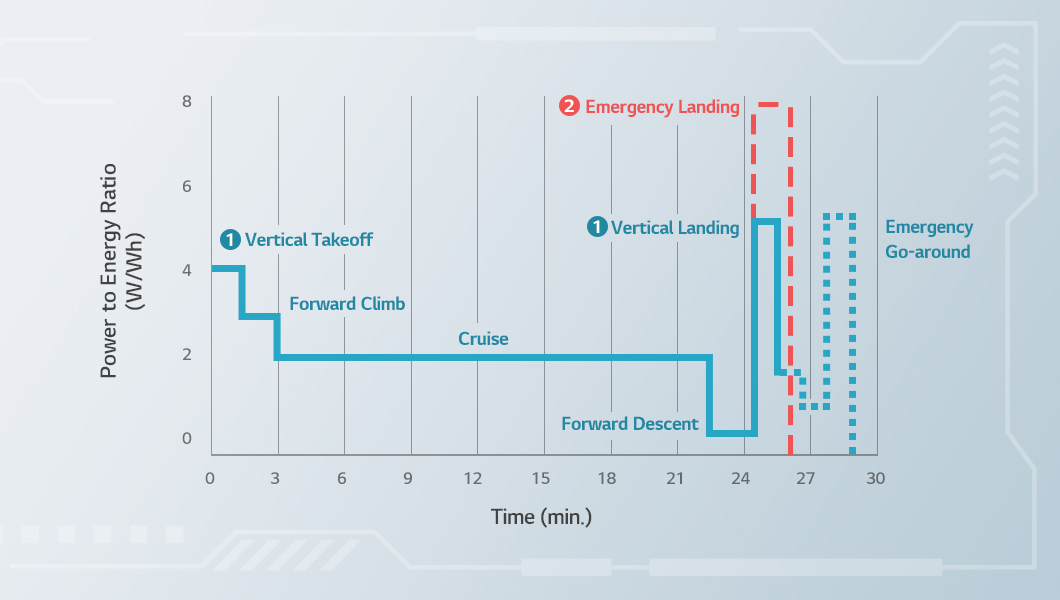
Unlike electric vehicles, which generally require relatively consistent power during normal driving, UAM aircraft experience significant variations in power demand across different phases of flight. In particular, vertical takeoff and landing require extremely high power output, while cruising requires comparatively less power.
High power output becomes even more critical during emergency situations. If a failure occurs in one battery pack, the remaining packs must temporarily increase their output to maintain stable flight and support a safe emergency landing. To prepare for these unforeseen situations, UAM batteries should be capable of delivering sufficient power output even at low State of Charge (SoC) and employ a battery architecture composed of multiple independent battery packs.
*View: Battery Glossary – State of Charge (SoC)
LG Energy Solution’s Battery Portfolio for UAM
LG Energy Solution is collaborating with global UAM companies while providing a range of battery solutions tailored to customers’ performance requirements. Because batteries for UAM applications must simultaneously deliver safety, energy density, and power output, the company works closely with customers to understand the intended application and performance requirements of the target aircraft, thereby providing the battery solution best suited to each application.
To address the diverse needs of the UAM market, LG Energy Solution offers a broad battery portfolio centered on cylindrical and pouch-type batteries optimized to balance safety, energy density, and power output across different applications.
Cylindrical batteries offer a high level of safety through their robust structure. Their cylindrical form factor, enclosed in a rigid metal case, provides excellent structural stability. One of LG Energy Solution’s flagship products is the H52A cylindrical battery, which delivers high power output and supports fast charging in approximately 15 minutes.
Pouch-type batteries deliver high gravimetric energy density thanks to their lightweight design and efficient use of space. LG Energy Solution’s pouch batteries achieve an energy density of approximately 300 Wh/kg. They also deliver high power output, enabling stable performance under the extremely demanding power conditions required for vertical takeoff, landing, and emergency operations.
*View: [Battery Pioneer] All-Solid-State Battery, the Ultimate Battery That Delivers Higher Safety and Density with Solid Electrolytes
*View: A Battery Without an Anode? LG Energy Solution’s Research on Combining Anodeless and Solid-State Batteries
Key Q&A
Q. What is UAM?
UAM is a next-generation transportation system that uses eVTOL and other advanced aircraft to transport passengers and cargo through low-altitude urban airspace.
Q. Why is battery technology important for UAM?
Because battery weight remains nearly constant throughout flight, UAM requires batteries that provide sufficient flight range, safety, and power output within a limited weight.
Q. What are the key performance requirements for UAM batteries?
Batteries for UAM applications must simultaneously deliver safety, high gravimetric energy density, and high power output.
Q. What battery solutions does LG Energy Solution offer for UAM?
LG Energy Solution offers battery solutions for the UAM market featuring both cylindrical and pouch-type batteries.
As UAM continues to emerge as a next-generation transportation solution, competition to develop the technologies needed for commercialization is accelerating. Turning urban air mobility into reality will require not only advances in aircraft technology but also ongoing innovation in battery technology to support safety, flight range, and power output.
Leveraging its world-class lithium-ion battery manufacturing capabilities, LG Energy Solution remains committed to addressing the evolving needs of the market. The company will continue expanding its battery technologies to support future mobility applications, including UAM.
- SNE Research. (2025). Technology Development and Market Outlook for Secondary Batteries for UAM/UAV (Drone) Applications ↩︎
- Vertiport: A terminal where vertical takeoff and landing aircraft take off, land, recharge, undergo maintenance, and board or disembark passengers. It is one of the core infrastructure elements supporting Urban Air Mobility (UAM). ↩︎