When you charge your smartphone or EV, can you use all of the energy that goes into the battery? The key lies in understanding the energy loss that occurs during charging and discharging. As energy is stored and then discharged, some of it can be converted into heat, reducing the amount of energy that’s actually usable.
The extent of this loss can vary depending on factors such as internal resistance, temperature, and charge and discharge rates. In addition, habits like charging only after a full discharge or keeping the battery close to 100% at all times can affect battery efficiency and lifespan over the long term.
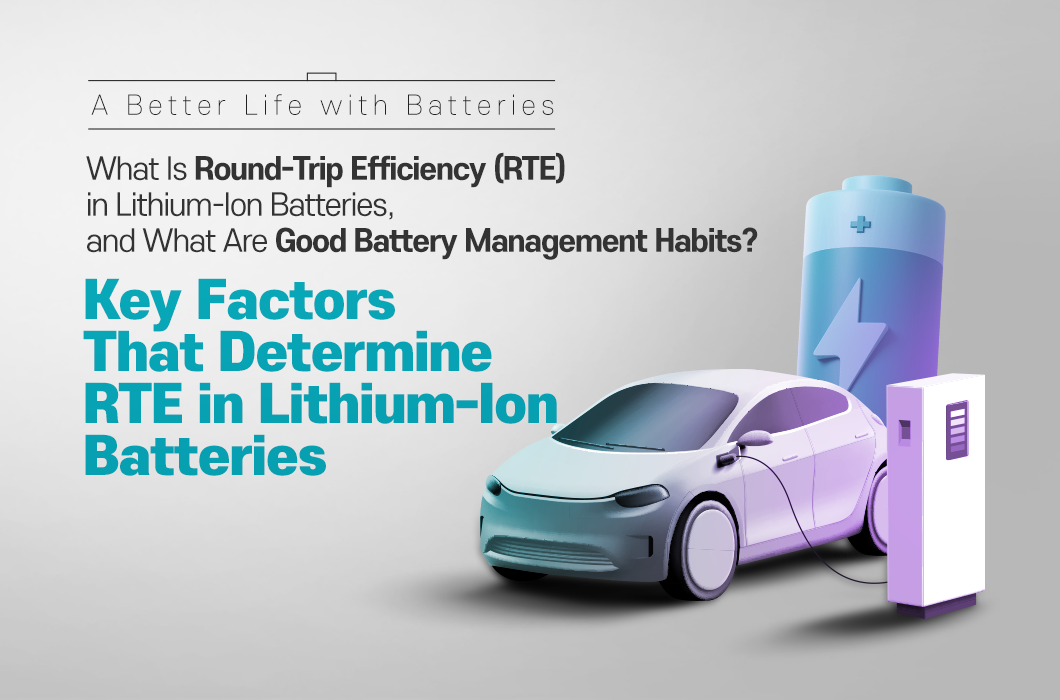
To understand this, it helps to take a closer look at round-trip efficiency. In this article, we’ll cover the round-trip efficiency of lithium-ion batteries and explore the conditions that affect battery efficiency and lifespan and good charging habits.
What Is Round-Trip Efficiency (RTE)?
Round-trip efficiency (RTE) is an indicator of how effectively energy is stored during charging and how much of that energy can be used during discharging.
It’s easy to assume that all the energy supplied to a lithium-ion battery during charging will be available for use, but that is not necessarily the case. During charging and discharging, some energy can be lost as heat due to factors such as internal resistance and temperature.
This means that a higher RTE indicates relatively lower energy loss and a higher proportion of stored energy that can actually be used. For this reason, RTE serves as an important benchmark for evaluating battery performance and energy utilization.
Key Factors That Determine Round-Trip Efficiency
The round-trip efficiency of a lithium-ion battery is not determined by a single factor. It’s shaped by both technical factors and real-world usage conditions.
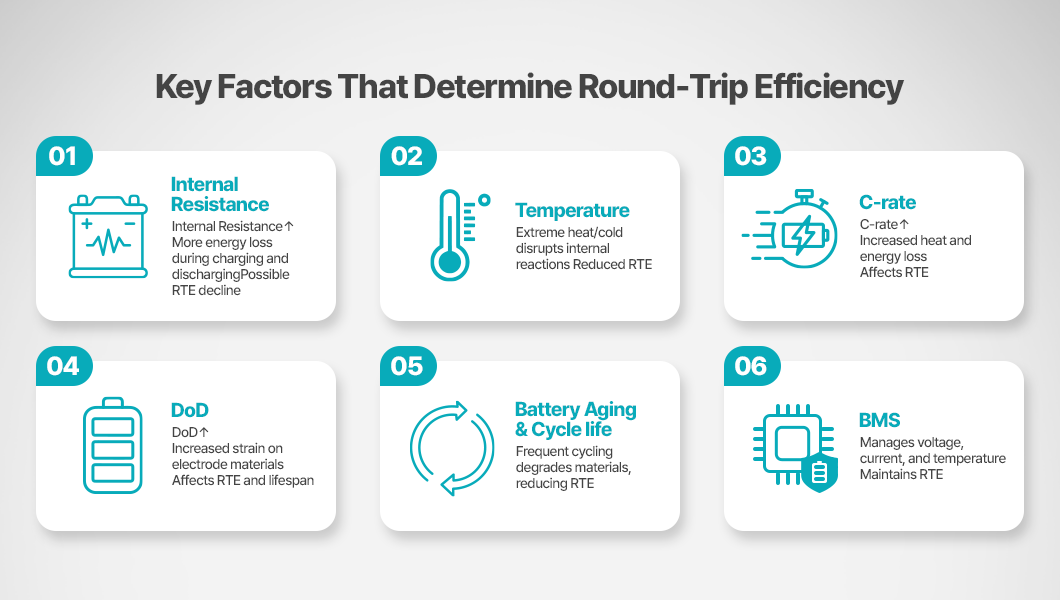
1. Internal Resistance: Internal resistance* is one of the key factors affecting RTE. It refers to the resistance encountered as current flows through the battery. The higher the internal resistance, the more likely some of the energy is to be converted into heat during charging and discharging. Conversely, lower internal resistance reduces energy loss and helps deliver the required power more efficiently.
*View: Battery Glossary – Internal Resistance
2. Temperature: Temperature also has a major impact on a lithium-ion battery’s RTE. At low temperatures, the electrolyte’s viscosity increases, which can slow lithium-ion transport. By contrast, at high temperatures, internal side reactions and material degradation can accelerate. For this reason, avoiding extremely low or high temperatures and using the battery within an appropriate temperature range helps maintain stable RTE.
3. Current Rate (C-rate): C-rate* is an indicator of how fast a battery charges or discharges. A high C-rate means a large amount of current flows in or out of the battery in a short period of time. As charging and discharging currents increase, greater stress is placed on the battery’s internal processes, which can lead to greater heat generation and energy loss. In other words, RTE can decrease when a large amount of power is drawn in a short time.
*View: Battery Glossary – C-rate (Current rate)
4. Depth of Discharge (DoD): DoD* indicates how much of a fully charged battery’s capacity has been used. For example, a DoD of 30% means 30% of the battery’s capacity has been used, while a DoD of 100% means the remaining capacity is 0%. A higher DoD means that more of the battery’s capacity is used in a single cycle, which can place added strain on the electrode materials. If such demanding usage patterns continue, they can affect both RTE and lifespan over the long term.
*View: Battery Glossary – DoD (Depth of Discharge)
5. Battery Aging and Cycle Life: As a lithium-ion battery goes through repeated charge and discharge cycles, internal materials such as the electrodes and electrolyte can gradually degrade. As these effects accumulate, energy loss during storage and use tends to increase, gradually lowering RTE.
This is closely related to the concept of cycle life, which refers to a battery’s ability to maintain its performance through repeated charging and discharging. As the number of cycles increases and the battery ages, its capacity and power output can change, which in turn affects RTE over the long term.
6. Battery Management System (BMS): The BMS* manages battery conditions to maintain efficiency and safety. It monitors the battery’s voltage, current, temperature, and state of charge and helps prevent the battery from operating under excessive stress. By precisely controlling the current flowing in and out of the battery and its operating conditions, the BMS helps reduce unnecessary energy loss and overheating, supporting stable RTE.
*View: Battery Glossary – BMS (Battery Management System)
Charging and Discharging Habits for Better Battery Performance
RTE is an indicator of how effectively stored energy can be used, and over the long term, it’s also closely related to battery lifespan. As internal resistance increases or materials degrade, the amount of usable energy can decrease even when the same amount of energy is charged. For this reason, not only understanding the conditions that affect efficiency but also developing good charging habits is important for reliable, long-term battery use.
Is It Better to Fully Discharge a Battery Before Charging?
Charging a lithium-ion battery while some capacity still remains is better for preserving battery lifespan than fully discharging it first. The reason has to do with DoD. A higher DoD means that more of the battery’s capacity is used in a single cycle, which can place a greater strain on its internal materials. Reducing the discharge range and charging more frequently is therefore more favorable for long-term battery use.
There is no need to periodically discharge a battery to 0% to extend its life. For smartphones, laptops, and EVs, charging before the battery level drops too low is a good habit.
Does Charging to 100% Reduce Battery Performance?
Charging a lithium-ion battery to 100% does not immediately reduce its performance. However, habitually keeping the battery close to 100% or repeatedly discharging it close to 0% can affect battery lifespan over the long term.
The key concept here is State of Charge (SoC)*, an indicator of the battery’s current charge level, expressed as a percentage such as 100%, 80%, or 20%.
| SoC Range | Cell State | Internal Battery Changes | Performance Impact |
|---|---|---|---|
| 80% to 100% | High-voltage state | Electrolyte oxidation, possible lithium plating | Difficulty maintaining capacity, safety concerns |
| 20% to 80% | Stable voltage and chemical reactions | Stable condition maintained | Efficient operating range, favorable for battery lifespan |
| 0% to <20% | Low-voltage state | Anode stability compromised | Increased internal resistance, possible capacity loss |
As SoC rises above 80% and approaches 100%, the battery cell is subjected to a higher voltage. If this condition is repeated excessively, unwanted chemical reactions inside the battery become more likely, including electrolyte oxidation and lithium plating, where lithium accumulates on the anode surface in metallic form. Over time, these changes can make it difficult for the battery to maintain its original capacity, which can also have implications for safety.
Similarly, frequently using the battery until its SoC drops to nearly 0% is not a good habit. Repeatedly operating the battery at a very low SoC can compromise anode stability and increase internal resistance. This reduces the efficiency of energy storage and use and can lead to permanent capacity loss over the long term.
For this reason, keeping the state of charge within a moderate range is advantageous for preserving battery lifespan. The commonly recommended “20–80% charging habit” means avoiding both discharging below 20% and fully charging to 100%. This keeps SoC within a relatively stable range, helping maintain stable voltage and chemical reactions for efficient battery operation.
Key Q&A
Q. What is Round-Trip Efficiency (RTE)?
RTE is an indicator of how much of the energy supplied to a battery during charging can be used during discharging. A higher RTE means less energy loss, including losses in the form of heat.
Q. What affects RTE?
The RTE of a lithium-ion battery is affected by internal resistance, temperature, C-rate, DoD, battery aging, and the BMS, among other factors. Energy loss can increase, particularly when internal resistance is high or the battery is exposed to unfavorable temperatures.
Q. Is it better to fully discharge a lithium-ion battery before charging?
Fully discharging a lithium-ion battery before charging is generally not beneficial for its lifespan. It’s better to charge the battery while it still has some capacity remaining rather than frequently allowing the battery level to drop to nearly 0%.
Q. Is it bad to charge a lithium-ion battery to 100%?
Charging to 100% does not immediately reduce performance. However, keeping the battery fully charged for extended periods can be unfavorable for its lifespan, so maintaining charge levels around 20–80% during everyday use is generally preferable.
RTE is an indicator of how much of a battery’s stored energy can be recovered. Even for the same lithium-ion battery, efficiency and lifespan can vary depending on a range of conditions.
To use a battery reliably over the long term, it is recommended to avoid fully discharging the battery or keeping it at 100% for extended periods. For everyday use, try to keep the battery within the 20–80% range and use it under appropriate conditions, charging it fully only when needed.