So far, the improvement in lithium-ion battery’s performance has been driven primarily by advancements in cathode materials. In contrast, anode materials have mostly been limited to graphite, with minor additions of silicon. Meanwhile, high-capacity cathode materials have continued to develop, and the capacity per unit mass of layered metal oxide-based materials is nearing the theoretical limit. This situation aligns with the market’s need for a higher energy density in batteries, drawing attention to anode material innovation as a new solution for enhancing the capacity.
*Curious about the layered structures? View (Infographic #14) cathode material structures here.
Besides graphite and silicon, “lithium metal” is also under research as an anode material. Lithium metal is currently applied to the anode in lithium metal batteries, which are often referred to as next-generation batteries. This time, let’s take a closer look at lithium metal batteries, one of the leading technologies among next-generation batteries.
What is a Lithium Metal Battery?
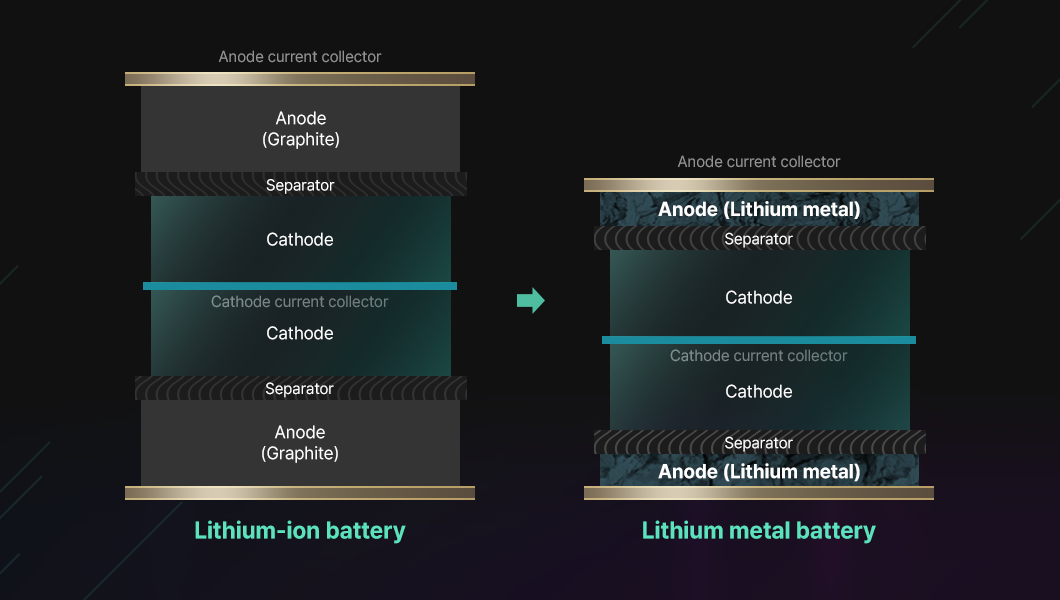
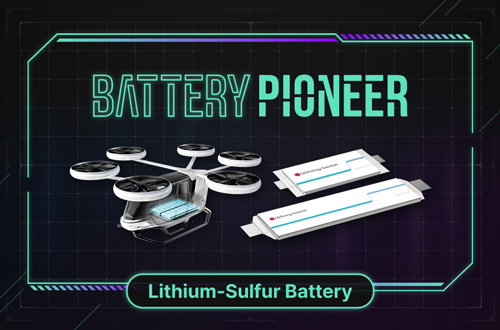
A lithium metal battery uses lithium metal for the anode, metal oxide-based materials (like the ones in lithium-ion batteries) for the cathode, and a liquid electrolyte. The lithium metal anode material is used for various next-generation batteries. A battery that has a cathode with a sulfur-carbon composite is a lithium-sulfur battery, and one containing oxygen as a cathode material is a lithium-air battery.
To trace the origins of lithium metal batteries, we need to go back to the 1970s. Professor Stanley Whittingham, a Nobel laureate in chemistry, developed a battery using titanium disulfide for the cathode and lithium metal for the anode. However, it was not commercialized due to safety concerns. Later, the Canadian company Moli Energy initiated commercialization efforts for lithium metal batteries. In 1988, Moli Energy developed “Molicel,” a rechargeable battery, using molybdenum disulfide for the cathode and lithium metal for the anode. Molicel was installed in mobile phones released by the Japanese telecom company NTT. Nevertheless, lithium-ion batteries, which were safer than the initial lithium metal batteries, eventually dominated the market.
Key Advantages of Lithium Metal Batteries
So, what makes lithium metal batteries one of the leading next-generation batteries?
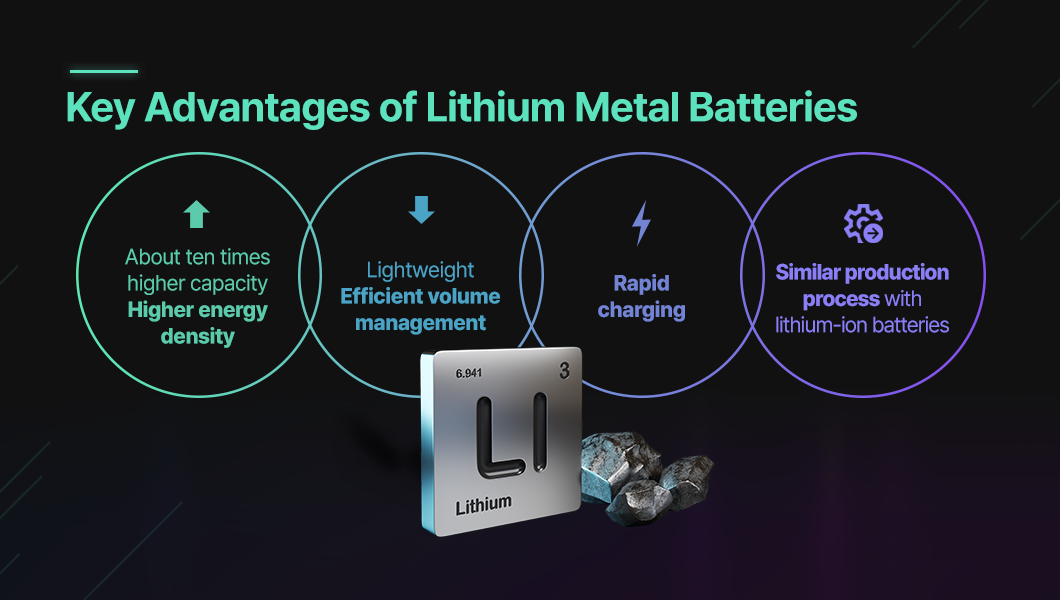
First, lithium metal batteries can achieve higher energy density than lithium-ion batteries that use graphite for the anode. Graphite has a relatively low theoretical capacity of 372mAh/g. In contrast, lithium metal has a theoretical capacity of 3,860mAh/g, which is over 10 times higher than that of graphite. Accordingly, lithium metal batteries can store significantly more energy for the same weight.
*Theoretical capacity: The maximum content of lithium ions that can be stored in an electrode material within the physical limit
Additionally, lithium metal batteries can reduce battery volume. Although lithium has a relatively large volume per unit mass (with the density of approximately 0.534g/cm³), it offers more than 10 times the capacity of graphite, allowing for a thinner anode. Therefore, the space can be utilized more efficiently, allowing storage of more electrical energy in the same space. This makes lithium metal batteries a suitable option for extending the operation time of battery-mounted devices or as an energy source for systems that consume a lot of power, such as autonomous vehicles.
Third, lithium metal batteries have the potential for faster charging than conventional lithium-ion batteries. In lithium-ion batteries, lithium ions are stored by intercalating into the layered structure of graphite during charging. However, in lithium metal batteries, lithium ions move to the anode and are directly reduced and electrodeposited onto the lithium metal surface, without needing to find spaces within the structure. This, theoretically, allows for faster charging.
Lastly, lithium metal batteries can be manufactured using liquid electrolyte, and therefore can be produced in a similar process with lithium-ion batteries. So, part of lithium-ion battery manufacturing equipment can be repurposed, and the production process can be optimized quickly. LG Energy Solution is focusing on these advantages of lithium metal batteries and is conducting extensive research to bring them to life.
“Dendrite,” the Obstacle to Overcome in Commercializing Lithium Metal Batteries
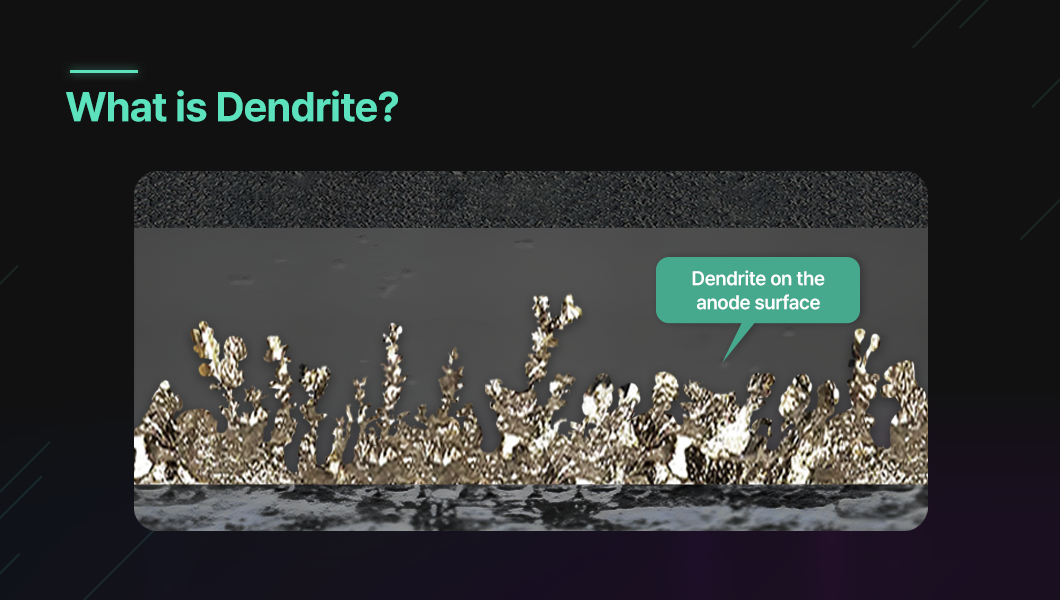
Despite its many advantages, lithium metal batteries face a key challenge for commercialization: dendrites.
Dendrites are tree-like lithium crystals that grow on the anode surface during charging. Their formation is closely related to the characteristics of lithium. When lithium is plated and accumulates on the anode surface, more lithium tends to build on top of the plated lithium metal particles, if there are some already. Then, instead of being plated uniformly across the entire electrode, lithium grows into a tree-like structure.
Dendrites could impact the lifespan and safety of the battery. As dendrites grow, they could damage the separator and extend to the cathode surface. When this happens, the cathode and anode can come into direct contact, causing an internal short circuit. Additionally, dendrites increase the surface area of the lithium electrode, which accelerates reactions with the electrolyte and leads to the corrosion of the lithium metal.
In lithium-ion batteries, a thin film called the Solid Electrolyte Interphase (SEI) forms on the surface of the graphite anode during the formation process. The SEI serves as a protective layer, allowing lithium ions to travel safely and preventing direct contact between the anode surface and the electrolyte. However, an uneven SEI formed due to dendrites compromises this protective layer, leading to reduced charge/discharge efficiency and diminished battery capacity.
LG Energy Solution’s Pursuit to Secure the Ultimate Anode Material: Committed to Developing Lithium Metal Batteries
LG Energy Solution swiftly embarked on research to overcome the challenges of lithium metal batteries and develop a high-performance lithium metal battery with advanced technology.
In 2013, LG Energy Solution began basic experiments as part of its innovative battery project to determine the right candidates for next-generation batteries. The lithium metal battery was selected as one. Requests of automotive manufacturers followed, and the battery was taken seriously from 2021.
As this was a highly difficult project, LG Energy Solution proactively sought diverse perspectives to find good ideas and build research capabilities. In 2021, the company established the Frontier Research Laboratory (FRL) with KAIST to develop source technology of lithium metal batteries, and in 2022, a new project team was formed to advance this research.
What are the unique features of LG Energy Solution’s lithium metal batteries? To maximize the advantage of high energy density of lithium metal batteries, LG Energy Solution is developing a lean electrolyte* system that minimizes the necessary amount of liquid electrolyte. The research team developed a borate-pyran-based electrolyte system in collaboration with KAIST. Their study led to a world-first discovery that restructuring the SEI layer improves stability and reduces electrolyte consumption, marking a step forward in realizing a lean electrolyte system.
*Lean Electrolyte: A system that uses a minimum amount of liquid electrolyte to maximize battery capacity.
LG Energy Solution’s Lithium Metal Battery Development Opens the Door to Fast Charging
Although dendrites have long been considered one of the key limitations of lithium metal batteries, LG Energy Solution has continued its efforts to overcome this challenge. In collaboration with the Frontier Research Laboratory (FRL) at KAIST, the company successfully developed a breakthrough core technology capable of dramatically improving charging speeds that had been limited by dendrite formation.
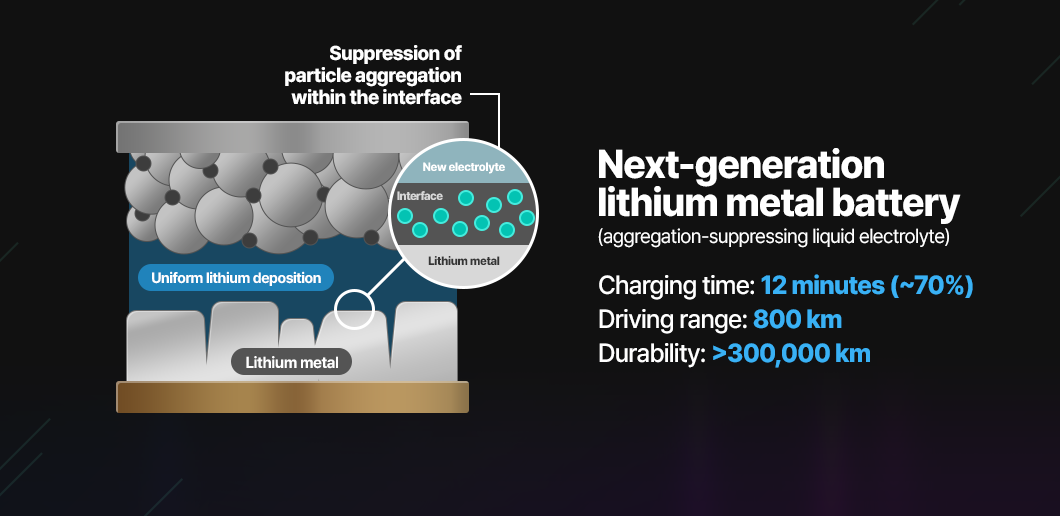
For years, lithium metal batteries have faced difficulties in securing both lifespan and safety due to dendrite growth. Under fast-charging conditions, dendrite formation becomes even more severe, increasing the risk of internal short circuits and creating significant barriers to commercialization. The research team identified the root cause of this phenomenon as non-uniform interfacial aggregation reactions on the lithium metal surface and became the first in the world to develop a novel liquid electrolyte capable of suppressing these reactions.
The newly developed electrolyte features an anion structure with weak binding affinity to lithium ions. This structure minimizes interfacial non-uniformity and effectively suppresses dendrite growth. As a result, it addresses the slow charging speeds that had long been considered a major limitation while enabling stable battery operation.
These research achievements also translated into improved performance. The technology demonstrated the potential for a driving range of more than 800 km on a single charge and a lifespan exceeding 300,000 km based on cumulative driving distance. Charging time was also reduced to just 12 minutes.
This study is a follow-up to LG Energy Solution’s 2023 research on lithium metal batteries based on a low-corrosivity borate-pyran liquid electrolyte. The achievement is particularly significant because it brings the commercialization of next-generation batteries one step closer by securing fast-charging technology, which had been regarded as one of the greatest challenges in the field. Going forward, LG Energy Solution plans to further strengthen industry-academia collaboration with leading universities in Korea and around the world while continuing to address key technical challenges in next-generation battery development.
So far, we have explored lithium metal batteries, one of the most promising next-generation battery technologies. As demand for high-performance batteries continues to grow, research into lithium metal batteries is also accelerating. LG Energy Solution remains committed to advancing research for commercialization. We look forward to LG Energy Solution’s continued efforts to secure next-generation technologies and advance battery innovation.