If you drive an EV, you have probably heard the advice to keep your battery charged between 20% and 80%. This is known as the “80/20 Rule.” But does staying within that range actually make an EV battery last longer?
The short answer: the exact numbers matter less than the principle behind them. What helps extend battery life is limiting how long a battery stays at very high or very low charge levels, and how often it is cycled at those extremes. So where did the 80/20 Rule come from, and how does charge level affect battery life? This article explains what the rule means, what drives battery degradation, and the technology used to manage it.
What Is the Battery 80/20 Rule?
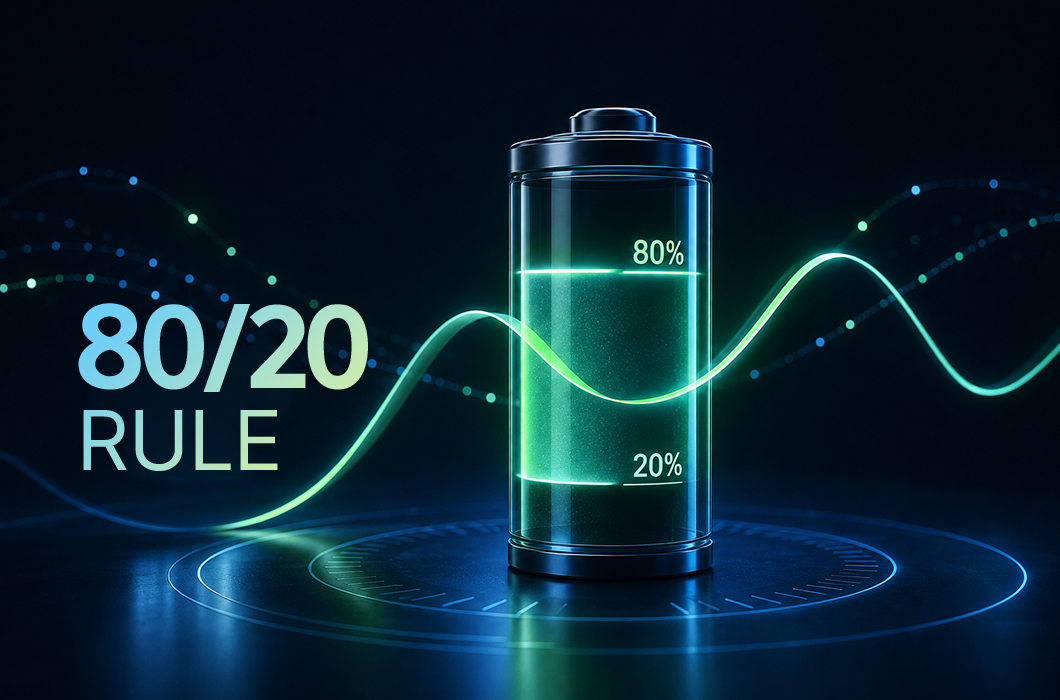
The 80/20 Rule is a charging practice that keeps a battery’s State of Charge (SoC)* between 20% and 80%, rather than leaving it at very high or very low levels for extended periods. SoC indicates a battery’s current charge level, expressed as a percentage of its total usable capacity.
The 80/20 Rule is not a universal formula. The appropriate charging range depends on battery chemistry, cell design, and operating conditions, so checking the vehicle manufacturer’s recommendations is important. The 80/20 Rule is best understood as a general guideline for charging and battery care rather than a strict rule.
Why Is the 20–80% Range Recommended?
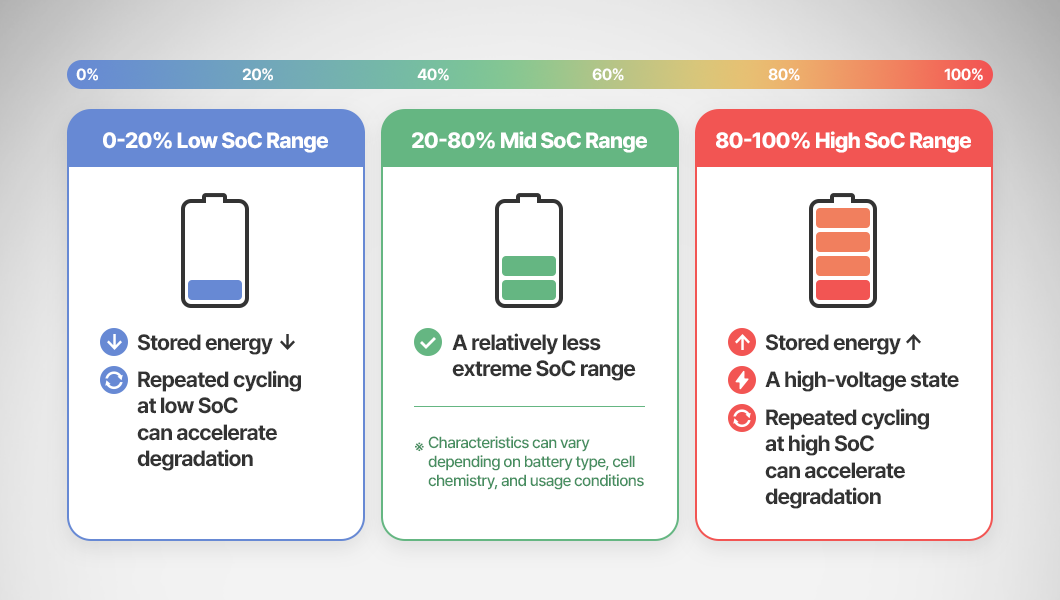
A battery’s SoC affects its internal electrochemical state and voltage, which in turn influences how the battery degrades. At high SoC, the higher voltage can reduce electrolyte stability and accelerate degradation. At low SoC, repeated charging and discharging can also speed up degradation, depending on the battery’s characteristics and operating conditions.
Research points to a similar trend. A 2024 study published in the Journal of Energy Storage analyzed how different SoC ranges affect degradation in 21700 lithium-ion cells. Cells repeatedly cycled at very high or very low SoC degraded faster than cells cycled in the mid-range. The fastest degradation occurred in cells cycled below 25% SoC, and degradation also tended to accelerate above 85% SoC.
A separate study on calendar aging, the degradation that occurs over time even when a battery is not in use, found that temperature and SoC both affect lithium loss and the decline in electrolyte conductivity.
These findings show that battery degradation is not determined by a single SoC value. Degradation depends on which SoC range a battery operates in and how the battery is used within that range.
Should You Charge Your EV to 100%?
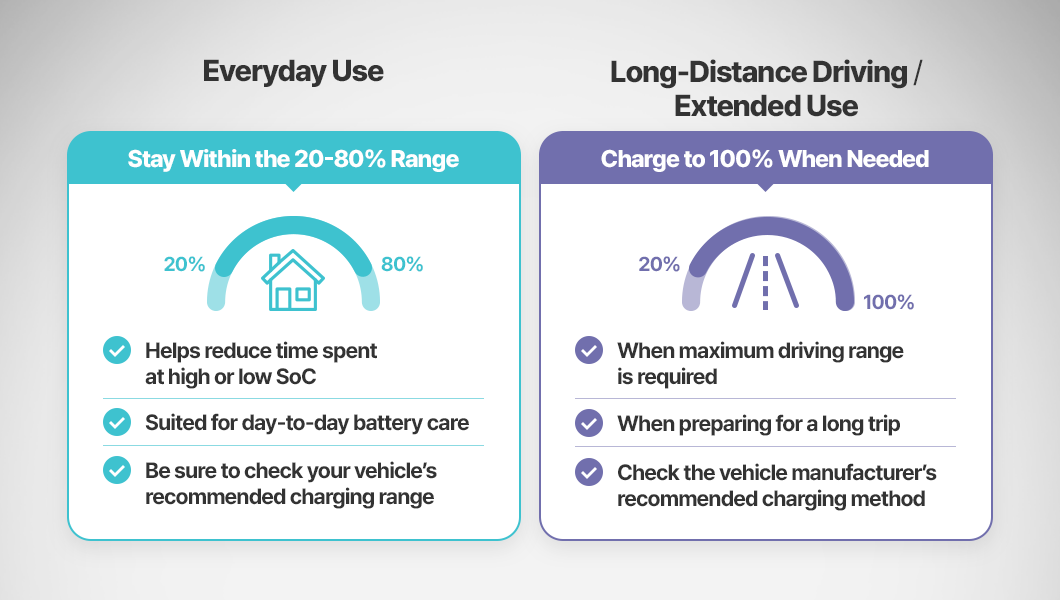
Charging an EV to 100% is not something to avoid altogether. When maximum usable capacity is needed, such as for a long-distance trip, a full charge may be necessary. The goal is not to avoid 100% charging, but to choose a charging approach that fits the battery’s characteristics and how the vehicle is used.
EV owner’s manuals may also give different charging guidance depending on battery type. Some recommend charging to 80% for everyday use, while others recommend charging to 100% at regular intervals. No single charging standard applies to every EV battery, which is why battery characteristics and each vehicle’s recommendations should be taken into account.
What Factors Affect EV Battery Life?
EV battery life depends not only on SoC but on a range of operating and environmental conditions, including depth of discharge (DoD), charge/discharge rate (C-rate), temperature, and usage patterns. Here is how each factor relates to battery life.
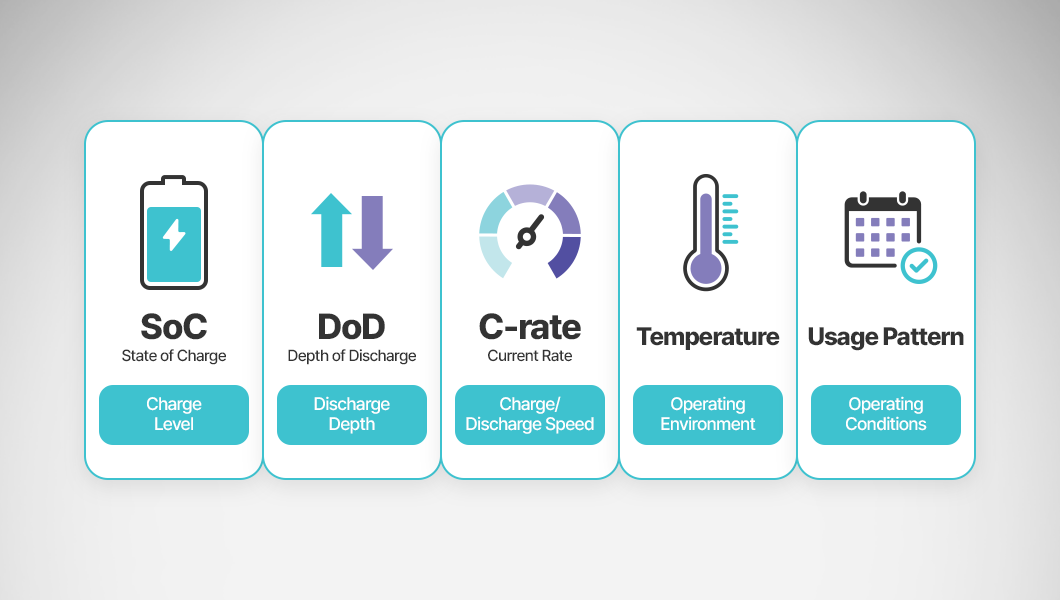
① State of Charge (SoC): A battery’s current charge level. Which SoC range a battery stays in, and for how long, can affect how it degrades.
② Depth of Discharge (DoD): How much of a battery’s capacity is used in a single charge/discharge cycle. DoD determines the range over which the battery is cycled, which can also influence degradation.
③ C-rate: The speed at which a battery charges or discharges. Changes in C-rate alter internal electrochemical reactions and heat generation, both of which can influence degradation.
④ Temperature: A key environmental factor in battery life. High temperatures can promote unwanted side reactions inside the battery, while low temperatures slow lithium-ion transport and electrode reactions, which can accelerate degradation depending on charging conditions.
⑤ Usage Patterns: How a vehicle is driven and charged. Driving and charging habits change the SoC range, DoD, and C-rate a battery experiences, and these conditions combine to shape its degradation.
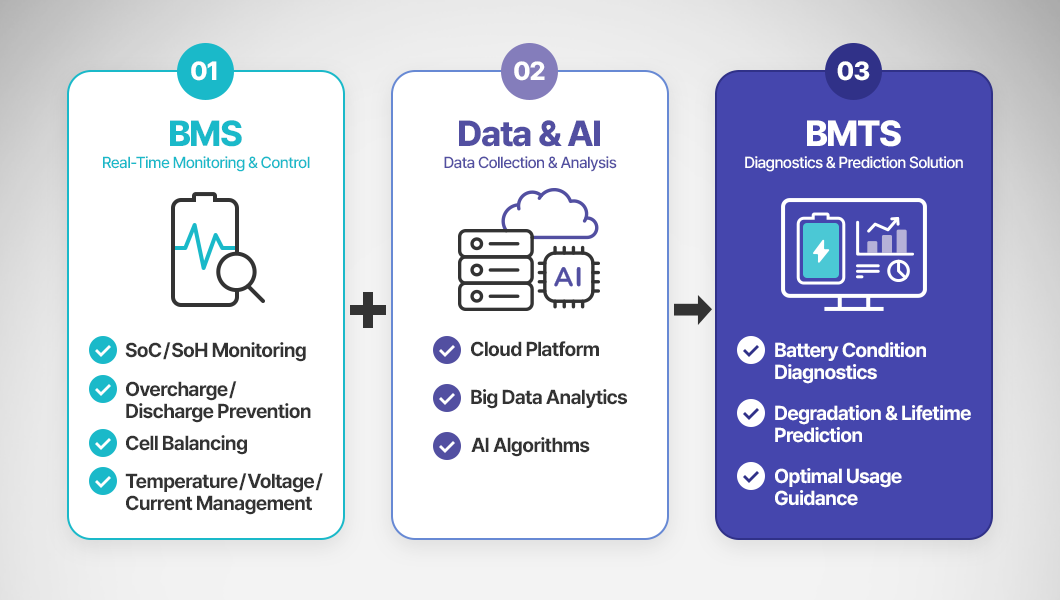
Because these factors interact, technology that continuously monitors battery condition and controls it appropriately plays an important role. A representative example is the Battery Management System (BMS). A BMS monitors voltage, current, and temperature, and estimates State of Charge (SoC) and State of Health (SoH). A BMS also performs cell balancing and protects against overcharging, overdischarging, and overcurrent, helping the battery operate safely and efficiently.
LG Energy Solution’s Total Battery Solution
LG Energy Solution has expanded battery management beyond the BMS with its Battery Management Total Solution (BMTS), which combines BMS with cloud connectivity and AI and machine learning-based software. BMTS is an integrated solution covering the full battery lifecycle, from condition monitoring to safety diagnostics and degradation and lifetime prediction.
In September 2024, LG Energy Solution launched B.around, its brand for BMTS services. B.around provides information such as State of Health (SoH), Remaining Useful Life (RUL), and safety diagnostics based on battery condition data, and supports systematic lifecycle management using accumulated condition history and performance data.
Battery management is moving beyond keeping a battery within a set charging range. It is expanding toward data-driven approaches that diagnose battery condition and usage environment and predict degradation and remaining life.
Key Q&A
Q. What is the battery 80/20 Rule?
The 80/20 Rule is a charging practice that keeps a battery’s State of Charge (SoC) mainly between 20% and 80%, rather than leaving it at very high or very low levels for extended periods.
Q. Does the 80/20 Rule apply to every battery?
Not exactly. The 80/20 Rule is not a universal rule. The appropriate charging method depends on battery chemistry, cell design, operating conditions, and manufacturer recommendations. Rather than applying the 20–80% range to every battery, charging should reflect each battery’s characteristics and how it is used.
Q. Is it bad to charge to 100%?
Not necessarily. A full charge may be necessary when maximum usable capacity is needed, such as for long-distance driving. The key is to avoid keeping the battery at high SoC for unnecessarily long periods. Because recommendations vary by battery and vehicle, drivers should check the manufacturer’s guidance.
Q. How should you charge an EV to maintain long-term battery health?
Rather than applying one fixed SoC range to every battery, charge in a way that fits the battery’s characteristics and how the vehicle is used. For everyday driving, minimize extended time at high or low SoC. For long trips, charge as much as needed and follow the vehicle manufacturer’s recommended charging method.
Q. How are battery life and performance managed?
The Battery Management System (BMS) plays a central role, continuously monitoring voltage, current, and temperature, estimating SoC and SoH, and controlling charging, discharging, and cell balancing.
LG Energy Solution takes this further with Battery Management Total Solution (BMTS), combining BMS with cloud connectivity and AI/machine learning-based software to deliver comprehensive condition monitoring, safety diagnostics, and degradation and lifetime prediction.
Battery life and performance are not determined by a single charging range. They are shaped by a combination of factors, including SoC, temperature, and charge/discharge conditions.
LG Energy Solution continues to advance battery management technology through BMTS, diagnosing battery condition and predicting degradation and remaining life. In the end, what matters is not the “20–80%” figure itself, but managing a battery in a way that fits its characteristics and how it is used.