Active materials alone are not enough to make battery electrodes. They also require conductive additives, which help electrons move efficiently throughout the electrode. Although only a small amount is added, conductive additives play a critical role in determining charging performance and energy efficiency.
Among the various conductive additives available today, one material has been drawing particular attention in the battery industry: carbon nanotube (CNT) conductive additives. CNT conductive additives can form conductive pathways even in small quantities, making them a key material for improving battery performance.

This time, we’ll explore what conductive additives are in greater detail and why CNT conductive additives are becoming an essential material for both cathodes and anodes.
View: A Better Life with Batteries – How to Make a Battery Step.1 Electrode Manufacturing: Mixing
What is Conductive Additive?
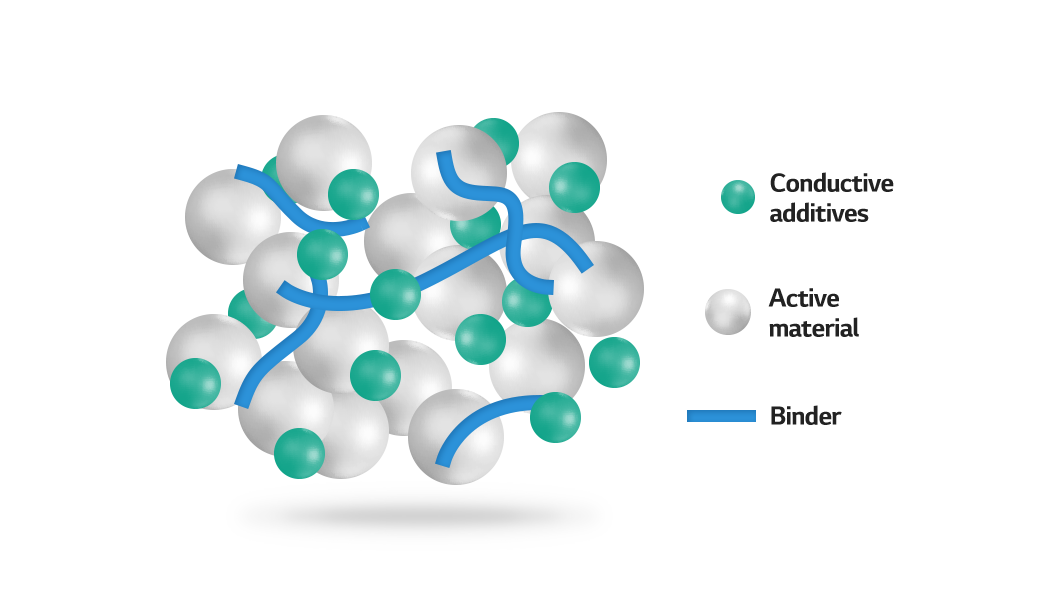
A conductive additive is a conductive material added to battery electrodes to promote electron movement between active materials within the electrode. It serves to connect cathode and anode active materials, giving the electrode electrical properties. Although only a small amount is added to the electrode, it is a critical material that helps reduce the battery’s internal resistance and improve battery performance.
What Is a CNT Conductive Additive?

CNT (Carbon Nanotube) conductive additives are gaining attention as a key material in the battery industry. Compared with carbon black conductive additives, CNT conductive additives can create stronger pathways for electron movement while using a smaller amount of material. In fact, they can deliver similar conductive performance with only about 20% of the amount of conventional carbon black.
Structure and Properties of CNT Conductive Additives

CNT conductive additives are made by rolling layers of graphene, in which six carbon atoms are arranged in a hexagonal pattern, into a tubular structure. As a result, they have a tube-shaped structure with a diameter of approximately 1 nanometer. In addition, CNT conductive additives have mechanical strength about 100 times greater than steel, while their electrical conductivity is comparable to that of copper. Although their diameter is only about one hundred-thousandth the width of a human hair, they simultaneously possess outstanding mechanical and electrical properties.
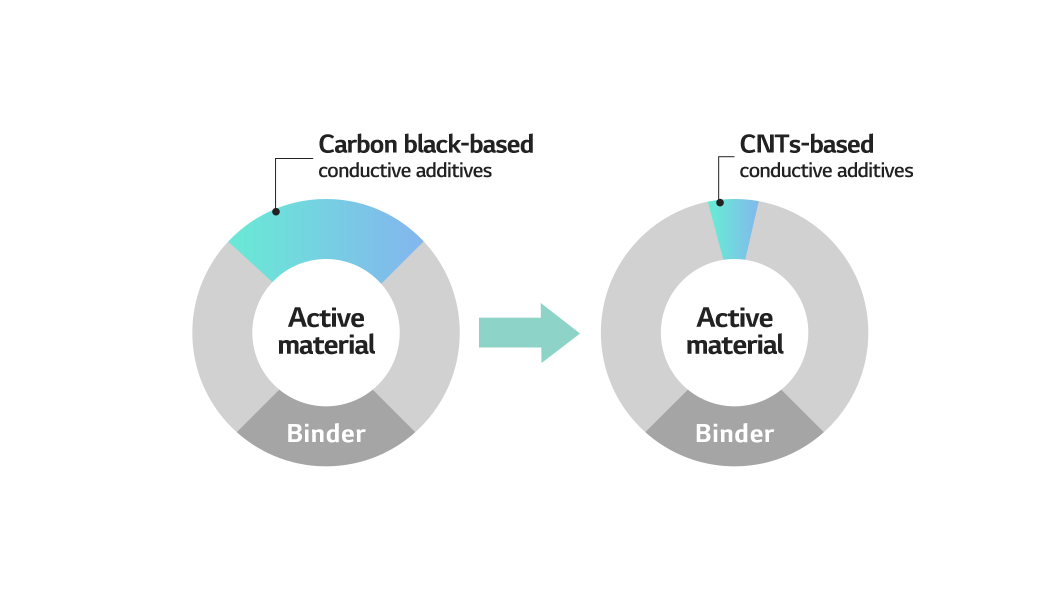
As discussed earlier, applying CNT conductive additives to cathodes can reduce the amount of conductive additive required to about 20% of that needed when using conventional carbon black. The space saved by using less conductive additive can then be filled with more active material, increasing the battery’s energy density. In addition, when CNT conductive additives are used in cathodes, they can achieve electrical conductivity that is more than 10% higher than that of conventional carbon black.
Types of CNTs: Multi-Walled Carbon Nanotubes (MWCNTs) and Single-Walled Carbon Nanotubes (SWCNTs)

CNT conductive additives can be classified into two types based on the number of graphene layers that make up their tubular structure: Multi-Walled Carbon Nanotubes (MWCNTs) and Single-Walled Carbon Nanotubes (SWCNTs).
Multi-Walled Carbon Nanotube (MWCNT)
- Multiple layers of graphene
- Thick and mechanically robust
- Relatively high thermal conductivity
Single-Walled Carbon Nanotube (SWCNT)
- Single-layer graphene structure
- Excellent flexibility and electrical conductivity
- Well suited for silicon anodes
Why are CNT Conductive Additives Needed for Silicon Anodes?
Graphite anodes have inherently high electrical conductivity, making them less dependent on conductive additives. However, as silicon anodes have been developed to increase battery energy density, the importance of CNT conductive additives has become increasingly apparent.
Silicon expands in volume as it reacts with lithium ions during charging and discharging. CNT conductive additives help support the structure and prevent it from breaking down during this process. As a result, using CNT conductive additives together with silicon anodes helps prevent silicon particles from fracturing, improves electrical conductivity, enhances battery lifespan, and enables faster charging.
In other words, CNT conductive additives provide an effective solution for overcoming the limitations of silicon anodes.
What Is the Outlook for the CNT Conductive Additives Market?

According to SNE Research, the market for conductive additives used in rechargeable batteries is expected to grow from approximately KRW 650 billion in 2021 to KRW 1.78 trillion in 2025 and KRW 3.07 trillion by 2035, representing a compound annual growth rate (CAGR) of 11.7%.1
Particularly noteworthy is the market outlook by CNT type. Between 2025 and 2035, demand for MWCNTs is projected to increase by approximately threefold, while demand for SWCNTs is expected to surge by approximately 300 times. During the same period, the MWCNT market is forecast to grow from KRW 960 billion to KRW 1.87 trillion, while the SWCNT market is projected to expand dramatically from KRW 50 billion to KRW 930 billion.2
Key Q&A
Q. What is a conductive additive?
A conductive additive is a conductive material that facilitates electron movement within an electrode.
Q. What is the difference between CNT and carbon black?
CNTs form a linear conductive network, allowing them to achieve high conductivity with a smaller amount of material.
Q. Why are CNT conductive additives needed for silicon anodes?
They help accommodate volume expansion, maintain conductivity, and improve battery lifespan.
Q. What is the difference between MWCNTs and SWCNTs?
MWCNTs feature a multilayer structure that forms a stable conductive network, making them well suited for large-scale use in cathodes. In contrast, SWCNTs have a single-layer structure with superior flexibility and conductivity, making them effective at mitigating volume expansion in silicon anodes.
Small in size but powerful in performance, CNT conductive additives are a key material for improving batteries. In cathodes, they help increase energy density, while in anodes, they compensate for the structural limitations of silicon and enhance overall battery performance and lifespan. As EV battery technology continues to evolve, CNT conductive additives are expected to play an even greater role in the industry. It will be exciting to see how this material continues to shape the future of batteries.