The moment you turn on your smartphone or drive an electric vehicle, countless invisible particles begin moving inside the battery. But how does the movement of electrons and lithium ions create electric current? Let’s take a closer look at what happens inside a battery, step by step.

Simply put, a battery converts the flow of electrons generated by redox reactions into electrical energy. To understand how this process works, we first need to look at the battery’s key components.
STEP 0. Battery Fundamentals
A lithium-ion battery consists of four key components:
● Cathode: The electrode that accepts lithium ions during discharge
● Anode: The electrode that releases lithium ions during discharge
● Electrolyte: The medium that allows lithium ions to move between the two electrodes
● Separator: The insulating layer that prevents the cathode and anode from coming into direct contact
A battery does not store electricity itself. Instead, it stores chemical energy and converts it into electrical energy when needed.
The fundamental electrochemical reactions that occur in a battery are oxidation and reduction.
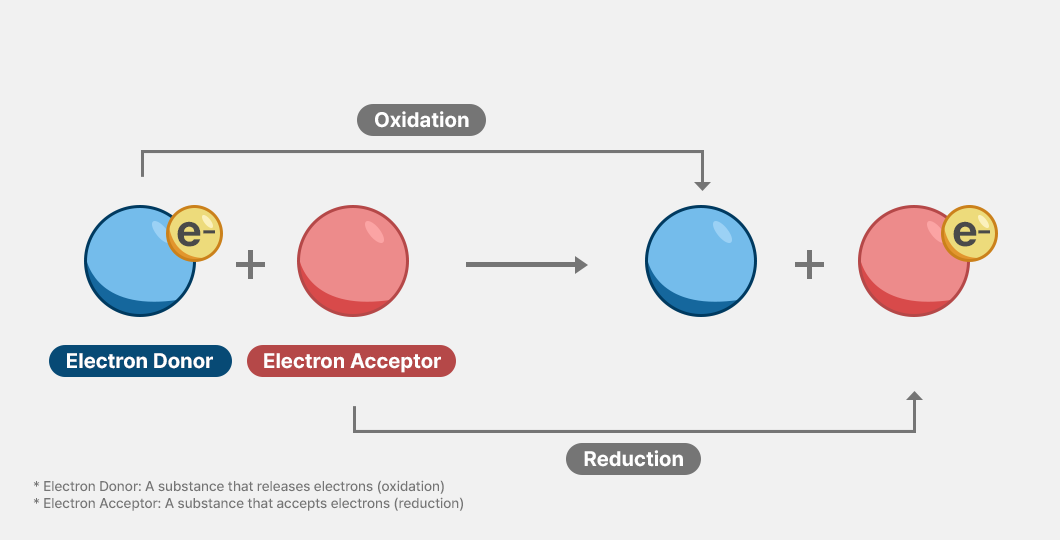
● Oxidation: Loss of electrons
● Reduction: Gain of electrons
An atom consists of a nucleus surrounded by electrons. When electrons leave an atom and begin to flow, an electric current is generated. During battery discharge, a reduction reaction occurs at the cathode, while an oxidation reaction occurs at the anode. These reactions always occur simultaneously because every electron released during oxidation must be accepted by reduction. Together, they are known as a redox reaction.
STEP 1. Potential Difference: The Driving Force Behind Electric Current
What causes electrons to flow? It is the potential difference that forms between the cathode and anode.
Potential refers to the electrical potential energy of a unit charge within an electric field and is measured in volts (V). In general, charge moves from a region of higher potential to a region of lower potential. The greater the potential difference between two points, the greater the force driving the movement of charge. When this potential difference exists between two electrodes, charge begins to flow, creating an electric current. This potential difference is what we commonly refer to as voltage (V).
The value used to compare electrode potentials is called the standard reduction potential, which is measured relative to the hydrogen/hydrogen ion reaction defined as 0 V. Under standard conditions, a substance with a more positive standard reduction potential is more readily reduced than hydrogen, while one with a more negative value indicates that it is more readily oxidized by releasing electrons. For example, lithium has a standard reduction potential of −3.04 V, making it highly susceptible to oxidation.
STEP 2. Oxidation at the Anode
However, even when a potential difference exists, electric current cannot flow unless there is a path through which electrons can move. Once the battery is connected to an external circuit, electrons begin to flow and initiate electrochemical reactions.
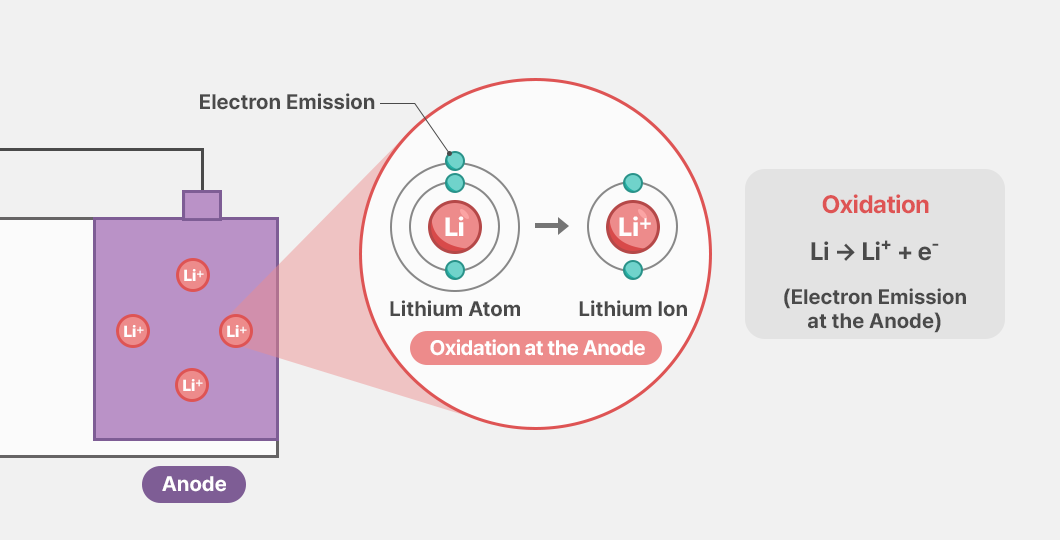
At the anode, lithium undergoes oxidation through the following reaction.
● Li → Li⁺ + e⁻
Lithium stored in the anode loses electrons and produces lithium ions (Li⁺) and electrons (e⁻). This is the point where lithium ions and electrons separate, marking the beginning of electric current.
STEP 3. The Movement of Lithium Ions and Electrons Toward the Cathode
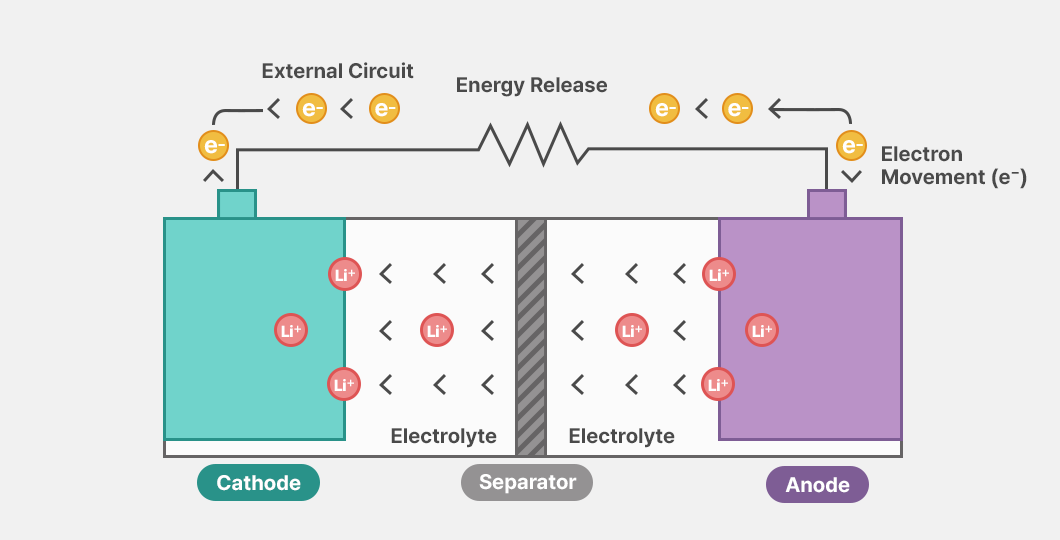
Lithium ions and electrons separated at the anode each move toward the cathode, creating a continuous flow inside and outside the battery.
Electrons travel through the external circuit, generating an electric current that is delivered to a device and used as electrical energy. In other words, the movement of electrons is not simply the movement of particles—it is the process by which electrical energy is transferred.
Meanwhile, lithium ions move through the electrolyte, maintaining electrical balance between the electrodes. The electrochemical reaction can continue only when both electrons and lithium ions move simultaneously.
During this process, the separator blocks the internal movement of electrons, ensuring that current flows through the external circuit. Otherwise, electrons could travel directly through the battery, which would result in a short circuit.
STEP 4. Reduction at the Cathode
Electrons traveling through the external circuit and lithium ions moving through the electrolyte meet again at the cathode. Lithium ions are inserted into the cathode structure, while electrons also enter the cathode. At this stage, the transition metal accepts electrons and undergoes reduction.
For example, in LFP cathode materials, iron (Fe) accepts electrons and undergoes reduction, while in NCM and NCA cathode materials, nickel (Ni) primarily plays this role.
The insertion of lithium ions and electrons proceeds as a continuous reaction, with electrons acting as charge carriers throughout the process. As long as these electrochemical reactions continue, electrons keep flowing through the external circuit, maintaining the electric current.
STEP 5. Charging: Reversing the Reaction
The process in which electrons flow through the external circuit and are continuously accepted by the cathode is called discharge. Because discharge proceeds toward a lower-energy state, it occurs spontaneously.
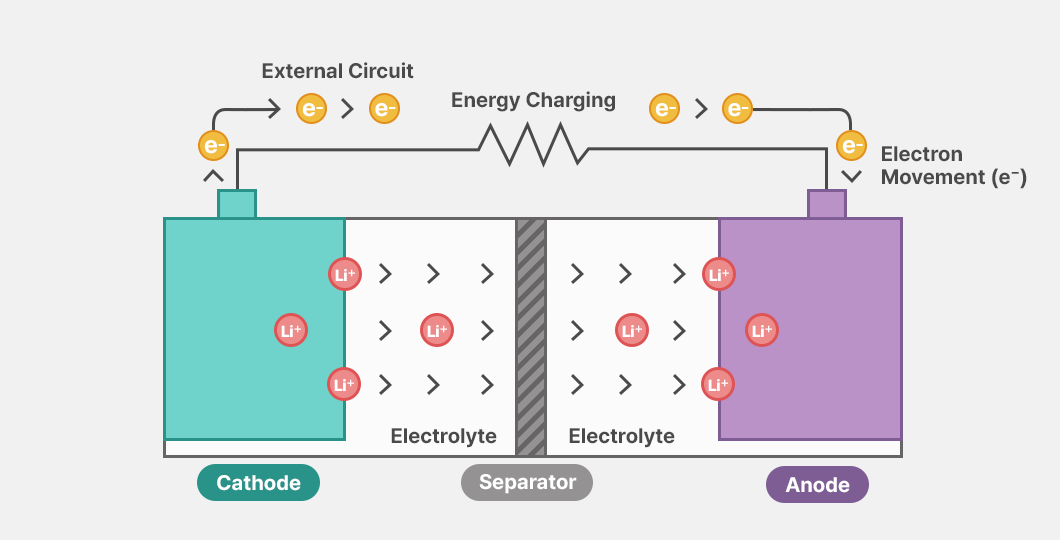
In contrast, charging reverses this process by supplying external energy. During charging, the electric field created by the applied voltage drives the electrochemical reactions in the opposite direction, causing lithium ions to move back to the anode. At the same time, electrons are supplied to the anode through an external power source, while lithium ions move through the electrolyte and are reinserted into the anode.
In other words, charging is a non-spontaneous electrochemical process driven by an externally applied voltage.
Key Q&A
Q. Does a battery store electricity?
A battery does not store electricity itself. Instead, it is an electrochemical system that converts electrical energy into chemical energy for storage, then converts it back into electrical energy when needed.
Q. How is electric current generated in a battery?
At the anode, electrons are released through an oxidation reaction. These electrons travel through the external circuit, generating an electric current. At the same time, lithium ions move through the electrolyte to the cathode, where a reduction reaction occurs, allowing the electrochemical process to continue.
Q. Why do lithium ions and electrons move along different paths?
Lithium ions move through the electrolyte, while the separator prevents electrons from passing through the battery’s interior, forcing them into the external circuit. As a result, electrons flow through the external circuit, generating an electric current.
Q. What happens inside a battery during charging?
During charging, the discharge process is reversed by an applied external voltage. Electrons are supplied to the anode through an external power source, while lithium ions move through the electrolyte back to the anode, where they are stored once again.
The operating principle of a lithium-ion battery is a continuous flow in which electrons move through the external circuit, lithium ions move through the electrolyte, and electrochemical reactions occur at the electrodes. As this process continues, electric current is generated, powering electronic devices.
A battery is not simply a device that stores electricity; it is a system that generates electricity through electrochemical reactions. Understanding how a battery works lies in recognizing this continuous flow. When learning about batteries, pay close attention to how electrons and lithium ions move, and how the reactions at the electrodes work together.