One of the key factors that determines battery lifespan is electrolyte stability. During battery operation, the electrolyte is continuously exposed to oxidation and reduction reactions on the surface of the electrodes. This process generates gas, and when gas accumulates, it can affect battery durability.
In response, LG Energy Solution developed a gas-free solvent by redesigning the solvent structure itself, which is the root cause of gas generation, ahead of others in the industry. In this session, we spoke with Jeongmin Lee from the Electrolyte Team 1 to learn more about the background and competitiveness of this technology.
*View: Electrolytes for Lithium Ions Transport
Why does gas form in batteries?
The electrolyte in currently commercialized lithium-ion batteries is a liquid electrolyte composed of organic solvents, lithium salts, and a small amount of additives. The electrolyte serves as a medium that enables lithium ions to move between the cathode and anode during charge and discharge. For this reason, it comes into direct contact with both electrode surfaces.
When a battery is charged, electrochemical reactions occur, with oxidation at the cathode and reduction at the anode. During this process, the electrolyte is continuously exposed to electrochemical reactions at the electrode interface, but it is designed to operate stably within the potential window1.
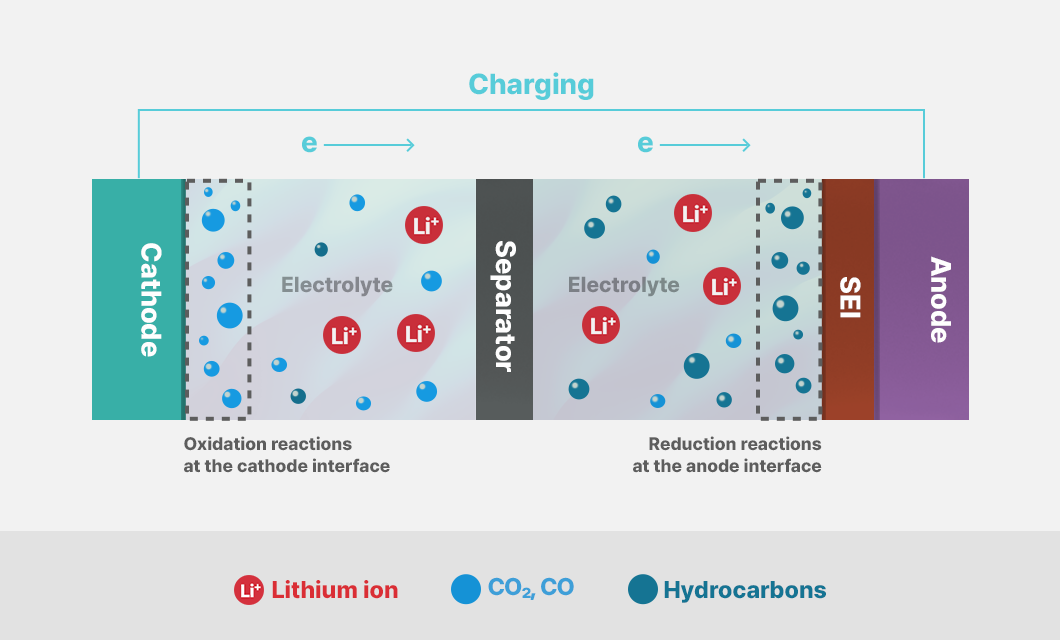
However, under high voltage and high temperature conditions, or when highly reactive electrode materials are used, the electrolyte operates outside the potential window. In this state, oxidation and reduction reactions at the cathode and anode interfaces become more active, and the organic solvent decomposes, with some of it converting into gas. As a result, carbon dioxide (CO₂) and carbon monoxide (CO) are mainly produced at the cathode interface, while hydrocarbon gases are primarily formed at the anode interface.
In addition, reactions of lithium salts in the electrolyte also contribute to gas generation. Lithium hexafluorophosphate (LiPF₆), one of the most commonly used lithium salts, reacts with trace amounts of moisture to produce hydrofluoric acid (HF). Due to its high acidity, it further attacks the electrode surface and electrolyte, promoting decomposition reactions. As a result, the generated hydrofluoric acid can secondarily attack organic solvents, leading to additional electrolyte decomposition and gas generation.
As electrolyte decomposition continues, gas accumulates, which can increase internal resistance and swelling, affecting long-term durability.
What is a gas-free solvent?
Electrolyte decomposition and gas generation are structural challenges that can occur during battery operation, and the battery industry has long discussed ways to address them. Recently, gas-free solvents, a new type of electrolyte solvent developed to overcome issues caused by electrolyte side reactions, have been gaining attention.
Until now, the industry has relied on carbonate-based organic solvents along with cathode additives such as PS (Propane Sultone) or anode additives such as VC (Vinylene Carbonate) to protect electrode interfaces and reduce gas. These approaches have been effective in delaying solvent decomposition and suppressing side reactions.
Despite these efforts, gas-free solvents are being further studied. The reason lies in the ratio of solvents and additives. Additives account for only about 0.5 to 5 % of the total electrolyte composition, while organic solvents make up approximately 80 %. If additives are gradually consumed under high voltage, high temperature, or long-term operating conditions, solvent—which makes up the majority of the electrolyte—can again undergo active decomposition. Hence the need for new solutions such as gas-free solvents.
LG Energy Solution’s gas-free solvent with a fundamentally different structure
In line with this trend, LG Energy Solution has been researching gas-free solvents through an approach not previously attempted in the industry: increasing the stability of the solvent structure itself. As a result, the company developed a completely new solvent structure that differs from conventional carbonate-based solvents.

In this session, we are joined by Jeongmin Lee from Electrolyte Team 1, who is leading gas-free solvent research, to gain deeper insight into the technology.
Q. What is LG Energy Solution’s gas-free solvent?
Carbonate-based solvents consist of carbonate groups and alkyl groups. The carbonate group can easily convert into gases such as carbon dioxide and carbon monoxide when electrochemically decomposed, while alkyl groups can produce hydrocarbon gases under reductive conditions. In other words, their structures inherently contain elements that can generate gas.
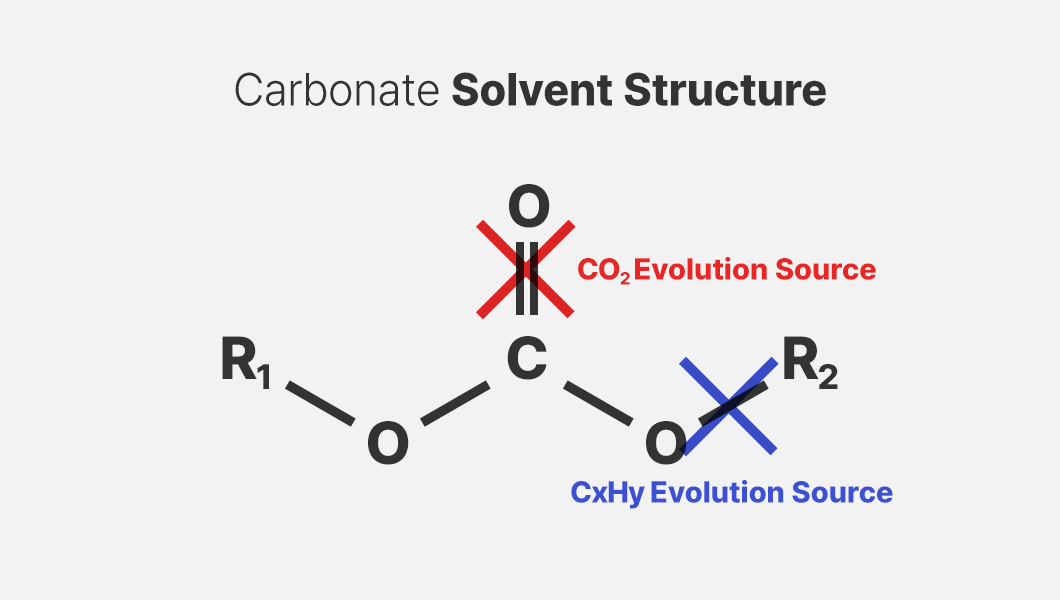
LG Energy Solution’s gas-free solvent departs from conventional carbonate systems and is characterized by a fundamentally redesigned structure. Inspired by the anion of LiFSI (Lithium Bis(fluorosulfonyl)imide), which has been used as a salt in conventional electrolytes, the company developed a stable structure that does not easily decompose. This structure is designed to improve oxidation stability while forming a durable SEI (Solid Electrolyte Interphase) layer during decomposition.
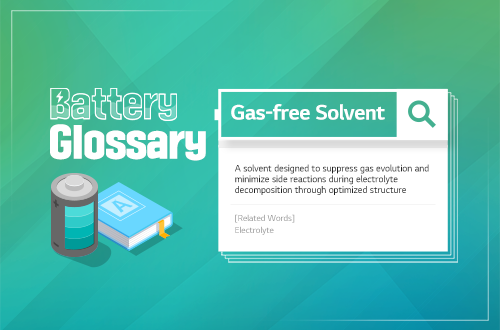
*View: Battery Glossary – SEI (Solid Electrolyte Interphase)
Q. What led LG Energy Solution to develop a gas-free solvent with a different structure?
Conventional carbonate-based electrolytes combined with additives have been stably used in commercial applications. However, as the importance of energy density continues to increase in the battery industry, customer requirements are also rapidly evolving, which served as the driving force behind this research.
To improve energy density, high-nickel cathodes are being increasingly adopted, while research on next-generation materials such as silicon anodes is actively advancing. These material changes make reactions at the electrode interface more complex and can increase the likelihood of electrolyte decomposition.
Accordingly, beyond simply increasing voltage, the diversification and advancement of materials have expanded the role and demands placed on the electrolyte. In response, LG Energy Solution chose to redesign the solvent structure itself rather than simply supplementing existing electrolytes, to ensure long-term stability even in next-generation battery environments.
*View: (Infographics #20) Silicon Anode Materials_Silicon Oxide & Silicon-Carbon Composite
Q. How did the development of gas-free solvents progress?

Much research has focused on controlling solvent decomposition through additives, and LG Energy Solution has also accumulated related technologies and patents in this area.
However, the development of gas-free solvents started from a different perspective. While additive research focuses on adjusting or supplementing existing systems, developing a new solvent structure is equivalent to redesigning all elements of the battery.
One of the biggest challenges was accounting for numerous side-reaction variables simultaneously. Since oxidation, reduction, and interfacial reactions occur in combination inside a battery, improving one characteristic could lead to unexpected changes in another. This required repeated decisions about which properties to prioritize and which risks to accept.
In addition, new solvents require long-term evaluation. Short-term testing alone is not sufficient, making it necessary to verify performance over extended periods while continuously refining the technology. During the research process, there were moments when the overall direction had to be reconsidered from the beginning. However, the team remained committed, recognizing that this was essential in the long run.
As a result, the first-generation gas-free solvent was successfully developed and recognized for its technological achievements, including receiving the LG Award.
The Changes and future roadmap of LG Energy Solution’s gas-free solvent

LG Energy Solution took a fundamentally different approach beginning with the solvent structure design. What changes can this technology bring when applied to actual batteries, and what future does the company envision through gas-free solvents?
Q. What are the benefits of applying gas-free solvents?
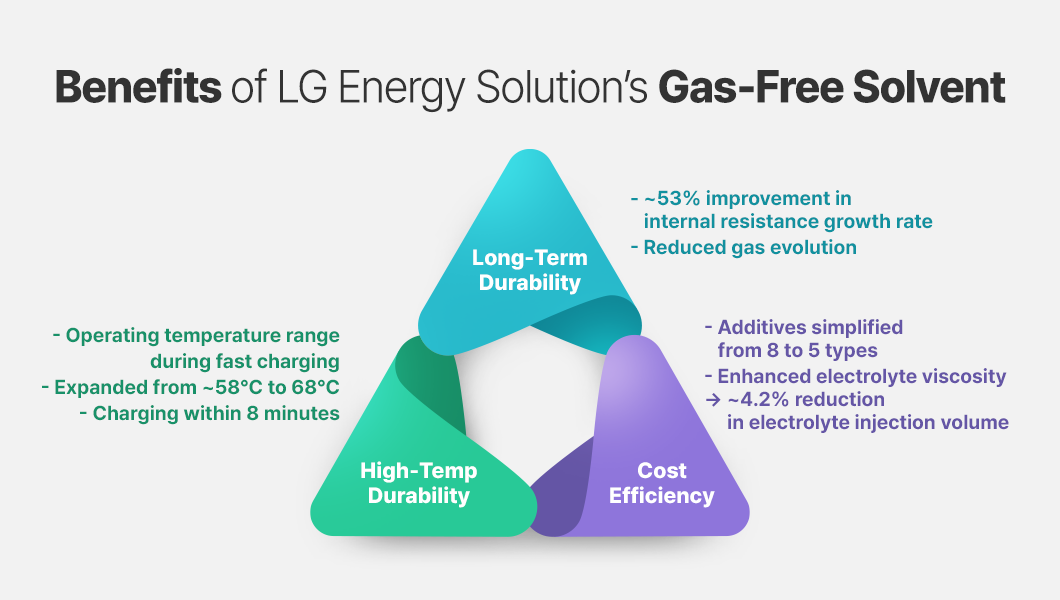
Most significantly, reducing gas generation improved long-term battery durability. Research results show that applying the first-generation gas-free solvent reduced the rate of internal resistance increase by about 53 %, while also lowering gas formation.
This stability was also maintained under high-temperature conditions. The allowable operating temperature range during fast charging was expanded from about 58°C to 68°C, and based on these results, the possibility of achieving high-performance electrolytes capable of charging within 8 minutes was confirmed.
There were also meaningful changes in electrolyte composition. The application of gas-free solvents reduced the number of additives from eight to five, while improved electrolyte retention decreased the electrolyte injection volume by about 4.2 %. With further development, this is expected to lead to additional material cost reductions.
Q. To what extent has the gas-free solvent been applied to actual batteries?

The currently developed gas-free solvent is a first-generation model, and research on second-generation gas-free solvents is already underway to further improve properties such as viscosity. At present, about 20 % of conventional carbonate solvents have been replaced with the first-generation gas-free solvent.
Side reactions inside lithium-ion batteries tend to expand in a chain reaction once they begin. Therefore, suppressing initial reactions alone can significantly mitigate long-term degradation. From this perspective, even a 20 % replacement can deliver substantial practical benefits.
In addition, in pouch-type batteries, gas accumulation can be directly linked to vent operation over time, making technologies that reduce the onset of side reactions particularly important. Gas-free solvents suppress solvent decomposition, minimize gas accumulation, and are regarded as a promising technology that can enhance long-term lifecycle stability and customer trust.
Q. What are your future plans and roadmap for gas-free electrolyte and solvent development?
Currently, verification and optimization for mass-production application of the first-generation gas-free solvent are ongoing. At the same time, the development of second-generation gas-free solvents that improve properties such as viscosity has begun. In the long term, LG Energy Solution plans to develop high-durability electrolyte systems based on Gas-Free solvents that replace most conventional carbonate solvents currently in use.
Q. Do you have any final thoughts to share?

If research on gas-free solvents continues, we expect to develop electrolytes with both high ionic conductivity and reduced gas generation, enabling next-generation batteries that operate stably even in high-temperature environments. The goal is to minimize performance degradation over long-term use while achieving more stable performance under fast-charging conditions. We will continue to focus on research and development so that gas-free solvents and the batteries that incorporate them can become part of everyday life.
We met Jeongmin Lee, who is researching gas-free solvents, and learned how LG Energy Solution is redesigning the solvent structure itself to suppress the root causes of gas generation. Through this approach, the company is establishing a foundation that can address not only current lithium-ion batteries but also future next-generation battery environments. Please continue to follow LG Energy Solution as it expands its technological competitiveness through gas-free solvents.
- Potential Window: The voltage range within which an electrolyte remains stable without decomposition ↩︎