How far can heat from a single battery cell spread? A battery pack is built by combining multiple cells into a module, and multiple modules into a pack. Because individual cells are placed close together, heat generated by an abnormal cell can affect neighboring cells. For this reason, preventing thermal runaway itself is not enough; it is equally important to control how the generated heat spreads to surrounding cells. The safety technology applied for this purpose is TP (Thermal Propagation) prevention technology. In this installment of the Battery Glossary, we take a closer look at what battery thermal runaway and thermal propagation are, and what technologies are applied to prevent them.
What Is Battery Thermal Runaway (TR)?
To understand Thermal Propagation (TP), it is essential to first look at Thermal Runaway (TR). Battery thermal runaway occurs when the temperature of a battery cell rises to a point that triggers an exothermic reaction inside the cell. The heat generated by this reaction raises the temperature even further, triggering a chain reaction that generates more heat.
Thermal runaway is extremely rare, but when it does occur, it can compromise battery safety. So how does thermal runaway in one cell affect the cells around it?
What Is Battery Thermal Propagation (TP), and How Does It Occur?
Battery Thermal Propagation (TP) refers to the spread of heat and thermal effects from a cell experiencing thermal runaway to adjacent cells, potentially triggering thermal runaway in those cells as well. While thermal runaway is a phenomenon that occurs inside an individual cell, thermal propagation refers to the spread of those effects to neighboring cells.
When heat generated by thermal runaway is transferred, the temperature of adjacent cells also rises, and in some cases this can lead to a chain of thermal runaway events. For this reason, battery systems require not only technologies that prevent thermal runaway, but also technologies that keep it from propagating to other cells even if it does occur.
What Role Does TP Prevention Technology Play?

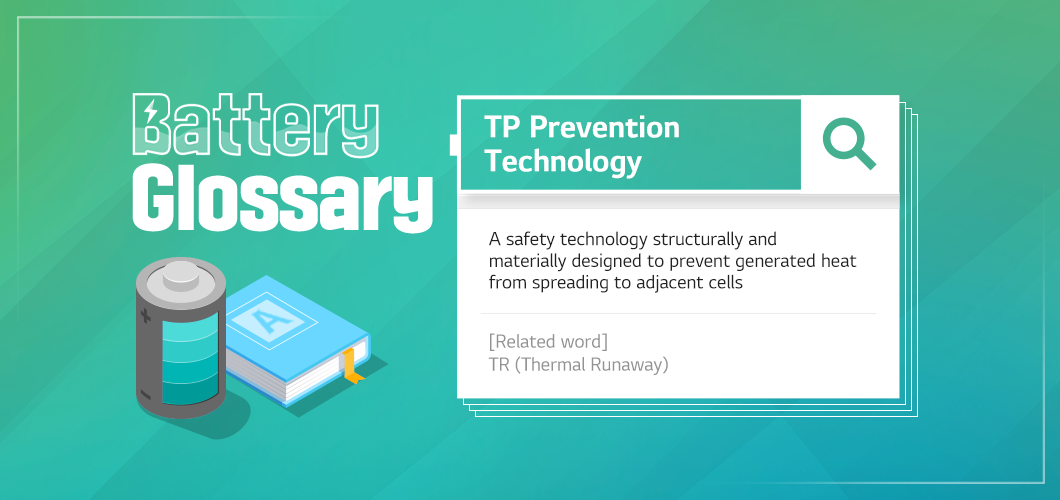
TP prevention technology suppresses the spread of heat and byproducts to adjacent cells even when thermal runaway occurs in one cell, helping prevent thermal propagation.
Batteries are designed with a multi-layered defense system that responds to abnormal situations in stages. At the first level of defense, predictive and preventive technologies are applied to reduce the likelihood of thermal runaway. At the second level of defense, TP prevention technology is applied to prevent already generated heat from spreading to surrounding cells.
In other words, battery safety is enhanced by combining technologies that reduce the likelihood of thermal runaway with TP prevention technologies that limit the spread of heat and its effects to neighboring cells even after thermal runaway has occurred.
What Types of TP Prevention Technologies Are There?
TP prevention technologies are safety technologies designed to limit heat transfer between cells through structural and material solutions, and they can be implemented in various ways depending on their purpose. Broadly, they fall into two categories: technologies that suppress heat transfer to adjacent cells, and technologies that prevent byproducts generated during thermal runaway from spreading to surrounding cells.
1. Technologies that suppress heat transfer
- Thermal barrier materials: Ceramic or silicone pads are placed between cells to reduce thermal conduction and slow the rate of heat transfer.
- Cell spacing and air gaps: A set distance is maintained between cells to create air gaps that help limit the spread of radiative heat.
- Phase Change Materials (PCM)1: These absorb heat as they melt, slowing the rise in battery temperature.
- Cooling systems: Airflow and similar methods are used to dissipate heat inside the battery.
2. Technologies that suppress the spread of thermal runaway byproducts
- Venting channels: Venting channels rapidly release gases and particles generated during thermal runaway to the outside, reducing their impact on surrounding cells.
- Flame-retardant additives: Flame-retardant additives are incorporated into the electrolyte to suppress the spread of the thermal reaction.
- Cell clustering structures: Cells are divided into separate zones, physically blocking heat from spreading from one zone to another.
LG Energy Solution’s TP Prevention Technologies
LG Energy Solution is making continuous efforts across multiple areas to advance battery safety technologies. In the field of TP prevention in particular, the company is focusing on developing diagnostic technologies to detect and prevent TP in advance.
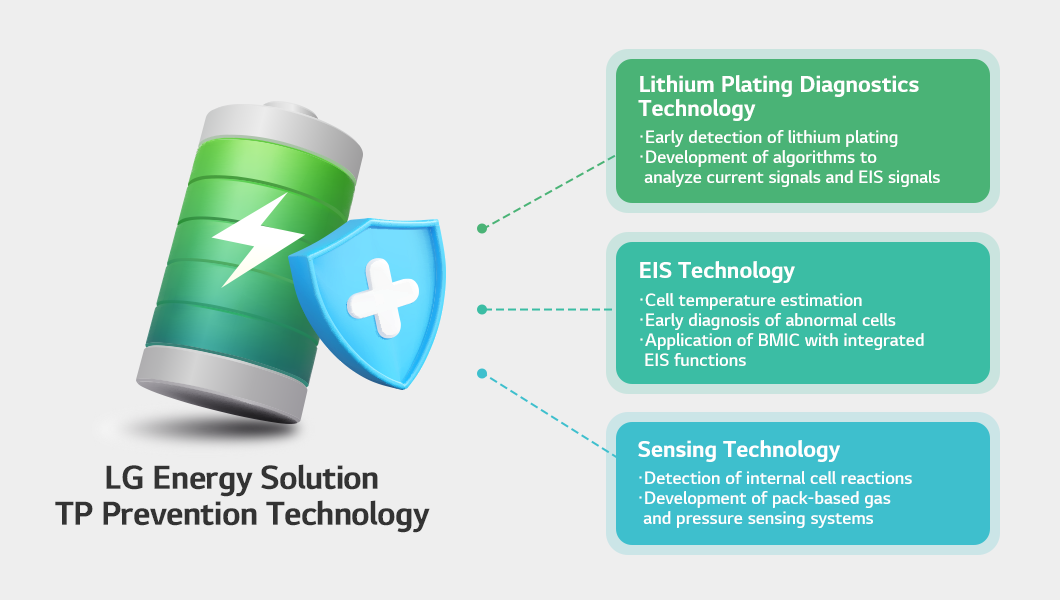
Lithium plating diagnostics: This technology detects lithium plating — one of the key causes of TP — at an early stage. By analyzing pulse current signals and using Electrochemical Impedance Spectroscopy (EIS), it can closely track changes occurring inside the cell.
Electrochemical Impedance Spectroscopy (EIS): This technology uses changes in cell impedance to estimate temperature and detect abnormal conditions early. It is integrated into the Battery Management IC (BMIC), enabling real-time monitoring of cell conditions.
Sensing technologies: Gas and pressure sensors directly detect internal cell reactions to enhance safety.
Through these diagnostic technologies, LG Energy Solution is identifying abnormal conditions in batteries at an early stage and continuing to strengthen its proactive safety technologies to prevent thermal propagation.
Key Q&A
Q. What is battery thermal runaway?
Battery Thermal Runaway (TR) is a phenomenon in which heat generated by an exothermic reaction inside a cell raises the temperature further, causing a chain reaction of additional heat generation.
Q. What is battery thermal propagation?
Battery Thermal Propagation (TP) refers to the effects of thermal runaway in one cell being transferred to adjacent cells, potentially triggering thermal runaway in those surrounding cells as well.
Q. How do thermal runaway and thermal propagation differ?
Thermal runaway is a phenomenon that occurs inside an individual battery cell, while thermal propagation is the spread of thermal runaway’s effects to adjacent cells.
Q. What role does TP prevention technology play?
TP prevention technology is a battery safety technology that suppresses the spread of heat and byproducts generated by thermal runaway to adjacent cells, preventing a chain of thermal propagation.
Q. What types of TP prevention technologies are there?
There are technologies that suppress heat transfer — such as thermal barrier materials, phase change materials, and cooling systems — and technologies that prevent the spread of thermal runaway byproducts, such as venting channels, flame-retardant additives, and cell clustering structures.
Improving battery safety requires both technologies that reduce the likelihood of thermal runaway and technologies that control the spread of heat and its effects to surrounding cells if thermal runaway occurs. LG Energy Solution is strengthening its “proactive safety technologies” — identifying abnormal signs in batteries at an early stage through lithium plating diagnostics, EIS, and sensing. The company will continue to advance these technologies to further build trust in its batteries.
- Phase Change Materials (PCM): Materials that absorb or release large amounts of latent heat while maintaining a nearly constant temperature during phase transitions — solid to liquid, liquid to gas, or the reverse. ↩︎