✍️Taeho Park Partner
Deloitte Korea
ESG: From Corporate Commitment to a Market-Access Requirement — A New Competitive Landscape for the Battery Industry
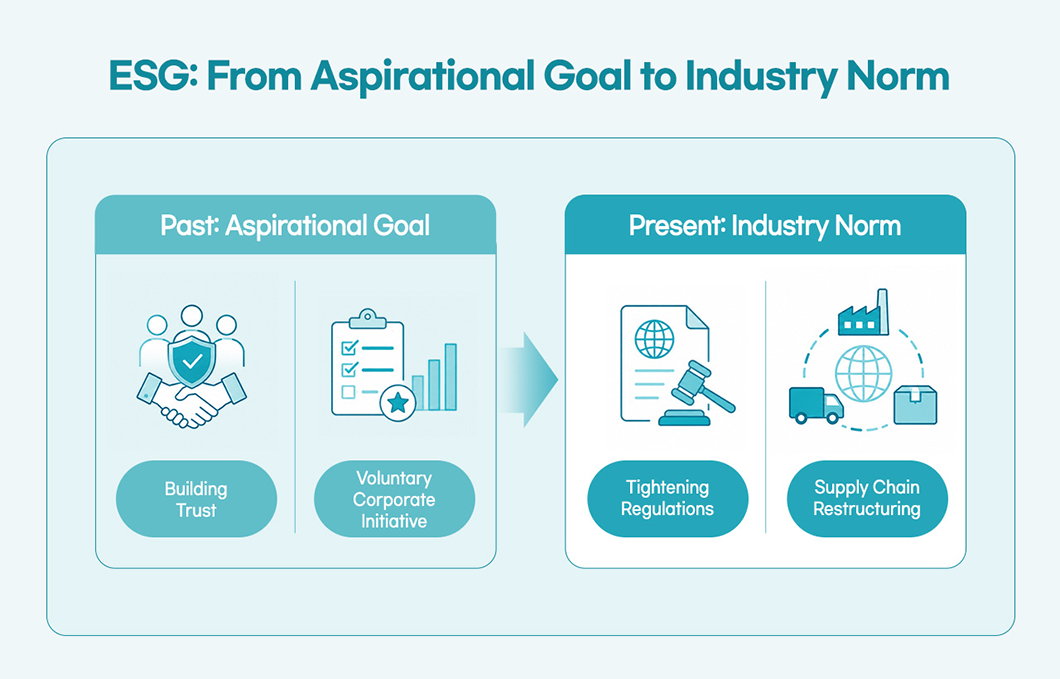
Historically, ESG was viewed as an aspirational goal for sustainable management and a voluntary corporate initiative. It served as a benchmark for earning the trust of investors and consumers, as well as an indicator for a company’s approach to responsible business practices. However, as the business environment surrounding the battery industry has evolved, ESG has become far more than a corporate assessment criterion. It is now a core operational capability and an industry norm that increasingly determines access to global markets and the ability to conduct business.
This shift has been driven by a broader paradigm shift—from a globalization model that prioritized efficiency to one that places greater emphasis on supply chain stability and resilience. In the past, cost reduction and production efficiency were the primary considerations in supply chain design. Today, however, as geopolitical tensions, supply chain disruptions, and competition for critical minerals intensify, secure sourcing capabilities, supply chain visibility, and effective supply chain management have emerged as key sources of competitive advantage. In response, major economies are reshaping the industrial landscape through regulation, with the battery industry at the center of this transformation.
The EU Battery Regulation and the U.S. One Big Beautiful Bill Act (OBBBA) are two prominent examples of this shift. Under the EU Battery Regulation, sustainability requirements covering the entire battery life cycle—including carbon footprint disclosures, the Digital Battery Passport, supply chain due diligence, and requirements for recycled content—are being introduced in phases, embedding sustainability as an integral part of product competitiveness. In particular, the regulation requires electric vehicle batteries and industrial batteries above specified capacity thresholds to disclose information on carbon footprints, raw materials, and recycling, thereby strengthening transparency and traceability at the product level.
In contrast, the United States has chosen to strengthen supply chain requirements by building on the framework established under the Inflation Reduction Act (IRA). The OBBBA introduces Prohibited Foreign Entity (PFE) provisions as part of the eligibility requirements for clean energy tax credits and distinguishes between two categories within this framework—Specified Foreign Entities (SFEs) and Foreign-Influenced Entities (FIEs)—thereby providing more detailed criteria for entities participating in relevant supply chains. In addition, by limiting tax credit eligibility for supply chains involving certain foreign interests, the legislation signals a policy direction aimed at strengthening supply chain independence and economic security.
Although the EU and the United States differ in their approaches, they are both redefining the foundations of industrial competitiveness through regulation. While the EU is establishing new industry norms centered on product sustainability, the circular economy, and information transparency, the United States is redefining the conditions for participation in the clean energy market, with a focus on supply chain restructuring and economic security. Ultimately, ESG is no longer a supplementary element for demonstrating corporate social responsibility. Rather, it has become an essential operational capability and a core competitive advantage for companies seeking to do business in global markets.
AI Redefines the Role of Batteries — The Emergence of a New Demand Driver
As shifting supply chain paradigms and evolving regulations reshape the rule of competition in the battery industry, a parallel transformation is taking place on the demand side, redefining the strategic importance of batteries. The EU’s designation of batteries as a Strategic Value Chain and its continued efforts to develop the sector as a priority area for investment and innovation reflect a strategic rationale that extends beyond supporting the growth of the electric vehicle industry to advancing the energy transition and strengthening industrial competitiveness. More recently, the rapid expansion of artificial intelligence (AI) has begun to reshape patterns of electricity demand, further broadening the role of batteries across the energy infrastructure landscape.
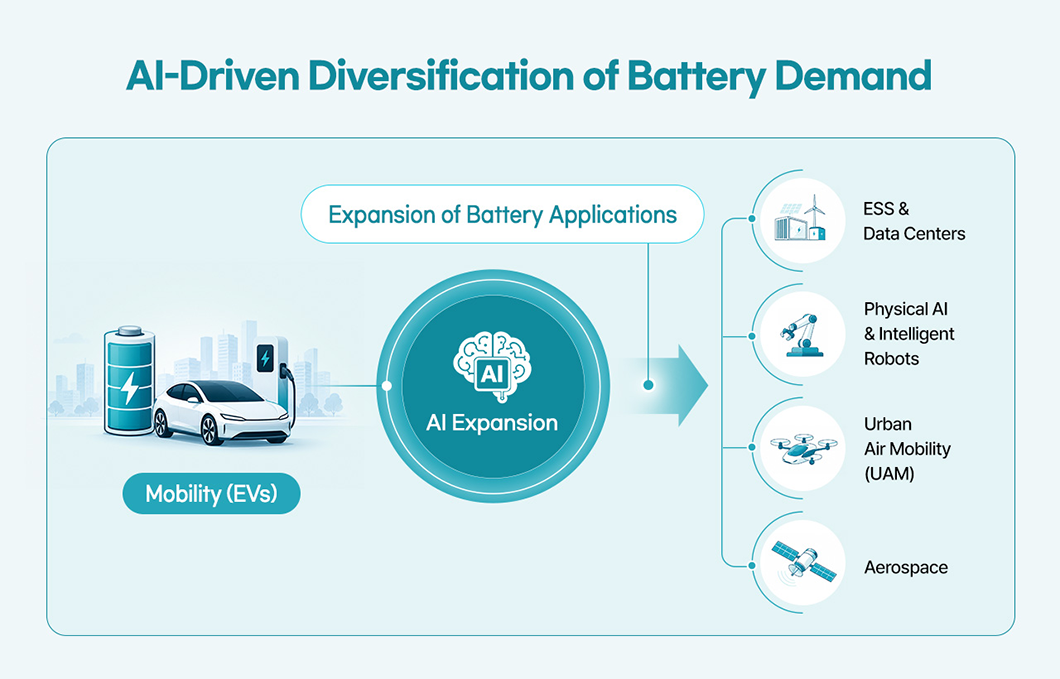
Although growth in the electric vehicle market has entered a period of moderation in some regions, raising concerns about the battery industry’s growth outlook, the expansion of AI and the broader digital transformation are creating new sources of demand. In particular, as AI data centers expand and renewable energy deployment accelerates, ensuring grid stability and flexibility has become an increasingly important priority, elevating the strategic importance of Energy Storage Systems (ESS). The International Energy Agency (IEA) projects that global data center electricity consumption will increase from approximately 415 TWh in 2024 to around 945 TWh by 2030. As a result, power grid investment and demand for energy storage solutions are also expected to grow.
Furthermore, the advancement of so-called “Physical AI”—the application of AI in physical environments—is gaining attention as a driver of demand for high-performance batteries across a wide range of industries, including robotics, autonomous mobility, urban air mobility (UAM), and aerospace. This underscores the potential for batteries to expand beyond their traditional markets and serve as a foundational technology for a broader range of industries. In other words, batteries are expanding beyond their role as core components of mobility to become a critical part of the energy infrastructure connecting AI, renewable energy, and power grids.
Notably, this shift is already being reflected in the medium- to long-term strategies of battery companies. In its latest ESG Report, LG Energy Solution defines this trend as a “Value Shift” and identifies growth in the ESS market, driven by the expansion of AI data centers, as a key opportunity. The company also identifies Physical AI, robotics, marine applications, and aerospace as emerging sources of next-generation battery demand, expanding the role of batteries across the future energy infrastructure landscape.
Ultimately, the battery industry is evolving beyond its reliance on specific product markets to become a critical infrastructure industry supporting AI and the energy transition. As a result, corporate competitiveness is increasingly likely to be determined not only by battery performance and production capacity, but also by how effectively companies integrate ESG considerations—including energy efficiency, raw material circularity, carbon emissions management, and supply chain transparency and resilience—into their business operations.
The Era of Verifiable Sustainability — Data Takes Center Stage
As AI and the energy transition drive demand for batteries, major markets are rapidly strengthening regulations that require companies to substantiate product sustainability with objective data. Through measures covering carbon footprint requirements, supply chain traceability, and the Digital Battery Passport, the EU requires companies to provide data demonstrating how batteries are produced, including the raw materials used and the supply chains involved, and how sustainably they are managed throughout their life cycle.
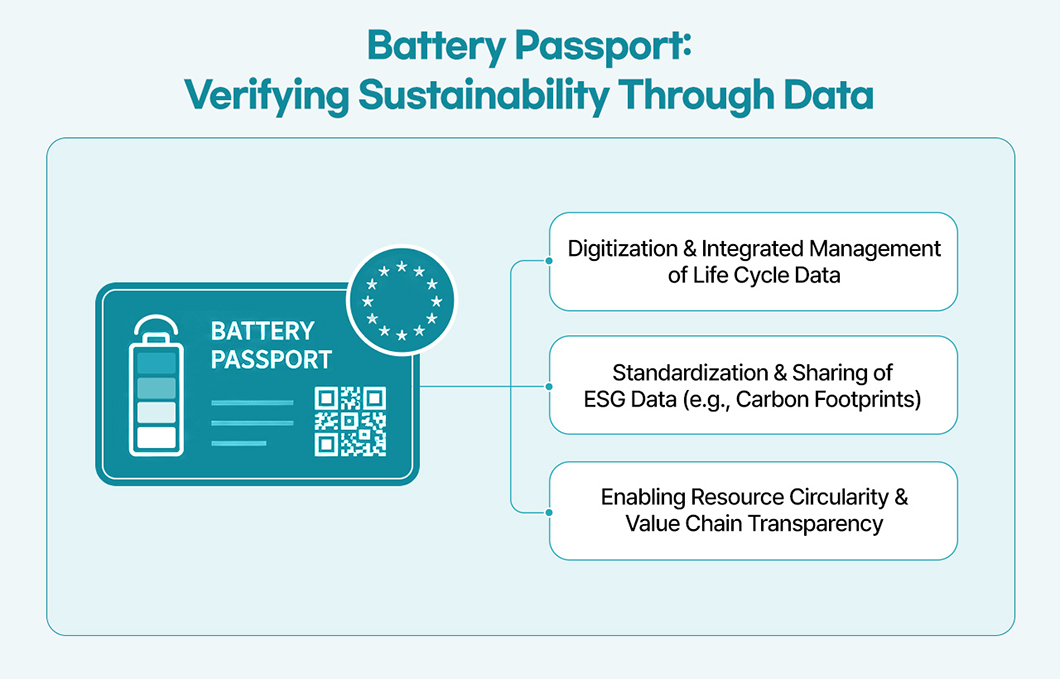
A prominent example is the EU Digital Battery Passport—a digital record through which data across the entire battery life cycle is managed and shared, including information on raw materials, carbon footprint, recycled content, battery use, and recycling. Beginning in 2027, it is set to become mandatory for electric vehicle batteries, industrial batteries with a capacity exceeding 2 kWh, and light means of transport (LMT) batteries.
Among these data points, the carbon footprint is one of the most important for companies to manage. It quantifies the greenhouse gas (GHG) emissions generated throughout a product’s life cycle—from raw material sourcing and manufacturing to distribution, use, end-of-life treatment, and recycling—and demonstrates how sustainably a product has been produced, even when compared with products offering the same level of performance. Companies are entering an era in which selling a product is no longer enough. They will also need to use data to demonstrate the supply chains through which their products are made and the associated environmental impacts.
The challenge, however, is not simply collecting data. Global supply chains involve numerous companies in the materials, components, and logistics sectors. Companies must collect data that meets regulatory requirements, link it at the product level, and manage it reliably. What they need is not separate systems for each regulation, but an integrated digital platform for managing supply chain data. When Life Cycle Assessment (LCA), supply chain data management, the Digital Product Passport (DPP), and data governance are integrated, companies can maintain consistent traceability and data reliability as regulations evolve. Ultimately, ESG and digital transformation (DX) are no longer separate priorities; they are converging into a unified source of competitive advantage.
As regulations become more stringent, companies are accelerating their digital transformation efforts to manage ESG data more systematically. LG Energy Solution, in particular, participated in the Global Battery Alliance (GBA) Battery Passport pilot project to validate approaches to system interoperability. Building on this experience, the company is developing an integrated system for managing product-level carbon footprints, compliance with battery regulations, and supply chain due diligence. This approach goes beyond regulatory compliance and reflects a strategic view that data capabilities will become a key source of competitive differentiation in the global battery industry.
The Rise of the Circular Economy — End-of-Life Batteries as a New Strategic Asset
If demonstrating sustainability with data has become a new requirement for market access, the circular economy provides the industrial framework for putting it into practice. The scope of ESG has also expanded beyond responsible mineral sourcing to encompass management across the entire battery life cycle—from production and use to collection, reuse, and recycling. As a result, end-of-life batteries are no longer viewed as waste to be disposed of, but as strategic assets that support future supply chain stability and resource security.
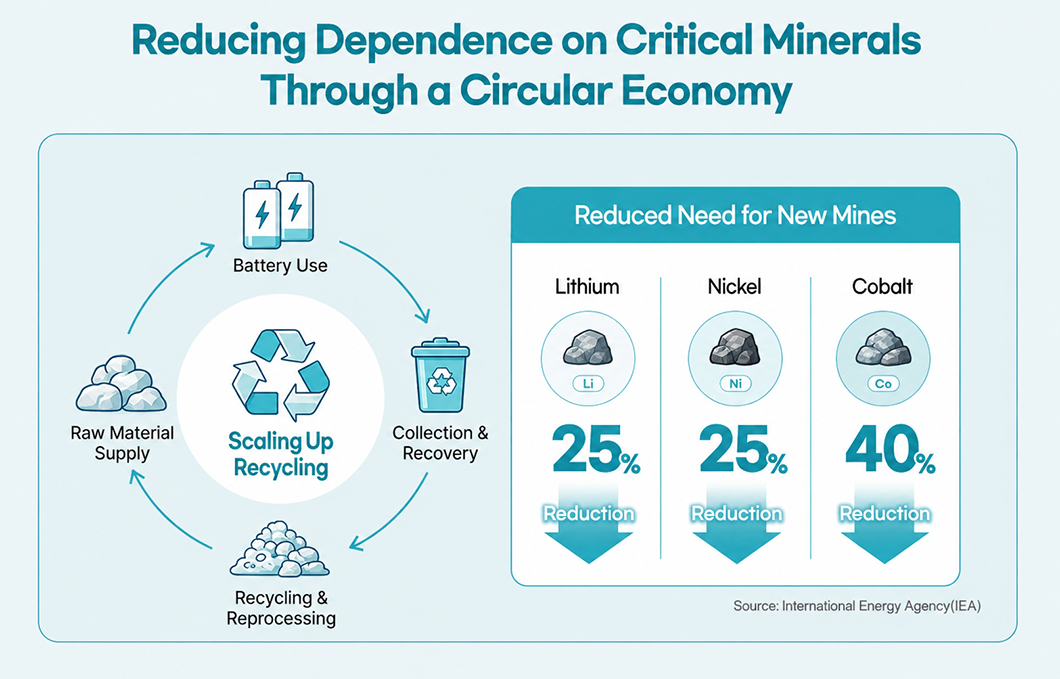
This shift is driven by growing uncertainty surrounding the supply of critical minerals. The production and refining of critical minerals such as lithium, nickel, and cobalt remain concentrated in a limited number of countries, while developing new mines involves long lead times and is subject to environmental and social constraints. As a result, recovering and recycling critical minerals from end-of-life batteries has emerged as an important alternative for enhancing both resource security and supply chain stability. The International Energy Agency (IEA) projects that expanded recycling could reduce the need for new mine development by approximately 25% for lithium and nickel and by around 40% for cobalt by 2050.
This trend is also reflected in regulation. The EU Battery Regulation requires management and information transparency across the entire battery life cycle—from raw material sourcing and manufacturing to use, collection, and recycling. As a result, closed-loop value chain that account for collection and recycling from the product design stage are becoming increasingly important.
LG Energy Solution is also taking a proactive approach to this shift. The company established EV LOOP with France-based Derichebourg (DBG), the first battery recycling joint venture (JV) between Korean and European companies, and formed GMBI with Toyota Tsusho in the United States. By expanding its global network of regional recycling partnerships, LG Energy Solution is strengthening its closed-loop battery system and the foundation for a circular economy. These efforts not only promote resource circularity from an ESG perspective, but also serve as a strategic approach to securing a stable supply of critical minerals and enhancing supply chain resilience.
The Era of Supply Chain Resilience — A New Standard for Sustainable Competitiveness
In an environment where geopolitical tensions, supply chain disruptions, and raw material price volatility have become the norm, building supply chain resilience has become increasingly important for companies seeking to sustain their competitiveness. Companies must now go beyond simply mitigating supply chain risks and build supply chains that can respond to and recover quickly from unexpected shocks. ESG provides the foundation for this resilience by enhancing supply chain traceability and transparency while strengthening responsible raw material sourcing and resource circularity.
The battery industry clearly illustrates this shift. According to the International Energy Agency (IEA), the refining and processing capacity for lithium, nickel, and cobalt remains concentrated in a limited number of countries, with a particular country securing a competitive advantage through an integrated supply chain extending from battery materials to cell manufacturing. Although efforts are underway to diversify supply chains and expand regional production, high production costs and limited refining and processing infrastructure remain significant constraints. As a result, battery supply chains are likely to remain exposed to geopolitical developments and policy risks.
Next-generation battery technologies—including sodium-ion, lithium manganese-rich (LMR), and all-solid-state batteries—offer the potential to reduce dependence on critical minerals or improve performance. However, these technologies also require new materials, manufacturing processes, and partner ecosystems, meaning they are not a fundamental solution to supply chain challenges. Ultimately, what matters is not which technology is chosen, but how effectively companies can design and operate supply chains that are both stable and flexible.
Supply chain resilience cannot be achieved through supplier diversification alone. Companies must establish end-to-end visibility across the entire value chain, from raw material sourcing and manufacturing to logistics and recycling. They also need the capability to quickly assess the impact of regulatory changes and geopolitical developments and adjust their supply chains accordingly. Ultimately, an integrated supply chain data management system and the flexibility to respond to change are becoming key determinants of sustainable competitiveness in the battery industry going forward.
ESG: No Longer About Compliance, but Strategy
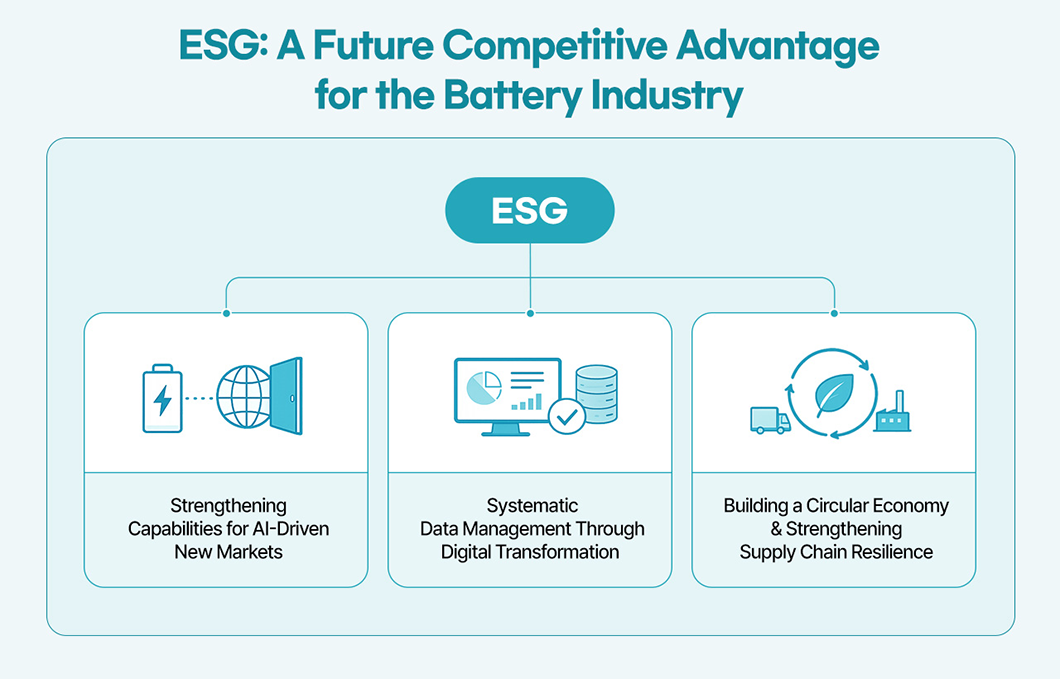
ESG has long been viewed primarily through the lens of regulatory compliance or as a source of additional costs. Indeed, expanding disclosure requirements, supply chain due diligence, and product-level environmental information management place new demands on companies. However, as global ESG regulations expand and supply chain restructuring accelerates, ESG is no longer an optional initiative but a fundamental requirement for doing business. It is evolving into a core competitive capability that helps secure market access, manage supply chain risks, and enable sustainable growth.
The battery industry, in particular, is entering a period of transformation in which rising demand for energy infrastructure driven by AI, increasingly stringent global ESG regulations, and the restructuring of supply chains in response to geopolitical shifts are unfolding simultaneously. In this environment, technological competitiveness, ESG data management capabilities, circular economy systems, and supply chain resilience are not separate challenges. The sustainable growth of companies is likely to depend on their ability to integrate these elements into a unified operating model and execute them effectively.
LG Energy Solution likewise positions ESG not as a matter of regulatory compliance, but as a core pillar of its business strategy. Its Life Cycle Assessment (LCA)-based carbon data management and Battery Passport readiness enhance global market access, while its closed-loop system for resource circularity strengthens the stability of critical mineral supply chains. In addition, supply chain due diligence based on the OECD Due Diligence Guidance, together with an integrated information management system, provides the foundation for greater supply chain visibility and resilience. Rather than treating ESG as a means of complying with individual regulations, the company has embedded it into its business operations as a strategy for strengthening competitiveness.
Ultimately, future ESG competitiveness will be determined not by how faithfully companies comply with individual regulations, but by whether they have built operating models capable of proactively responding to evolving market conditions and supply chain risks. Only companies that have embedded ESG into their business strategy, rather than treating it as a reactive compliance measure, will be able to sustain growth within the emerging industrial order shaped by the AI era and the restructuring of global supply chains.
※ The views expressed in this column are those of the author and do not necessarily represent the official position or strategy of LG Energy Solution.