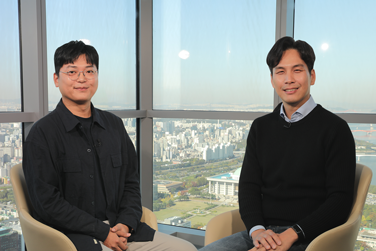
On May 14, LG Tech Conference 2026 was held at LG Sciencepark in Magok, Seoul, showcasing the latest technologies across a wide range of fields, including AI, robotics, mobility, batteries, materials, and telecommunications. LG Energy Solution also had the opportunity to meet with future STEM talent and share its latest technologies and vision.
As AI continues to emerge as a key topic across industries, many attendees were particularly interested in how AI is being applied in the battery industry, one of the most advanced manufacturing sectors. Leveraging more than 300 PB of data, world-class AI experts specializing in manufacturing, and extensive research infrastructure, LG Energy Solution continues to lead the industry.
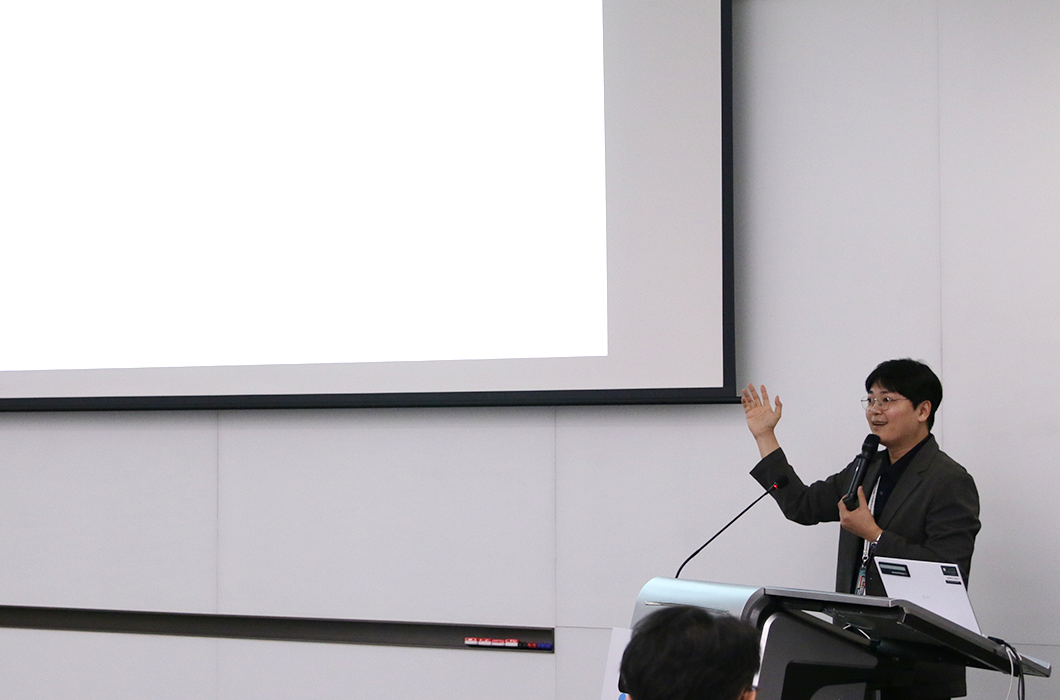
In this post, we explore how LG Energy Solution is leveraging AI across the battery industry through the session “Virtual Lab to Dark Factory: Bringing the Future of Batteries to Reality with AI,” presented by Vice President Jeongsuk Yoon and Research Fellow Junho Yim.
Why AI Has Become a Competitive Advantage in a Battery Industry Driven by Countless Variables
One of the biggest challenges facing battery manufacturers is continuously responding to diverse customer requirements. In particular, the battery industry is both a convergence of numerous advanced technologies and a field where new innovations emerge rapidly. As a result, analyzing customer specifications, controlling countless variables, managing costs, and incorporating new technologies to propose the optimal battery design is becoming increasingly complex.
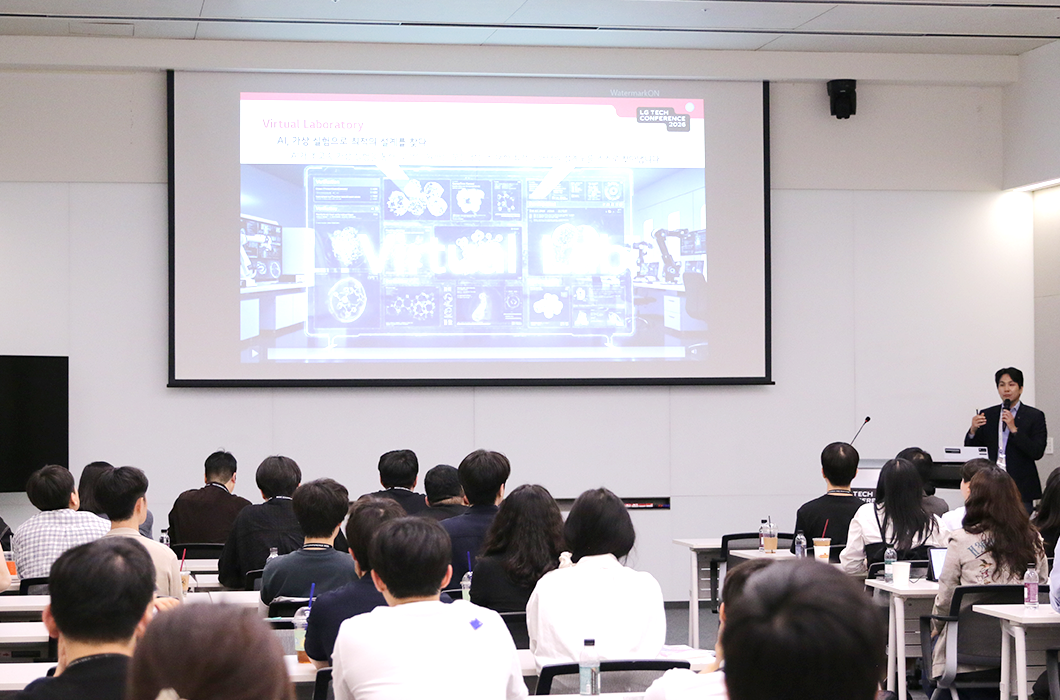
This challenge extends across multiple stages of the battery lifecycle. First, during the development phase, thousands of customer-specific requirements must be accurately reflected in product designs. Based on this, engineers must also review and optimize hundreds of parameters. Therefore, the ability to technically analyze complex requirements within a short period of time and derive optimized solutions has become increasingly important.
In the manufacturing phase, maintaining the stable operation of large-scale production lines is critical, as large volumes of battery cells must be produced with consistent quality. A single battery production line can stretch approximately 800 to 900 meters and consist of around 5,000 pieces of equipment that are organically interconnected. In such a complex environment, even minor variations can affect overall product quality, making it essential to have the capability to precisely control the entire manufacturing process.
To enable more sophisticated analysis and more efficient decision-making, LG Energy Solution applies AI throughout both its R&D and manufacturing operations. Specifically, the company is advancing its Virtual Lab initiative in R&D while further developing the Dark Factory in manufacturing.
Virtual Lab Expands Battery R&D into a Virtual Environment
Traditionally, R&D relied on researchers developing hypotheses, creating samples, and validating results through experiments. However, there are clear limitations to physically testing every possible material candidate and design condition. In addition, the quality of R&D outcomes often depended heavily on the experience and expertise of individual engineers.
To overcome these limitations, the concept of the Virtual Lab emerged. A Virtual Lab uses AI and simulation technologies to explore materials, design products, and predict performance within a virtual environment. This approach enables more consistent design quality while significantly reducing trial and error throughout the R&D process.
LG Energy Solution applies Virtual Lab technologies across a wide range of areas, including △new material development, △optimal product design, △evaluation and analysis optimization, and △early prediction of battery performance and lifespan.
Virtual Lab 1) AI Screens Potential New Materials
One of the biggest challenges in developing new materials is identifying suitable materials from an enormous pool of candidate materials. The number of candidate materials can range from hundreds of thousands to tens of millions. In the past, researchers often relied on an Edisonian approach, repeatedly conducting experiments to identify suitable materials. However, it is practically impossible to evaluate every candidate through experimentation alone.
To make this process more efficient, LG Energy Solution is automating computational science1-based material discovery using AI. By entering the desired material requirements into the system, AI predicts chemical properties and performs multiple rounds of screening to screen promising candidates. The AI draws on accumulated experimental data as well as publicly available patent and research paper data. This enables the rapid exploration of vast candidate pools that would be difficult for humans to review manually, allowing materials that meet the required criteria to be prioritized.
Virtual Lab 2) One Day RFx Accelerates Optimal Battery Design
Battery design is a highly complex task that must simultaneously satisfy multiple customer requirements, including capacity, lifespan, fast-charging time, and cost. Traditionally, engineers developed candidate designs, predicted performance using simulators, and repeatedly adjusted design conditions while evaluating the results. One Day RFx2 is a project aimed at reducing the conventional battery design process, which previously took several weeks, to less than a day through the use of AI.
The project began by using simulators to build databases linking design parameters with performance parameters. A straightforward approach was initially attempted in which AI was trained to generate design parameters based on target performance requirements. However, many different designs can achieve similar performance levels. As a result, this approach had the limitation of converging toward the average of multiple design candidates that satisfied the target performance requirements.
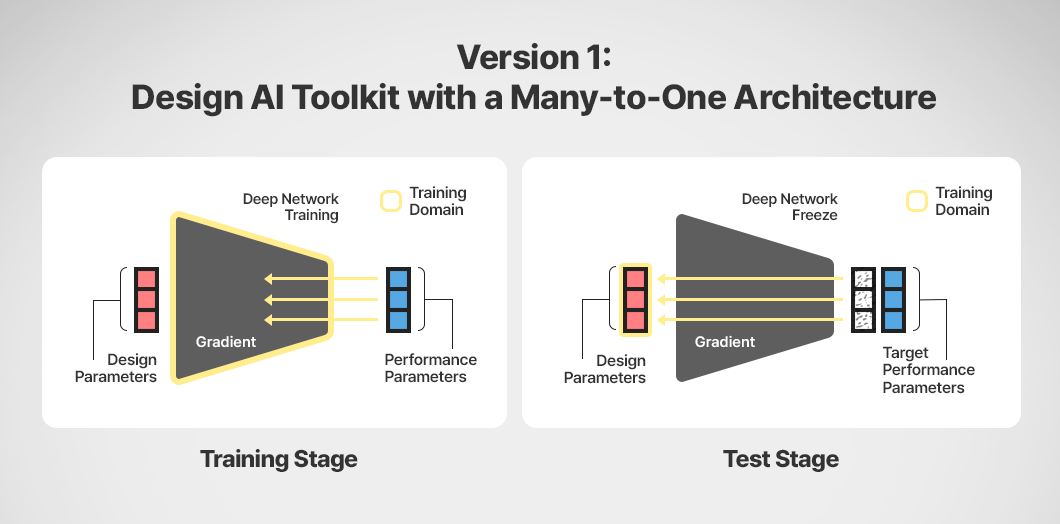
To address this limitation, LG Energy Solution developed a Design AI Toolkit based on a many-to-one architecture. The toolkit learns the relationship between design parameters and performance parameters through one-to-one mappings. It then iteratively adjusts design conditions until the target performance is achieved. In simple terms, engineers first define the desired battery performance, and the AI works backward to identify the design conditions needed to achieve it. However, because the system generated only one result at a time, there were limitations in quickly generating and comparing multiple candidate design options.
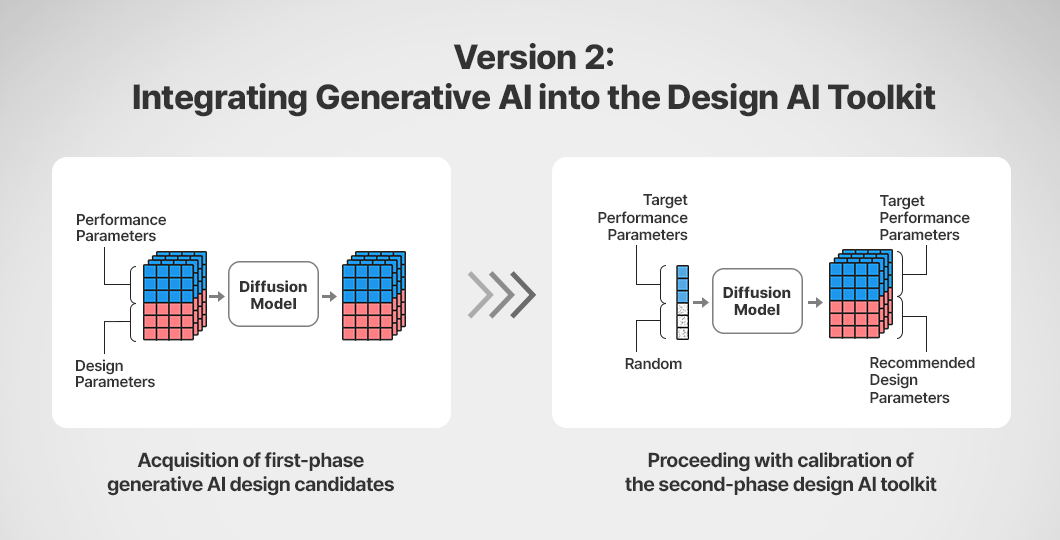
To overcome this challenge, LG Energy Solution integrated Generative AI into the Design AI Toolkit. The toolkit was further enhanced by first generating multiple design candidates that satisfy the target performance requirements using Generative AI and then refining those candidates through the Design AI Toolkit. This enables engineers to compare multiple promising design options more efficiently.
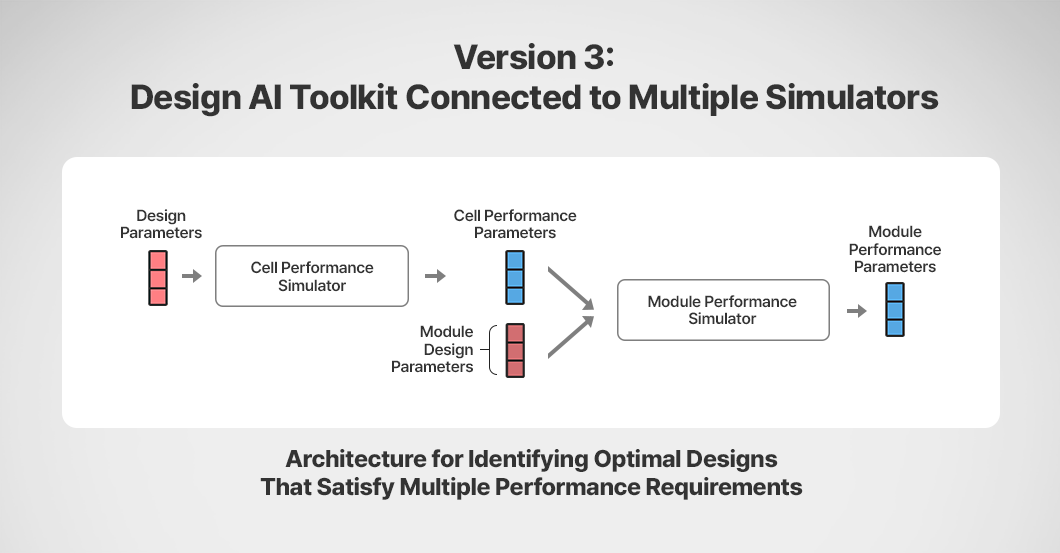
The company is further expanding this framework to identify optimal designs that satisfy multiple performance requirements simultaneously, including cell performance, module performance, lifespan, fast-charging capability, and cost. To achieve this, individual simulators for different battery characteristics are connected and trained using a network-sharing approach. As a result, the process of deriving design candidates, which previously took approximately two to four weeks, can now be completed within a single day.
Virtual Lab 3) Improving Evaluation and Analysis Efficiency While Predicting Performance in Advance
After product development, the next step is to evaluate and analyze whether the target performance has been successfully achieved. LG Energy Solution is improving both the speed and accuracy of this process by applying Vision AI analysis technologies.
One representative example is separator image analysis. Electron microscope images are commonly used to examine the uniformity, shape, and distribution of separator particles. Because it is impossible for humans to manually inspect every area of an image, researchers traditionally reviewed selected sections and extrapolated the results to estimate the overall particle distribution. Today, this analysis process has been automated using vision technology. Vision AI automatically identifies particles within images, classifies them by size and shape, and quantifies and presents the predicted particle distribution.
LG Energy Solution also combines accumulated particle distribution data with simulation technologies to predict which particle distributions can achieve higher energy density. This allows researchers to evaluate material development directions before conducting physical experiments and accelerate the performance validation process.
Dark Factory Enables Data-Driven Manufacturing
What is a Dark Factory? A Dark Factory refers to a manufacturing facility that can operate even with the lights off. Through a high level of automation, AI controls and manages manufacturing processes based on data without requiring humans to directly oversee operations. As an evolution of the Smart Factory, a Dark Factory leverages advanced AI-driven system automation to enable more precise manufacturing operations.
LG Energy Solution is advancing the implementation of Dark Factories through continued Smart Factory and AI innovation. To achieve this, the company is applying AI technologies across a wide range of areas, including △defect prevention, △manufacturing operation optimization, △automated process correction, and △equipment anomaly detection.
Dark Factory 1) Detecting Manufacturing Defects in Real Time with AI
In the past, battery performance was verified during the final inspection stage after production was completed, and products that failed to meet quality standards were identified and sorted accordingly. Today, vision inspection systems and measurement devices are deployed throughout the production process to monitor CTQ (Critical to Quality)3 values in real time. By identifying potential defects before they occur, LG Energy Solution is improving both quality control and manufacturing efficiency.
Examples of these technologies can be found in ultrasonic welding and anode coating processes. In ultrasonic welding, AI analyzes camera footage in real time to detect subtle defects such as electrode tearing or separation. In anode coating, AI identifies potential electrode damage that may occur during the unwinding process before it impacts product quality.
How Can Vision Inspection AI Detect Previously Unseen Defects?
Developing this Vision Inspection AI required LG Energy Solution to overcome several technical challenges.
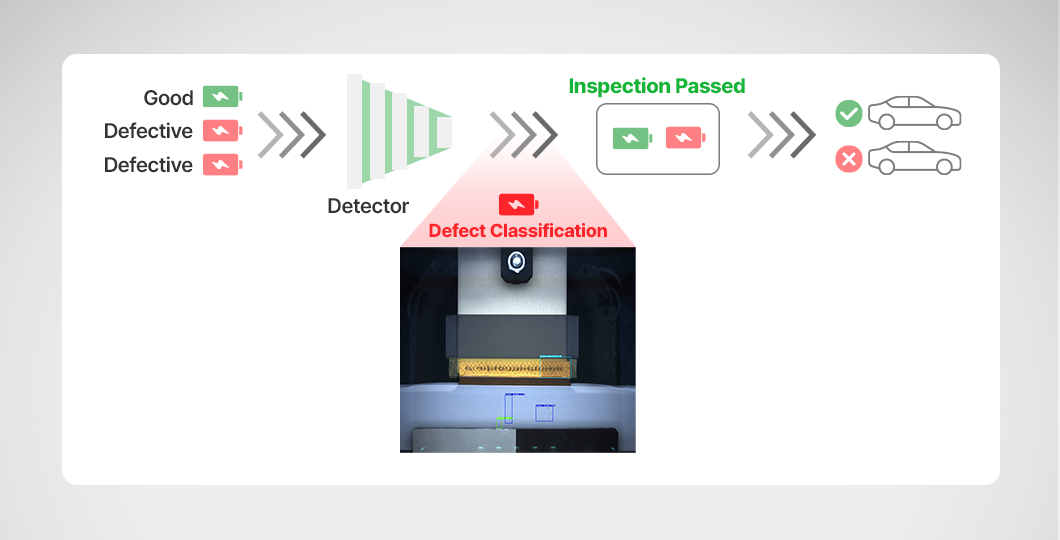
One of the first challenges was Domain Shift. Domain Shift occurs when the data environment encountered during real-world deployment differs from the environment represented in the training data, resulting in reduced AI performance. Changes in lighting conditions or process environments can lower inspection accuracy, causing the AI to miss actual defects or incorrectly classify normal products as defective. Addressing this issue requires continuously training the AI with new data. However, generating new training datasets is both time-consuming and costly because people must manually label whether each sample is defective and identify the location of each defect.
To reduce this burden, LG Energy Solution progressively enhanced its AI vision inspection technology. The first step involved selecting only the data that the AI found difficult to classify and having human reviewers examine those cases. While this approach was more efficient than labeling every defect from the outset, it still had a limitation. The system could fail to identify previously unseen defect types that were not included in the training data.
To address this challenge, LG Energy Solution introduced Visual Prompting*. With Visual Prompting, AI learns from example images and identifies regions within a target image that are similar to the learned examples. This approach enables the detection of previously unseen defects without requiring large-scale training datasets. However, defects in battery manufacturing are often extremely subtle, making the differences between normal and defective regions very small. As a result, the system occasionally generated false positives by incorrectly identifying normal regions as defects.
LG Energy Solution has changed its perspective on image analysis. The key was focusing on the subtle pattern changes caused by defects. Defects such as micro-scratches are characterized by rapid changes in brightness and color within a very narrow area. These are not easily revealed through conventional image analysis, but when an image is decomposed into frequency signals, these abrupt changes become clearly visible.
In addition, the company also utilized an approach that converts images into vector form and analyzes them based on directional (angular) information. By removing intensity information and focusing only on vector direction, the method is able to capture intrinsic features without being affected by lighting conditions. Finally, contrastive learning4 was incorporated to further distinguish subtle defects more clearly. As a result, the time required compared to full manual visual labeling was reduced by approximately 99%, and the related paper was accepted at CVPR 2026, one of the top conferences in the field of computer vision.*Kim, G. et al. (2026). UniSpector: Towards Universal Open-Set Defect Recognition via Spectral-Contrastive Visual Prompting. CVPR 2026.
Dark Factory 2) Optimizing Manufacturing Environments with AI
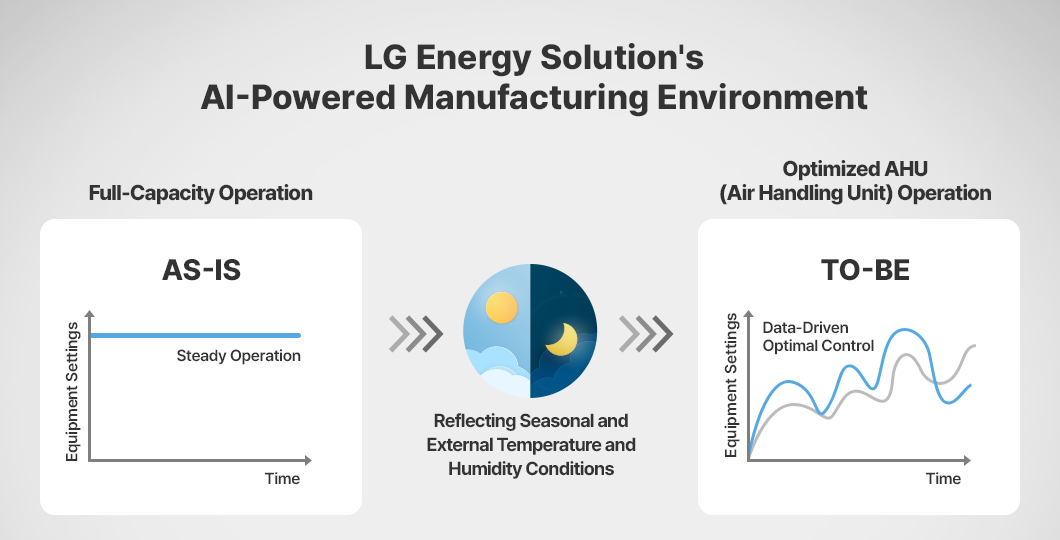
Battery performance is highly sensitive to manufacturing conditions, making it essential to maintain consistent process environments. In particular, batteries are highly sensitive to humidity. To control temperature and humidity during manufacturing, Air Handling Units (AHUs) are operated throughout production facilities. However, continuously running these systems at high capacity regardless of weather or seasonal conditions can significantly increase energy consumption and operating costs.
To address this challenge, LG Energy Solution collected operational data from air handling systems as well as experimental results gathered under various operating conditions. Based on this data, the company developed an AI-powered performance prediction model for AHUs. The system uses simulations that incorporate external environmental conditions to determine optimal control strategies and automatically adjust equipment settings even during unmanned operation. Through this approach, LG Energy Solution achieved annual energy cost savings of over KRW 10 billion.
Dark Factory 3) Automated Process Correction and Future Manufacturing Technologies
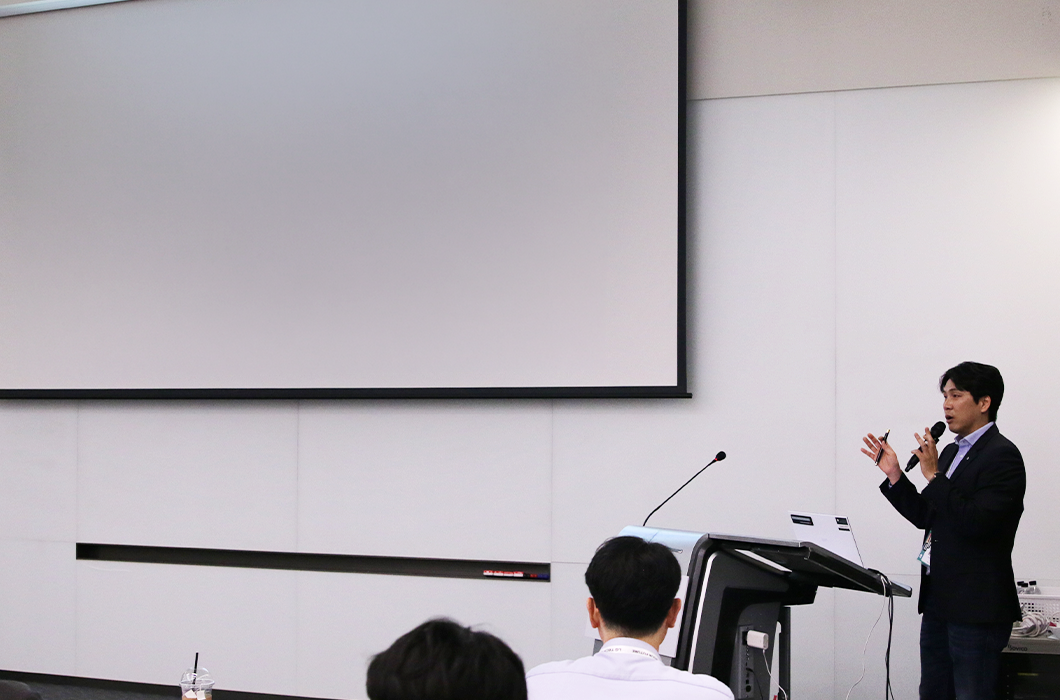
Automated process correction enables AI to support fine adjustments that previously relied on human experience. For example, after anode slurry is coated onto copper foil, it passes through a drying process. At this point, if the temperature is too high, the material can be damaged. If the temperature is too low, the slurry may not dry sufficiently. As a result, precise temperature control is critical.
LG Energy Solution utilizes an automated correction AI agent that analyzes a wide range of process data, including gas conditions inside drying ovens and the thickness of coated slurry layers. Based on this analysis, the system recommends optimal equipment settings or automatically adjusts operating conditions. This resulted in significantly reduced quality variation and a more stable manufacturing process.
In addition, LG Energy Solution is researching and developing advanced technologies that combine anomaly detection systems with quadruped and humanoid robots. Quadruped robots can move throughout manufacturing facilities and inspect equipment for abnormalities. When issues are detected, humanoid robots can perform follow-up tasks such as replacing equipment components. These efforts are aimed at enabling safe and reliable equipment management in high-temperature or hazardous areas that are difficult for people to access.
Key Q&A
Q. Why is AI needed in the battery industry?
Batteries are complex products shaped by a combination of customer requirements, design conditions, and manufacturing process variables. AI helps accelerate optimal design and enable more precise manufacturing management.
Q. What is a Virtual Lab?
A Virtual Lab is an R&D approach that uses AI and simulation technologies to evaluate material discovery, product design, and performance prediction in a virtual environment before physical testing.
Q. What is a Dark Factory?
A Dark Factory is an intelligent automated manufacturing facility where equipment and AI analyze data to make decisions and control manufacturing processes.
Q. How does LG Energy Solution use AI?
LG Energy Solution utilizes Virtual Labs to enhance design optimization and performance prediction in R&D. In manufacturing, the company leverages Dark Factories to improve quality control and manufacturing efficiency.
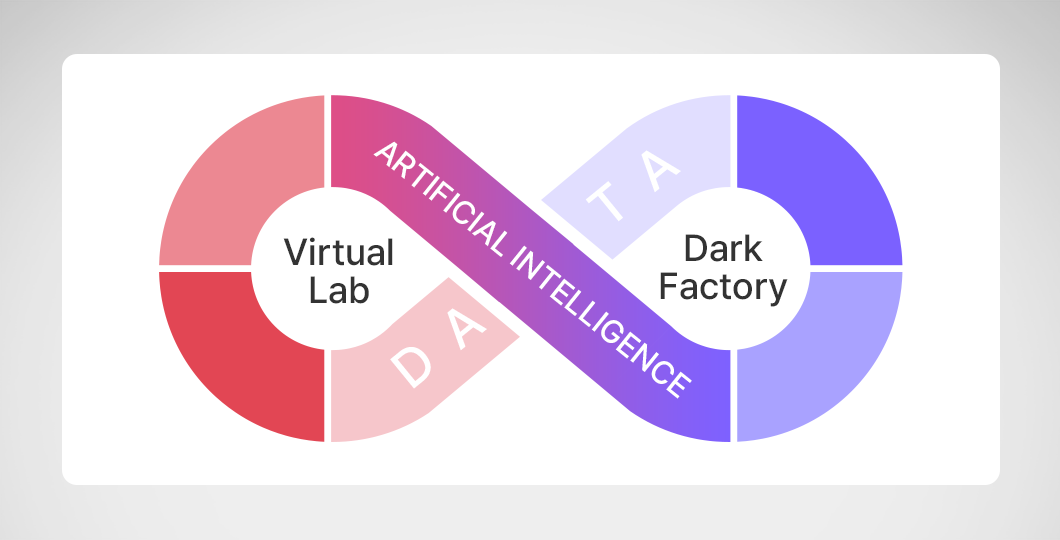
Virtual Labs and Dark Factories are not separate domains. The vast amount of production data collected through Dark Factory operations is continuously fed back into the design models used in Virtual Labs. In turn, the optimized designs generated by Virtual Labs are implemented more precisely through Dark Factory manufacturing systems. This creates a virtuous cycle in which manufacturability is considered from the design stage onward.
LG Energy Solution is expanding AI innovation across the entire battery value chain, from Virtual Labs in R&D to Dark Factories in manufacturing, strengthening competitiveness in both battery development and production. Moving forward, the company will continue creating new paradigms for the battery industry through AI-driven innovation.
- Computational Science: A field of study that uses numerical analysis and computer-based calculations to solve scientific and engineering problems. ↩︎
- RFx (Request for X): A document used to review customer requirements for battery materials and specifications, as well as the corresponding quotations. ↩︎
- CTQ (Critical to Quality): Quality characteristics that are considered critical from the customer’s perspective and serve as key quality indicators. ↩︎
- Contrastive Learning: A learning approach that restructures the representation space for data analysis and maximizes the similarity between feature vectors, enabling similar data points to be grouped more closely together. ↩︎