Charging batteries is essential for EV drivers. Those who are not familiar with EVs yet may still find charging an EV unfamiliar and difficult. In this session, we will explore the different types of EV battery charging methods, how they work, and the differences between rapid and standard charging.
Q. What are the methods of charging EV batteries?
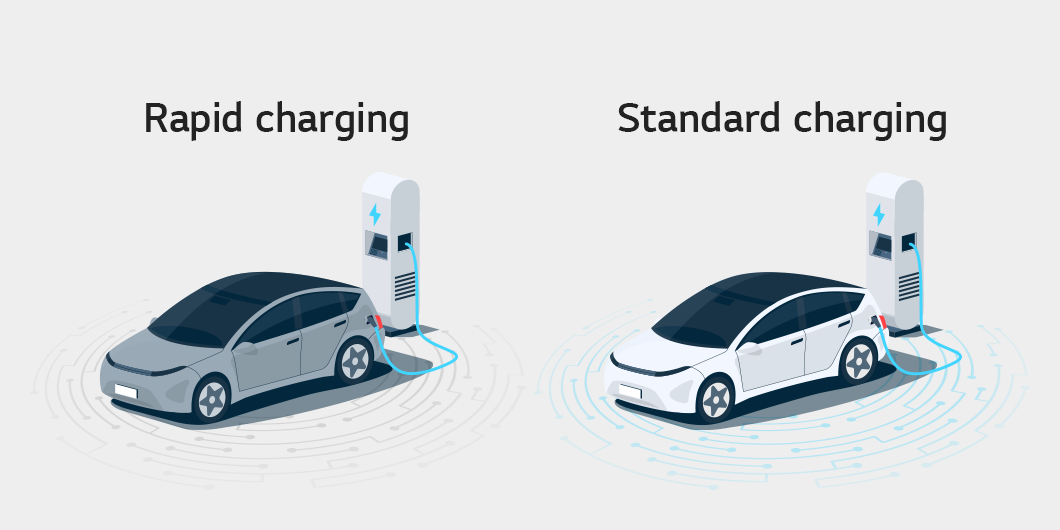
Charging EV batteries can be broadly divided into two methods: rapid charging (DC charging) and standard charging (AC charging). The two methods differ in terms of power supply principles, charging speed, and their impact on battery life.
Q. What is rapid charging?
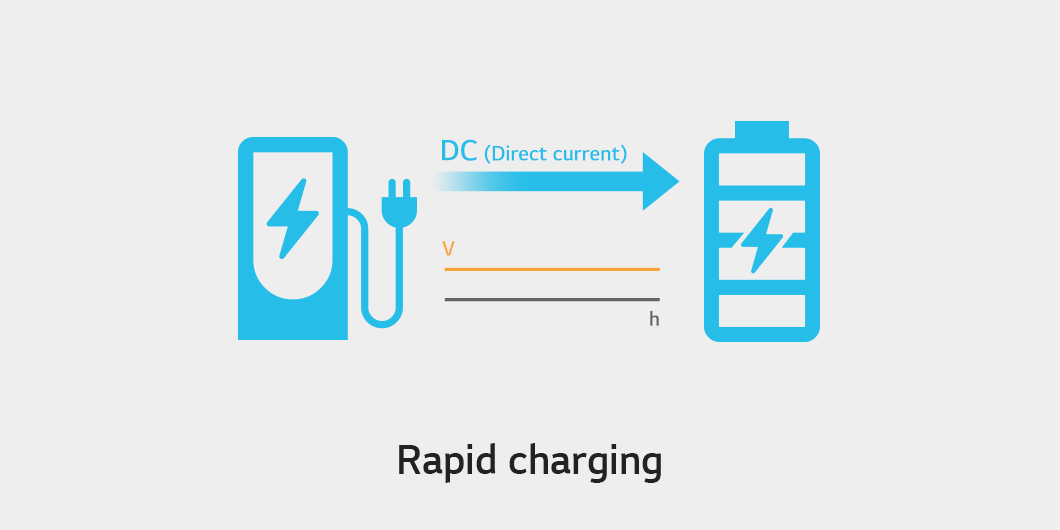
Rapid charging is a method that directly supplies DC (Direct Current) power from the charger to the battery. Here, direct current refers to an electric current that flows steadily in one direction. Rapid charging is characterized by its ability to charge the battery quickly within a short period of time.
- Power supply method: Direct supply of DC power
- Charger output: 50 kW or higher
- Charging limit: Up to approximately 80% of battery capacity
- Charging time: Around 1 hour (up to 80%)
- Main installation locations: Public institutions, large commercial facilities, highway rest areas
Because rapid charging rapidly delivers high-output power, it is generally designed to charge up to only 80%. Why is charging limited to 80%? Rapid injection of high-current power can place stress on the internal electrode structure of the battery. To help protect the battery, the charging limit is therefore set at 80%.
Q. What is standard charging?
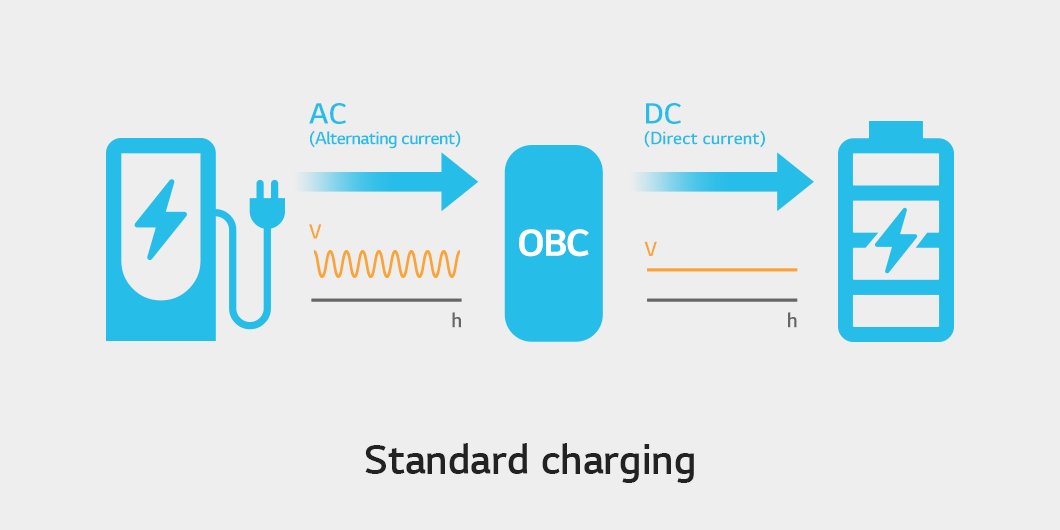
In standard charging, AC (Alternating Current) power is supplied and converted into DC by the vehicle’s On-Board Charger (OBC)1 before being stored in the battery. Here, alternating current refers to an electric current whose magnitude and direction change periodically over time.
- Power supply method: AC power → OBC → conversion to DC power
- Charger output: 3 kW to 7 kW
- Charging limit: Supports full charging up to 100%
- Charging time: Approximately 5 to 12 hours
- Main installation locations: Residential spaces such as apartments and multi-unit housing
Because the process involves converting the current, standard charging is slower than rapid charging. However, it places relatively less stress on the battery, making it suitable for everyday charging.
Q. What are the differences between rapid charging and standard charging?
| Comparison Category | Rapid Charging | Standard Charging |
|---|---|---|
| Current | Direct Current (DC) | Alternating Current (AC) → Direct Current (DC) |
| Charging Output | 50 kW or higher | 3–7 kW |
| Charging Range | ~80% | ~100% |
| Main Usage Locations | Public commercial facilities | Residential spaces |
The biggest differences between rapid charging and standard charging are charging speed and their impact on the battery. In summary, rapid charging is advantageous for rapid charging, while standard charging is more beneficial for battery life management.
Q. Are there any precautions to keep in mind when charging an EV?

Frequent use of rapid charging may shorten battery life. Repeated rapid charging can affect the internal electrode structure of the battery, which may lead to long-term performance degradation.
The following charging habits can help extend the lifespan of EV batteries.
- Set a charging target level in advance
- Alternate between rapid and standard charging
- Choose a charging method suitable for the charging environment
Q. What are the prospects for the EV charging market?
As EV adoption continues to expand, the EV charging market is also growing rapidly.
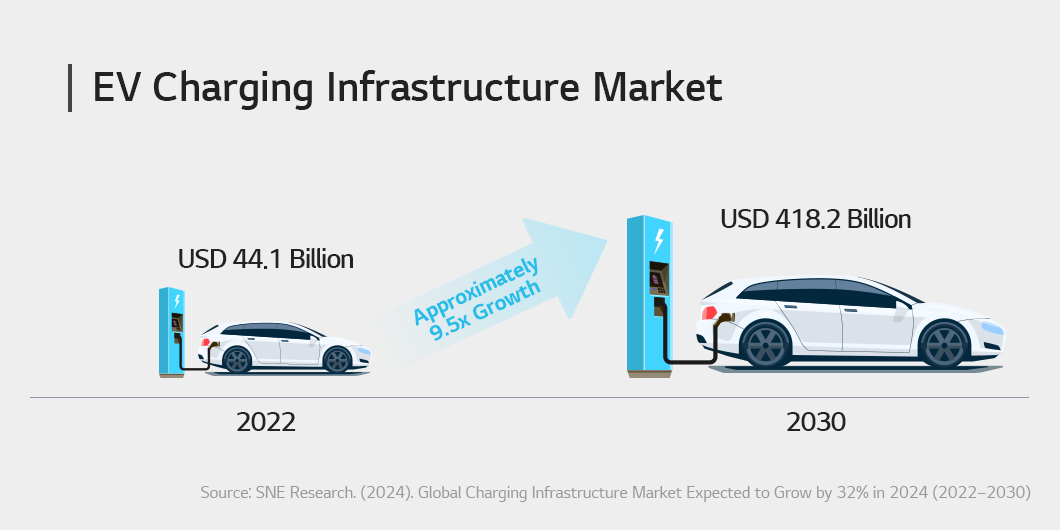
According to SNE Research, the global EV charging infrastructure market is projected to grow from USD 44.1 billion in 2022 to USD 418.2 billion by 2030. The overall market is expected to record a compound annual growth rate (CAGR) of 32%.2 In line with these market trends, related industries are expanding charging infrastructure while also making efforts to improve charging convenience and safety for EV users.
Key Takeaways
EV charging is divided into rapid charging (DC) and standard charging (AC), which differ in charging speed and their impact on battery life.
● Rapid charging enables charging up to 80% in approximately 1 hour, but charging is generally limited to 80% for battery protection.
● Standard charging takes approximately 5 to 12 hours, but supports full charging up to 100%.
● Rapid charging is advantageous for charging speed, while standard charging is more beneficial for battery life management.
● As EV adoption continues to expand, charging infrastructure is also steadily growing.
So far, we have explored the principles and differences between rapid charging and standard charging for EV batteries. We also examined the key considerations when selecting a charging method. As EV charging infrastructure continues to expand, more drivers are expected to enjoy a more convenient EV charging environment.