Electrolytes provide the pathway for lithium ions to move while establishing the environment for electrochemical reactions. But have you ever wondered what happens within the electrolyte itself? During repeated charging and discharging cycles, various electrochemical reactions occur inside a battery. These processes inevitably alter the electrolyte, and some reactions can generate gas. To mitigate this phenomenon, LG Energy Solution is researching gas-free solvent technology, which features a newly designed solvent structure.
In this article of the Battery Glossary, we’ll take a closer look at what gas-free solvents are, their key characteristics, and the latest progress of LG Energy Solution’s development.
What are Gas-free Solvents?
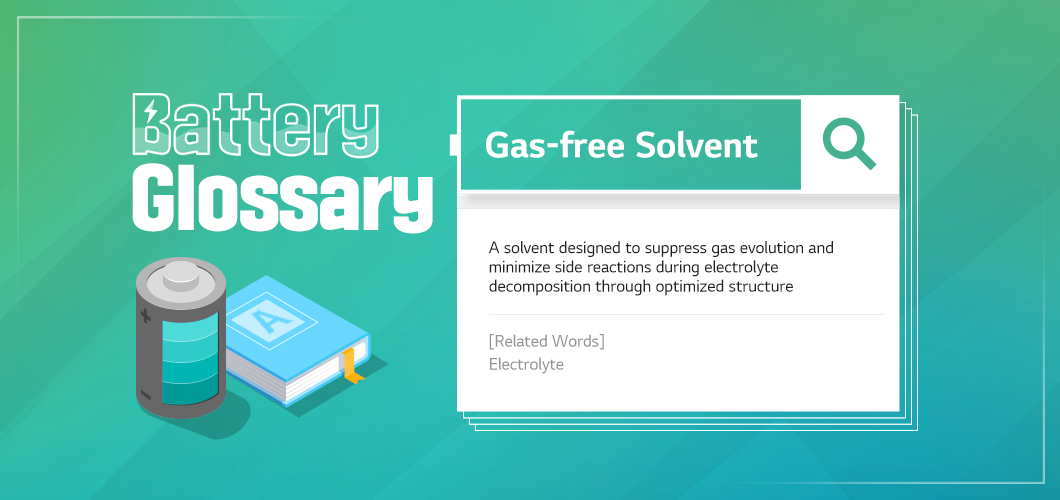
Gas-free solvents are solvents designed to suppress gas evolution caused by electrolyte decomposition while minimizing side reactions. This technology represents a new approach that optimizes the solvent structure itself to improve electrolyte stability.
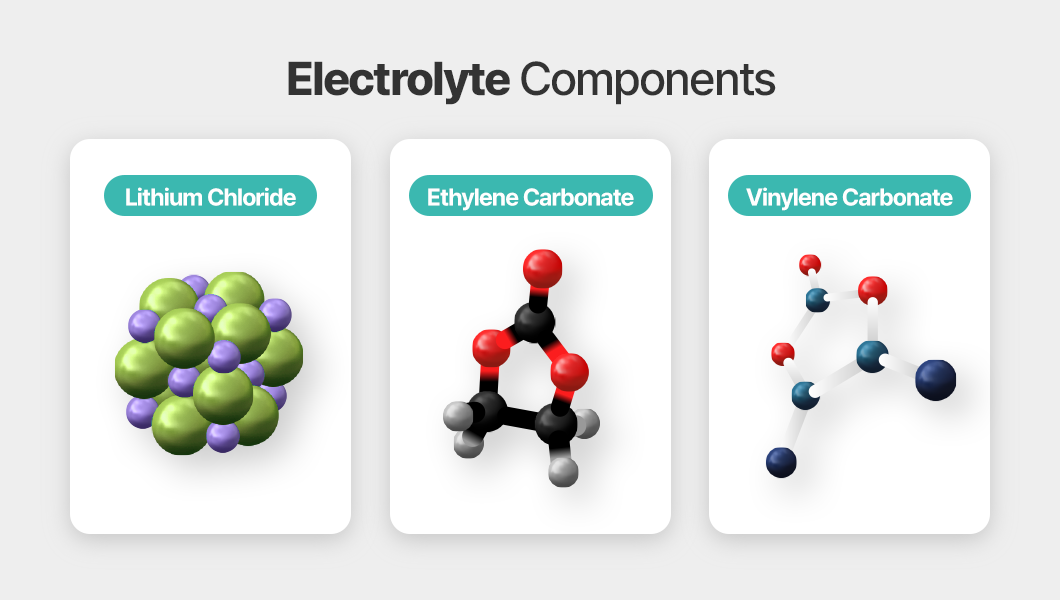
Commercial lithium-ion battery electrolytes are typically composed of organic solvents, lithium salts, and a small amount of additives. When batteries operate under high-voltage or high-temperature conditions, or when highly reactive electrode materials are used, oxidation and reduction reactions accelerate at the cathode and anode interfaces. During this process, the organic solvent can partially decompose, leading to gas evolution.
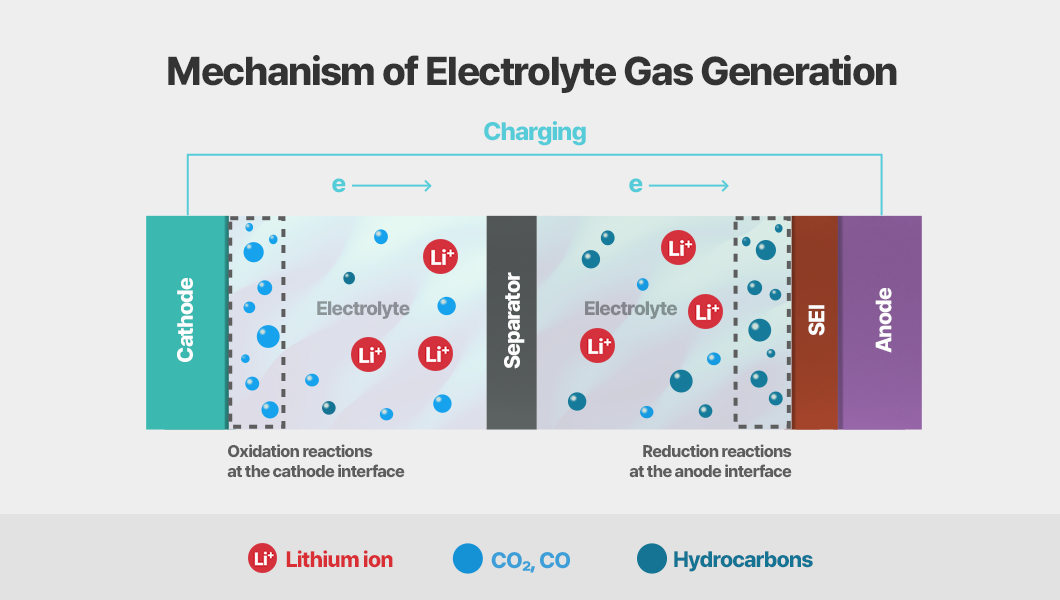
As a result, gases such as carbon dioxide (CO₂) and carbon monoxide (CO) are primarily generated at the cathode interface, while hydrocarbons are mainly generated at the anode interface. As these gases accumulate, they increase internal resistance and trigger cell swelling, affecting the battery’s long-term durability.
How are Gas-free Solvents Different from Conventional Solvents?
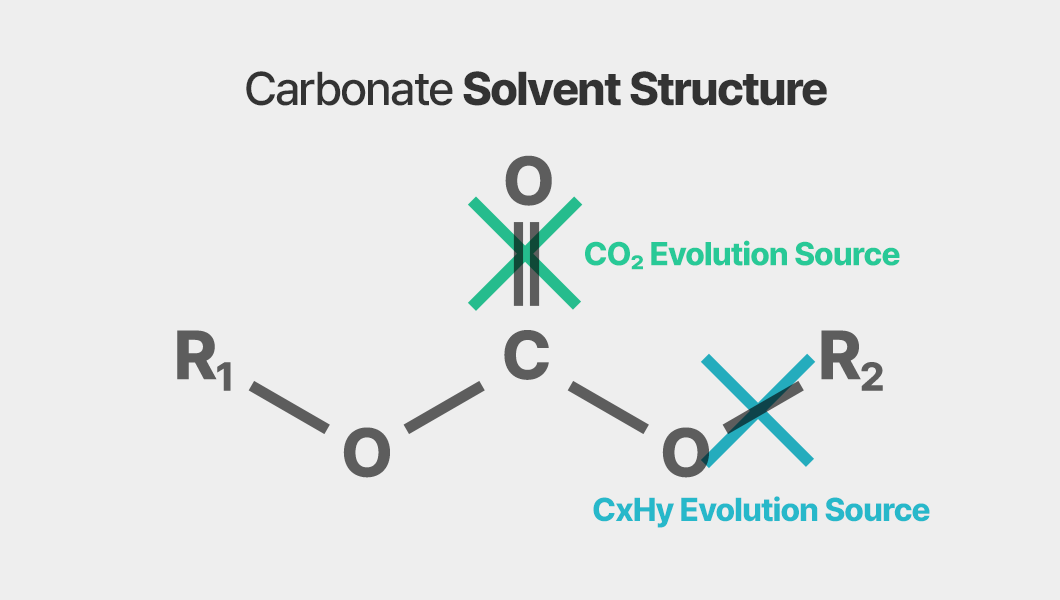
To suppress gas evolution in electrolytes, the battery industry has widely adopted carbonate-based organic solvents combined with electrolyte additives. While this approach effectively delays solvent decomposition, it presents limitations over extended operating periods.
Carbonate-based solvents feature molecular structures composed of carbonate and alkyl groups. When these structures undergo electrochemical decomposition, they can generate gases such as carbon dioxide, carbon monoxide, and hydrocarbons.
Although additives are used to suppress these reactions, they typically account for only 0.5% to 5% of the total electrolyte formulation. By comparison, organic solvents make up about 80% of the mixture. As additives are gradually consumed under prolonged operation or high-voltage and high-temperature conditions, solvent decomposition can become more active again.
To address this challenge, LG Energy Solution moved beyond improving conventional solvents with additives and instead focused on redesigning the solvent structure itself. Replacing conventional carbonate-based systems, the company developed a solvent with a molecular structure that is more resistant to decomposition. It also forms a highly durable Solid Electrolyte Interphase (SEI) layer on the electrode surface, further distinguishing it from conventional solvent systems.
What are the Benefits of LG Energy Solution’s Gas-free Solvents?
The benefits of gas-free solvents can be summarized in three key areas.
First, enhanced long-term durability. Research results showed that applying the first-generation gas-free solvent reduced the rate of internal resistance increase by approximately 53%. It also reduced gas evolution.
Second, superior high-temperature performance. Batteries have an allowable operating temperature range during fast charging. Utilizing the first-generation gas-free solvent expanded this upper limit from about 58°C to 68°C. The technology also demonstrated the potential for high-performance electrolytes to enable charging within 8 minutes.
Finally, greater cost efficiency. The formulation reduces the number of required additives from eight to five, while enhanced electrolyte retention enables a 4.2% reduction in electrolyte injection volume. Together, these improvements are expected to lower material costs and increase manufacturing efficiency.
Development Status of LG Energy Solution’s Gas-free Solvents
LG Energy Solution has completed the development of its first-generation gas-free solvent and is currently conducting validation and optimization for mass production. At the same time, the company is advancing a second-generation gas-free solvent with further improved physical properties, including viscosity. Looking ahead, LG Energy Solution aims to develop highly durable electrolyte systems based on gas-free solvents that can replace most conventional carbonate solvents.
Key Q&A
Q. What are gas-free solvents?
Gas-free solvents are electrolyte solvents designed with a stable molecular structure to suppress gas evolution during electrolyte decomposition.
Q. How are gas-free solvents different from conventional solvents?
Conventional electrolyte systems primarily rely on additives to suppress electrolyte decomposition. Gas-free solvents, on the other hand, are designed with a molecular structure that is more resistant to decomposition, thereby improving long-term stability.
Q. What are the benefits of applying gas-free solvents?
By reducing gas evolution, gas-free solvents suppress cell swelling, mitigate the rate of internal resistance increase, and improve high-temperature and fast-charging performance.
Q. What is the current development status of LG Energy Solution’s gas-free solvents?
LG Energy Solution is currently validating its first-generation gas-free solvent for mass production while also developing a second-generation version with improved physical properties.
We’ve explored what gas-free solvents are, how they differ from conventional approaches, and the progress LG Energy Solution has made in developing this technology. By redesigning the solvent structure to suppress gas evolution, gas-free solvents have the potential to contribute to longer-lasting and more reliable batteries. We look forward to sharing future developments as this technology continues to advance.
To learn more about LG Energy Solution’s gas-free solvents, check out the interview below!