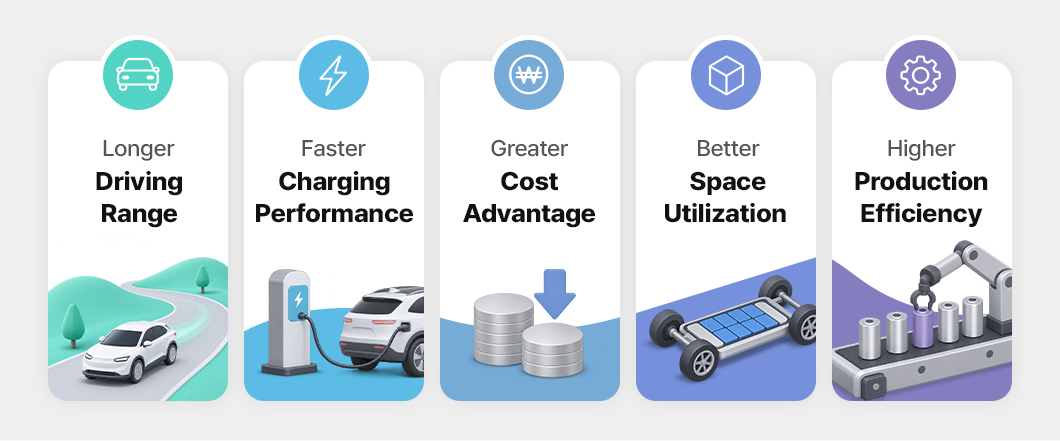
EV battery technology is advancing to extend driving range and improve charging performance while also improving vehicle cost competitiveness and boosting production efficiency. In response, automakers are experimenting with a variety of approaches, from the shape and size of battery cells to pack design and manufacturing methods.
One option drawing increasing attention is the 46-Series, a family of large-format cylindrical batteries with a diameter of approximately 46 mm. Examples include Tesla’s 4680 cell, Rivian’s R2, which features a structural battery pack incorporating 4695 cells, and BMW’s next-generation EVs equipped with Gen6 cylindrical cells.
So how does a change in cell size affect vehicle performance, battery pack design, and manufacturing efficiency? Let’s look at how the 46-Series differs from conventional small-format cylindrical cells, why it’s gaining attention in the North American market, and how LG Energy Solution is responding to this demand with its technology and North American production base.
Why Does Cell and Pack Design Matter in EV Batteries?
The competitiveness of an EV battery isn’t determined by driving range, power output, and safety alone. A battery’s weight, cost, and production speed, as well as how efficiently it can be integrated into a vehicle, are equally important. That’s why the shape and size of the cell, along with how multiple cells are grouped into modules and packs, affect not only battery performance but vehicle design as a whole.
This is also why automakers choose different battery configurations depending on a vehicle’s size, structure, and target performance. The 46-Series cylindrical battery is one option that responds to these design requirements.
What Makes the 46-Series Cylindrical Battery Different?
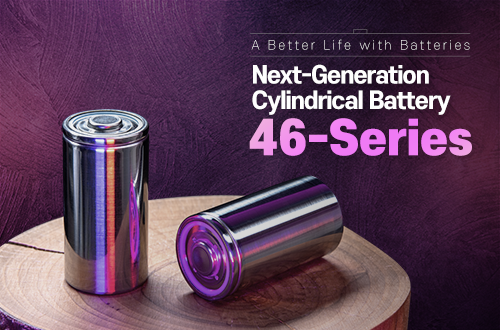
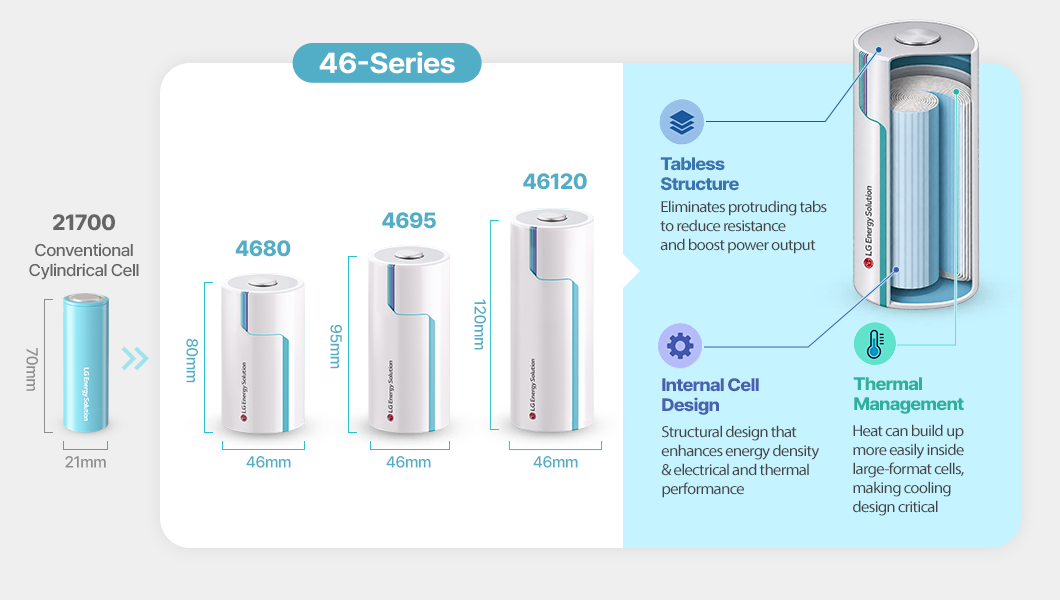
The 46-Series is a family of large-format cylindrical batteries with a diameter of about 46 mm. The lineup includes different formats based on cell height, such as the 4680, 4695, and 46120. For example, the 4680 refers to a cell with a diameter of about 46 mm and a height of about 80 mm.
Compared with the 21700 cells commonly used in EVs, which measure 21 mm in diameter and 70 mm in height, the 46-Series can store more energy in a single cell. This offers a potential advantage: fewer cells are needed to build a pack of the same energy capacity. However, higher capacity per cell doesn’t mean energy density or pack efficiency rises by the same proportion. Actual performance and cost can vary depending on cell chemistry, internal structure, cooling method, pack design, and manufacturing process.
Larger cells also bring new challenges. A key one is how to dissipate the heat generated inside the cell. Resistance can increase during fast charging, so the current path and cooling structure must be designed together. To address this, 46-Series batteries typically adopt a tabless structure, which eliminates the upper and lower tabs of the jelly roll. The tabless structure can help boost power output by reducing the resistance that arises as current flows. That said, charging performance depends on more than just the tabless structure. It is also influenced by the overall design of the cell and battery pack.
Ultimately, the competitiveness of the 46-Series doesn’t come from size alone. What matters is increasing energy capacity without compromising power output or safety, while also improving thermal management, manufacturing processes, and pack design.
Automakers Taking Notice of the 46-Series
Automakers are taking notice of the 46-Series for reasons beyond the performance of the cells themselves. When large cylindrical cells are designed together with the battery pack, body structure, and manufacturing process, they can improve space efficiency while reducing the number of parts and production costs.
① Tesla – Design That Spans from Cell to Battery Pack
Tesla uses its 4680 cylindrical cells across multiple vehicle models. It directly oversees everything from material selection and cell chemistry to manufacturing processes and quality inspections, while designing its battery packs to suit the characteristics of the cells. By using both externally supplied and in-house-produced cells, Tesla maintains an integrated approach that spans cell development, battery pack design, and validation.
② Rivian – Integrated Body Structure and Simplified Manufacturing
Rivian has announced plans to use LG Energy Solution’s 4695 cylindrical batteries in the R2, its midsize electric SUV. The R2 features a structural battery pack and large cast body components, with a focus on lowering production costs by reducing part counts and simplifying manufacturing. In its first-quarter 2026 earnings announcement, Rivian projected that by the end of 2027, the R2’s bill of materials (BOM) cost would be approximately 50% of the R1’s, with non-BOM costs also expected to decrease by more than 50%.*
*This is a target set by Rivian. Actual cost savings may vary depending on factors such as the production ramp-up and manufacturing efficiency.
③ BMW – Cell-to-Pack Design and Performance Improvements
BMW is applying Gen6, its sixth-generation eDrive technology, to its next-generation EV platform, the Neue Klasse. Gen6 batteries use cylindrical cells measuring 46 mm in diameter and 95 mm in height. Instead of grouping cells into modules, BMW uses a cell-to-pack design that assembles cells directly into the battery pack, improving space efficiency and simplifying the pack structure. According to BMW, Gen6 cylindrical cells offer 20% higher volumetric energy density than previous-generation prismatic cells, while charging performance and driving range each improve by up to 30%. Based on an 800V system, the new BMW i3 with Gen6 supports DC fast charging at up to 400 kW. BMW has announced a provisional WLTP driving range of up to 900 km.
How Is LG Energy Solution Responding to North American Demand for the 46-Series?
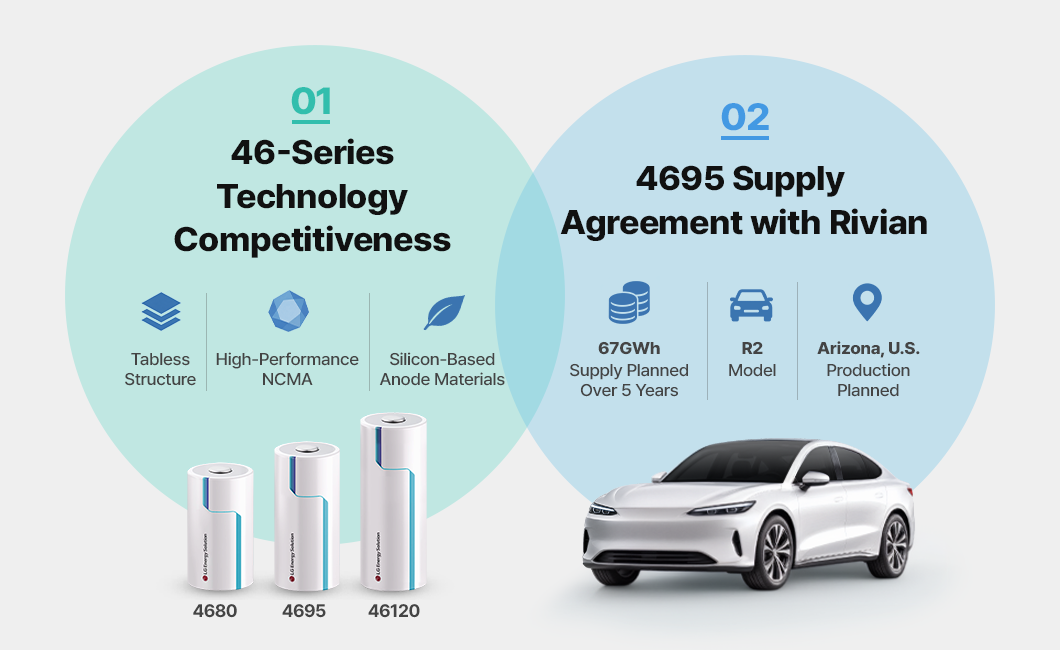
LG Energy Solution has developed a range of 46-Series cylindrical battery formats, from the 4680 to the 46120, to meet the requirements of different vehicle platforms and performance specifications. The company reduces internal cell resistance through its tabless structure and enhances energy density and power output by using high-performance NCMA cathode materials and silicon-based anode materials. As a result, the 46-Series delivers more than five times the energy and power output of conventional 21700 cells. In addition, the CAS (Cell Array Structure) design, optimized for the 46-Series, enhances structural rigidity, cooling performance, and safety.
Building on these technologies, LG Energy Solution is expanding its supply partnerships with automakers. In November 2024, it signed a supply agreement with U.S. EV maker Rivian for 67 GWh of 4695 cylindrical batteries. The batteries will be used in Rivian’s next-generation midsize SUV, the R2.
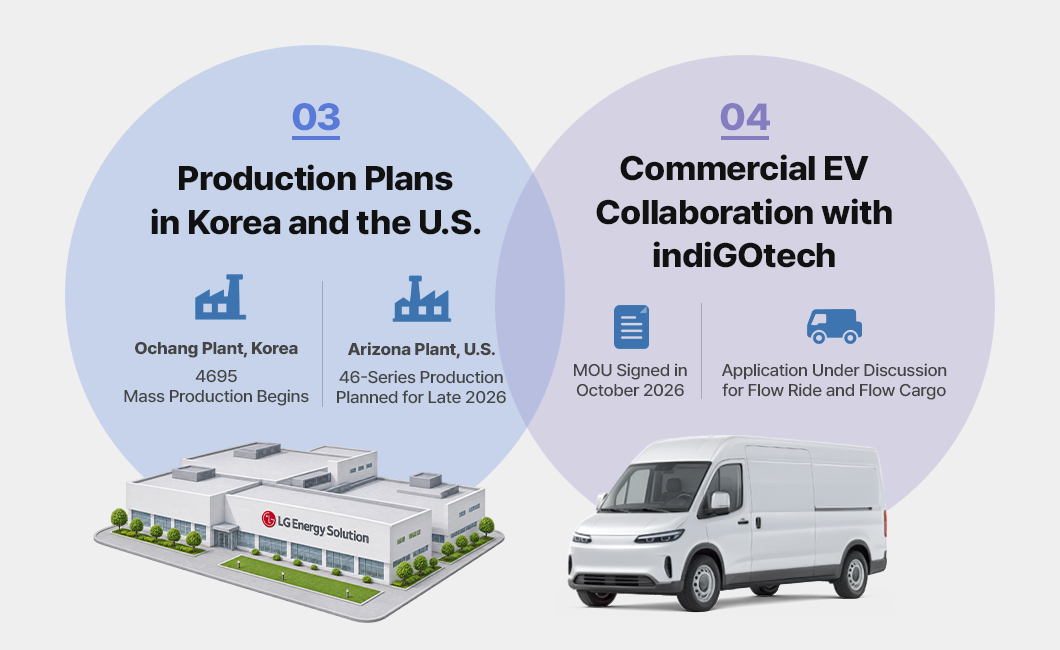
The company is also expanding its local production base. It began mass production of 46-Series batteries at its Ochang Energy Plant in Korea in late 2025. It is also preparing to produce 46-Series batteries at LG Energy Solution Arizona, where the production line is designed to deliver 50% higher equipment efficiency than before.
Applications are also expanding into commercial vehicles. In October 2026, LG Energy Solution signed a memorandum of understanding (MOU) with indiGOtech, a U.S. electric commercial vehicle startup, to discuss the potential supply of 46-Series NCM cylindrical cells. The two companies agreed to discuss prioritizing LG Energy Solution’s 46-Series cylindrical cells for use in indiGOtech’s electric commercial vehicles, the Flow Ride and Flow Cargo, over the 2027–2030 period. They also plan to discuss technical collaboration, including vehicle–battery integration and performance validation.
Key Q&A
Q. What is a 46-Series battery?
The 46-Series is a family of cylindrical batteries with a diameter of about 46 mm, available in formats such as the 4680, 4695, and 46120 depending on cell height. The size and structure of the cell affect not only energy capacity per cell but also battery pack design and how the battery is integrated into the vehicle.
Q. How does the 46-Series battery differ from conventional cylindrical batteries?
The 46-Series has greater energy capacity per cell than conventional cylindrical cells such as the 21700, so fewer cells are needed to build a pack of the same capacity. However, actual energy density, cost efficiency, and thermal management performance vary depending on cell materials, internal structure, cooling method, and pack design.
Q. Why are automakers taking notice of the 46-Series battery?
The 46-Series increases the energy capacity of the cell while allowing the battery pack, body structure, and manufacturing process to be optimized together. To improve vehicle performance and price competitiveness, automakers are considering not only cell performance but also space efficiency and production efficiency.
Q. How are automakers using the 46-Series battery?
Tesla integrates in-house production of its 4680 cells with vehicle design, while Rivian is applying 4695 cells and a structural battery pack to the R2 to integrate the battery into the vehicle structure and simplify manufacturing. BMW applies 46 mm cylindrical cells and a cell-to-pack design to its Gen6 battery, improving energy density, charging performance, and driving range.
| Automaker | Battery and Design Applied | Key Features |
|---|---|---|
| Tesla | 4680 Cell | In-house 4680 Cell production linked with vehicle design |
| Rivian | 4695 cell for the R2 | Structural battery pack aimed at body integration and simplified manufacturing |
| BMW | 46 mm cylindrical cell in the Gen6 battery | Cell-to-pack design improving energy density, charging performance, and driving range |
Q. How is LG Energy Solution responding to the 46-Series battery market?
LG Energy Solution is meeting each customer’s requirements with a lineup that includes the 4680, 4695, and 46120, backed by its materials and cell structure technologies. It has signed a supply agreement with Rivian for 4695 batteries for the R2 and is expanding its North American production base. It has also signed an MOU with indiGOtech, a U.S. commercial EV startup, to explore the potential supply of 46-Series batteries and opportunities for technical collaboration, with a view to expanding their use in commercial EVs.
Changes in battery cell size are affecting more than how much energy a cell can hold. They are also shaping pack design, vehicle structure, and production methods. As automakers introduce vehicles featuring the 46-Series and LG Energy Solution continues to advance its technology while expanding its North American production and supply capabilities, stay tuned to see how the 46-Series could shape the future of the North American EV market.