✍️Dong-hyun Han Partner
Deloitte Korea
Fueled by AI: Soaring Power Demand and Worsening Grid Bottlenecks
For years, the competitiveness of the AI industry was driven by software innovation, semiconductor performance gains, computational scaling, and algorithmic refinement. Recently, however, as these technological advances are scaled into real-world industrial operations, the hosting capacity of power infrastructure itself has emerged as a primary constraint. Consequently, the ability to secure energy infrastructure has become a new cornerstone of global competitiveness.
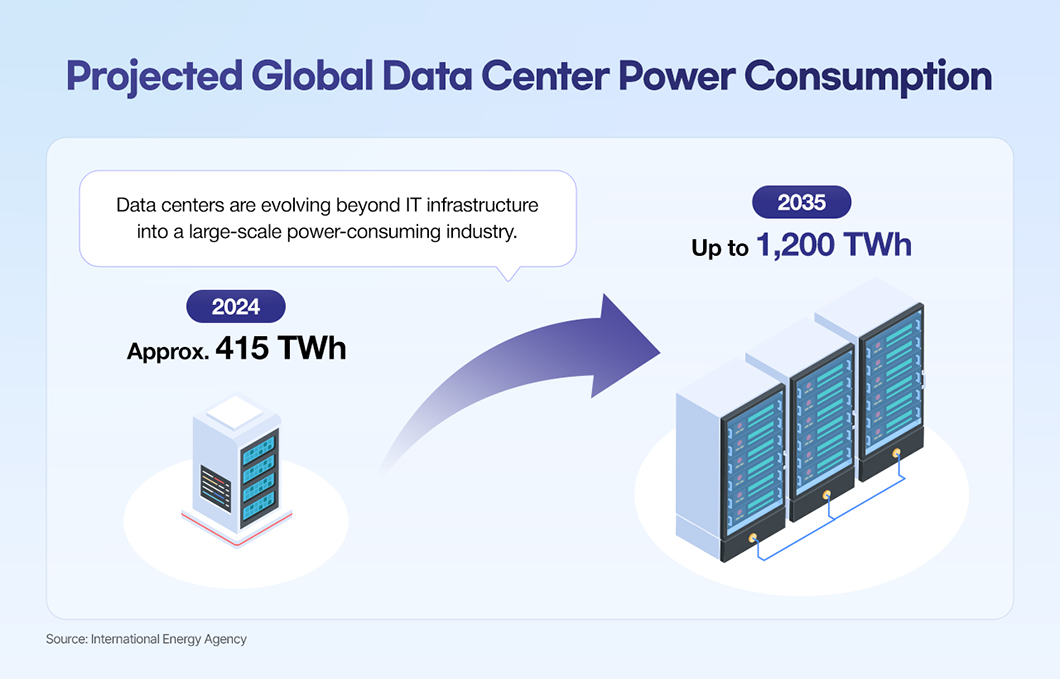
The rapid expansion of AI data centers is reshaping power demand structures, shifting the focus from scale alone to fundamental changes in load characteristics. Generative AI and HPC-based data centers are built around ultra-high-density GPU clusters, driving a sharp increase in power load density. Furthermore, their 24/7 uninterrupted operation creates a continuous demand profile close to a base load, exerting a profound structural impact on power grids compared to traditional industries. The International Energy Agency (IEA) projects that global data center electricity consumption could rise from approximately 415 TWh in 2024 to as much as 1,200 TWh by 2035.
The fundamental challenge is not a power shortage per se, but a structural mismatch between grid investment cycles and the pace of demand growth. While data centers can be built within one to two years, expanding power infrastructure—including power generation capacity, transmission network expansion and grid interconnection approvals—typically requires several years to more than a decade. Transmission networks, in particular, are subject to significant nontechnical constraints such as regulatory approvals, community acceptance, and environmental regulations, making rapid expansion effectively unfeasible.
This discrepancy leads to a deepening temporal mismatch between power supply and demand, resulting in an increasing number of cases where grid interconnection for new data centers is restricted or significantly delayed. Grid bottlenecks are no longer a localized issue, but have become a critical factor shaping global data center site selection and investment decisions.
Beyond Performance: The Shift in Global AI Competition Toward Energy Infrastructure
Power bottlenecks are becoming increasingly evident across major data center hubs worldwide. In the United States, which accounts for approximately 45% of global data center electricity consumption, transmission network saturation and grid interconnection backlogs have become a reality, particularly in Northern Virginia, where more than 600 data centers are concentrated. In some areas, utilities have already begun restricting new load connections. This suggests that the challenge now extends beyond infrastructure shortages alone, with operational constraints tied to maintaining grid stability—including voltage stability and frequency response—emerging as tangible limitations on further investment.
Europe is also nearing its grid capacity limits, with prolonged interconnection queues directly impacting the viability of new projects. Rising grid congestion costs and the increasing burden of system reinforcement charges are further intensifying business risks.
In response, major economies are complementing expanded infrastructure investment with improvements in grid operations and market structures to ease power bottlenecks. The United States is coupling expanded transmission investment with enhanced long-term transmission planning, while streamlining permitting processes to shorten project lead times.
Simultaneously, the European Union is reconfiguring its data center location strategies toward regions with surplus grid capacity. It is also expanding the adoption of on-site generation and ESS-based microgrids. This represents a structural shift aimed at reducing grid dependency and decentralizing the load by enabling localized autonomous power management.
Ultimately, competitiveness in the AI era is shifting away from mere computational power toward the ability to secure firm capacity and ensure long-term operational stability.
Structural Shift in Power Infrastructure: The Rise of BESS-Based Distributed Energy Systems
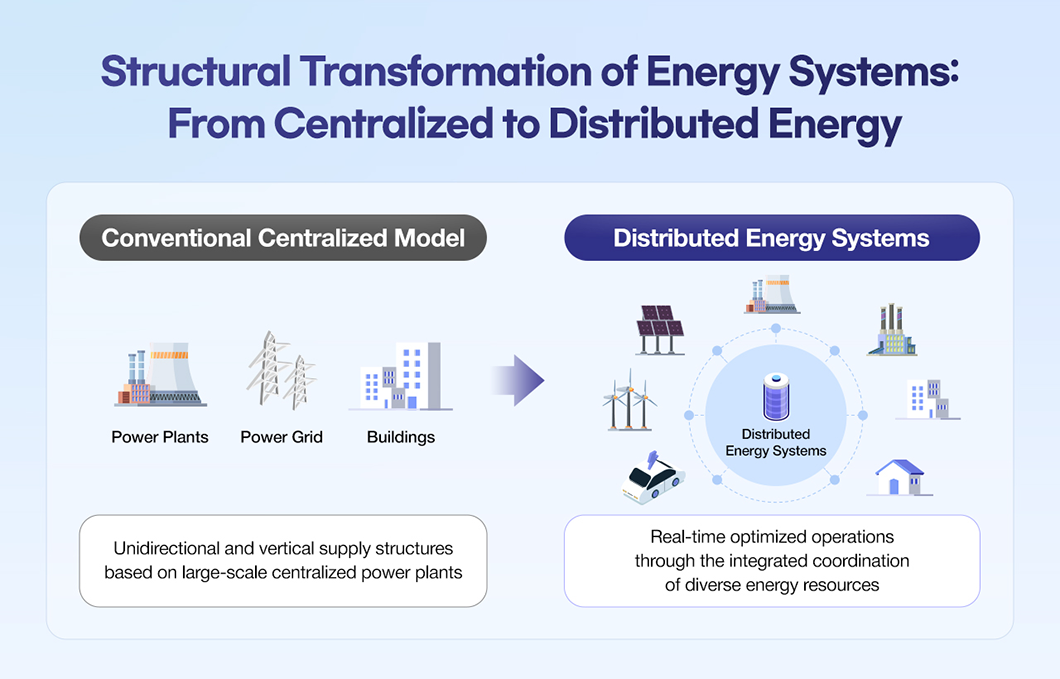
As traditional investments in power generation and transmission face limitations in addressing AI-driven demand in the short term, the power system is steadily shifting from centralized to distributed systems.
The core of a distributed energy system lies in its operational flexibility, the ability to manage generation, storage, and consumption in an integrated manner while responding to demand fluctuations in real time. As the share of renewable energy grows and supply volatility increases, the battery energy storage system (BESS) has become an essential infrastructure component to mitigate these imbalances.
Expanding beyond its traditional role as a storage facility, ESS now functions as a critical operational asset within the power system, performing a diverse range of functions:
- Peak load management
- Grid stabilization (frequency regulation, ramp-rate control)
- Revenue generation through power market participation
Furthermore, long-duration energy storage (LDES) is emerging as a pivotal technology for mitigating the extended supply-demand imbalances inherent in renewable-based power systems.
According to Deloitte’s AI Infrastructure Survey, 82% of respondents identified technological innovation as the primary means to bridge the infrastructure gap, with ESS and LDES projected as key technologies to meet the surge in power demand. This reflects a paradigm shift in power infrastructure—from a focus on capacity expansion to one centered on operational optimization.
In particular, the U.S. Inflation Reduction Act (IRA) is reshaping project financing structures by recognizing ESS as an independent investment asset, while simultaneously accelerating supply chain reorganization through local production requirements. This policy environment is pushing ESS providers to evolve beyond simple equipment supply toward business models that incorporate investment and operational capabilities.
Data Center Reliability: Advancing Power Operations via UPS and BBU
AI data centers require significantly higher power quality standards compared to traditional industries. In GPU-based high-density computing environments, load fluctuations occur rapidly and irregularly, increasing the stress placed on both the grid and the power facilities.
In such environments, power quality management and high availability (uninterrupted operation) have become the core operational pillars, moving beyond the simple provision of electricity.
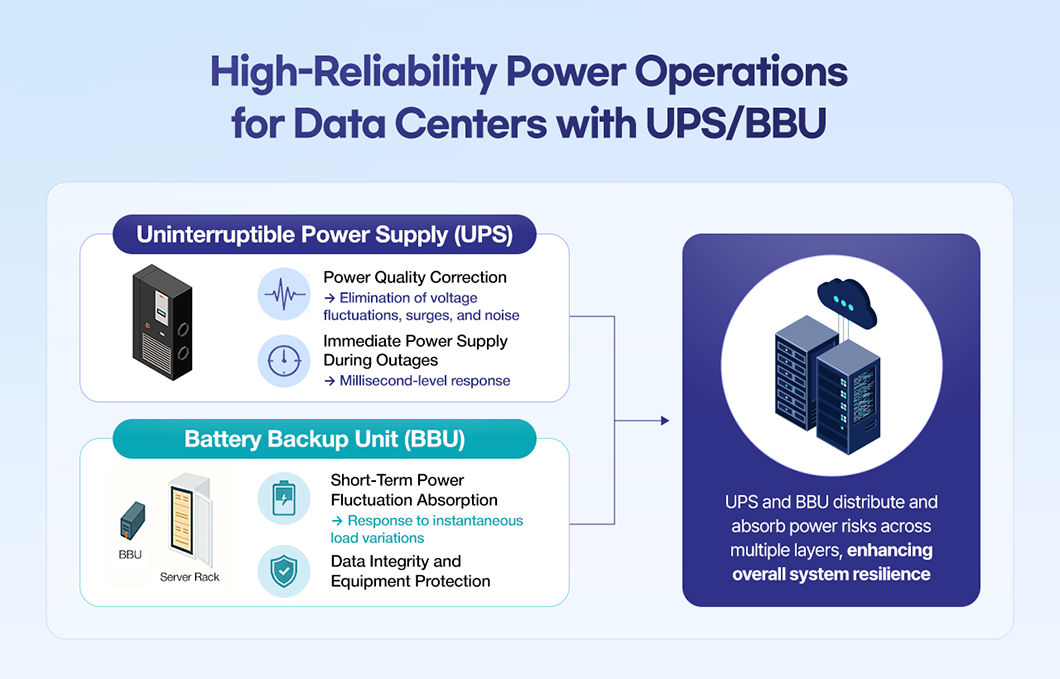
In the event of a grid anomaly, the uninterruptible power supply (UPS) ensures power continuity by supplying electricity within milliseconds while maintaining system stability by controlling voltage fluctuations and surges. Simultaneously, the battery backup unit (BBU) absorbs ultra-short-term power fluctuations at the server and rack levels, preventing localized failures from cascading through the entire system.
This multi-layered power stabilization architecture is designed to incrementally absorb power risks across the grid, facility, and server levels. Consequently, it functions as the critical infrastructure that dictates the service continuity and overall reliability of the data center.
Evolution Toward Advanced and Intelligent Energy Infrastructure Operations
The competitiveness of power infrastructure is entering a stage where it is determined not by the scale of facilities, but by the efficiency of their operations.
Virtual power plants (VPPs), which integrate distributed energy resources to operate as a single unified power plant, are becoming a key means of balancing supply and demand in real time and ensuring grid flexibility. By integrating renewables, ESS, and demand response (DR), VPPs can significantly mitigate grid congestion and enhance peak-shaving capabilities.
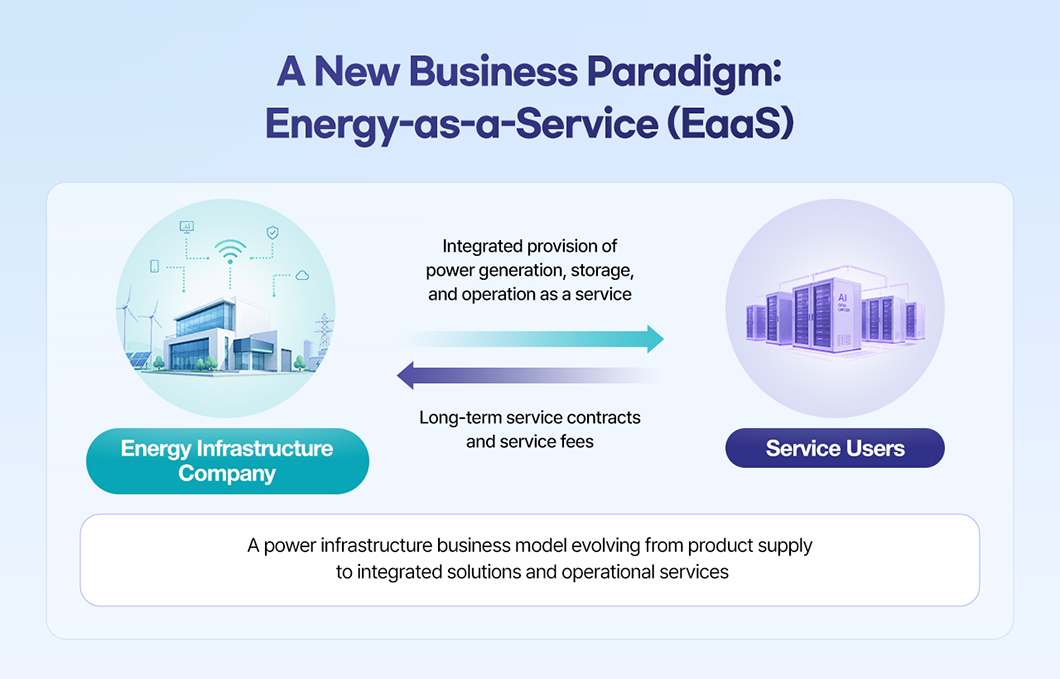
In addition, the energy-as-a-service (EaaS) model transforms energy infrastructure from an owned asset into a service-based model, reducing capital burdens for customers while maximizing operational efficiency. For data center operators, this serves as an important strategic option by externalizing power-related risks and enabling greater focus on core business operations.
These shifts are accelerating a paradigm shift across the entire power industry—from a product-centric model to one centered on operational capabilities.
The Evolution of Battery Companies: From Suppliers to Integrated Management and Operations Providers
In high-power demand industries, including AI data centers, the challenge has evolved beyond merely securing electricity. It is now essential to simultaneously ensure power quality, reliability, and flexibility to respond to fluctuating demand. Within this shifting landscape, the role of battery-based solutions is expanding rapidly.
While the traditional role of battery companies was confined to supplying cells and modules, today’s market demands a more complex set of functions that encompass the entire power infrastructure. Beyond the deployment of ESS, success now hinges on integrated capabilities: system integration (SI) to organically connect diverse power assets, energy management systems (EMS) to control power flow in real time, and operational data-based optimization capabilities.
These shifts are fundamentally transforming the business models of battery companies. Leading global players are moving beyond traditional manufacturing-centric structures to rapidly transition into energy solution providers that offer integrated storage, distribution, and operational services. This represents more than an expansion of the value chain; it signals a broader redefinition of their role and positioning within the power infrastructure market.
In the future, the competitiveness of a battery company can no longer be defined by cell technology alone. The core competitive advantage is now shifting toward total execution capability: the ability to design and execute projects based on a deep understanding of power systems, the technical expertise to optimize power operations in complex demand environments, and the strategic flexibility to navigate rapidly evolving policies and market landscapes.
As the energy infrastructure paradigm is reshaped for the AI era, battery companies are positioning themselves as integral components of the power system rather than simple suppliers. Their influence and impact are projected to expand even further in the years to come.
※ The views expressed in this column are those of the author and do not necessarily represent the official position or strategy of LG Energy Solution.