What is the first step in electrode manufacturing? The answer lies in slurry, which is created through the mixing process. Slurry is made by blending active material, conductive additive, binder, and solvent in specific proportions. The resulting slurry is then coated onto the current collector to form the cathode and anode. Because the properties of the mixture affect the structural stability and electrical characteristics of the electrode, slurry can be regarded as the foundation of electrode performance. In this infographic, we take a closer look at the three key components that make up slurry.
Key Slurry Component 1: Active Material That Generates Electrical Energy
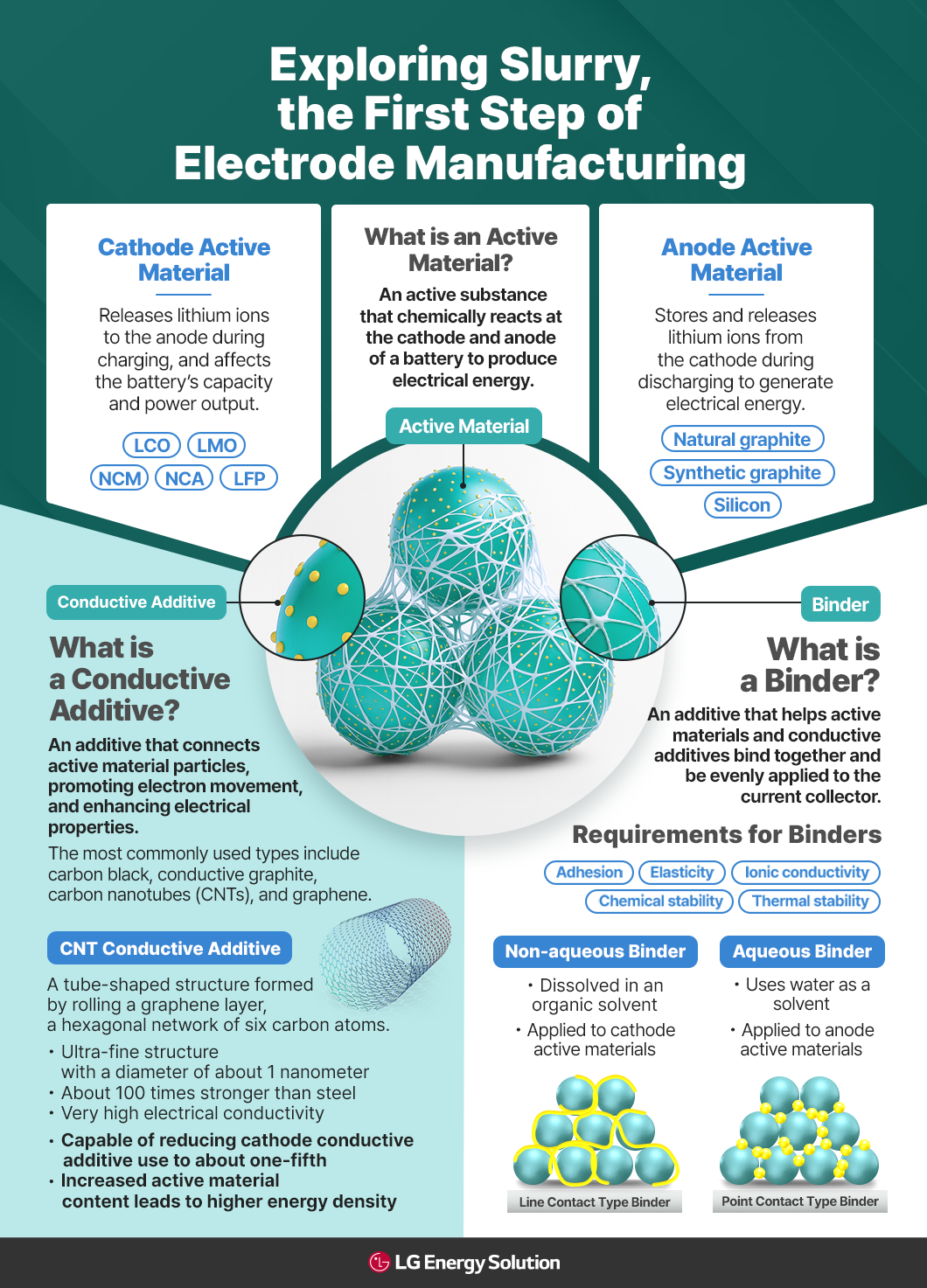
Active material refers to the substance that generates electrical energy inside a battery. When a battery charges and discharges, chemical reactions occur at the cathode and anode, producing electrical energy. The material directly responsible for these reactions is the active material.
*View: Battery Glossary – Active Material
Active material used in the cathode and anode is referred to as cathode active material and anode active material, respectively.
Cathode active materials release lithium ions to the anode during charging and receive them again during discharging. They play an important role in determining battery capacity and output. Representative cathode active materials include LCO (Lithium Cobalt Oxide), LMO (Lithium Manganese Oxide), NCM (Nickel Cobalt Manganese), NCA (Nickel Cobalt Aluminum), and LFP (Lithium Iron Phosphate). Different cathode materials are applied depending on battery application and required performance.
Anode active materials store lithium ions that move from the cathode and release them again during discharging, generating electrical energy. Natural graphite and artificial graphite are widely used because their well-ordered layered structures can stably store lithium ions. Recently, silicon has also gained attention for its ability to achieve higher energy density than graphite, driving the development of various anode materials.
Key Slurry Component 2: Binder That Holds the Electrode Materials Together
Binder is an adhesive that helps the components of the slurry bind together. It ensures that the active material and conductive additive are uniformly mixed and coated onto the current collector, helping maintain the stability of the electrode.
As research into next-generation active materials intensifies, the importance of binders continues to grow. Binders are required to maintain the structural stability of the electrode while also supporting ion transport. For this reason, binders must meet multiple requirements, including adhesion strength, mechanical strength, elasticity, ionic conductivity, and chemical and thermal stability.
Binders are divided into non-aqueous and aqueous types depending on the solvent used. Non-aqueous binders that use organic solvents such as NMP (N-Methyl-2-Pyrrolidone) are mainly applied to cathode active materials and form a line-contact structure between particles. In contrast, aqueous binders that use water as the solvent are mainly applied to anode active materials and form a point-contact structure centered at particle contact points.
Representative non-aqueous binders include PVDF (Polyvinylidene Fluoride), PTFE (Polytetrafluoroethylene), and PAN (Polyacrylonitrile). Aqueous binders include combinations such as CMC (Carboxymethyl Cellulose) and SBR (Styrene-Butadiene Rubber), as well as materials such as PAA (Polyacrylic Acid) and PAM (Polyacrylamide).
Key Slurry Component 3: Conductive Additive That Creates Pathways for Electron Transport
Conductive additive is a material that connects active material particles and helps electrons move smoothly between them. In other words, it links the active materials to provide electrical characteristics. Although it is added in small amounts, it contributes to improving battery performance.
The most widely used conductive additive is carbon black. In addition, conductive graphite, carbon nanotubes (CNTs), and graphene are also used.
In particular, CNT conductive additives have a tube structure formed by graphene layers arranged in a hexagonal lattice. Despite having an ultra-fine diameter of about 1 nanometer, they exhibit strength approximately 100 times greater than steel and have very high electrical conductivity.
Using CNTs can reduce the amount of conductive material required in the cathode to about one-fifth. As a result, the amount of active material can be increased, which helps improve the energy density of the battery.
Through this infographic, we have examined the roles of active material, binder, and conductive additive that make up slurry. Although each component performs a different function, a stable electrode can only be achieved when these three components are properly balanced within the slurry.
In future posts, we will continue to introduce a wide range of battery technologies in a clear and accessible way.