Cathode materials, anode materials, separators, and electrolytes are commonly referred to as the four key components of lithium-ion batteries. Each component plays a different role, but all are essential to improving battery performance. Among them, the anode is responsible for storing lithium ions released from the cathode. The amount of lithium ions the anode can stably store directly affects battery performance, such as lifespan and charging speed. For this reason, the battery industry continues to conduct research on anode technologies.
One of the technologies that has emerged from this research is anodeless battery technology. In this installment of Battery Glossary, we take a closer look at what an anodeless battery is and why it is gaining attention as a next-generation battery technology.
What is Anodeless?
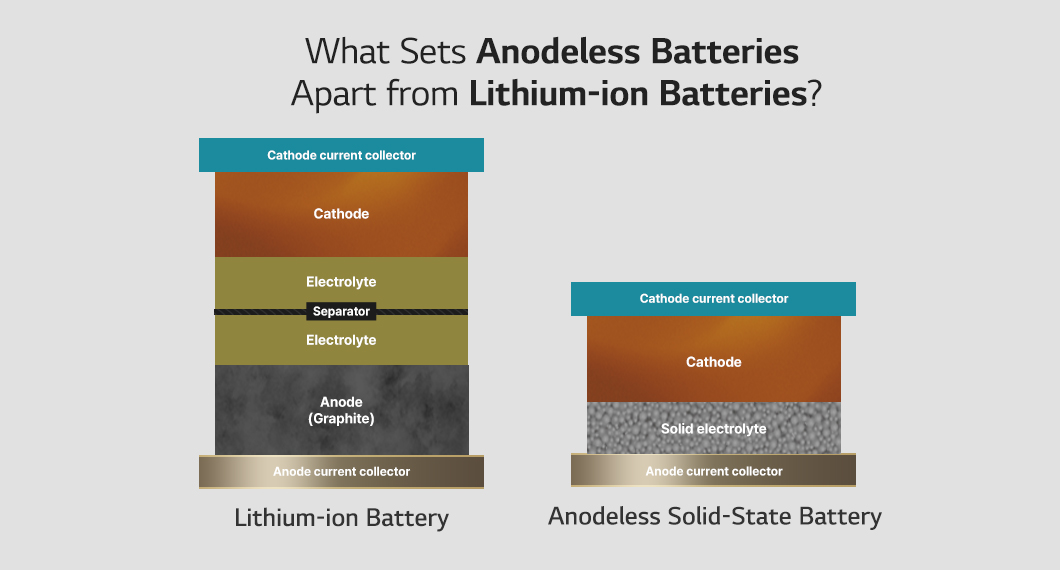
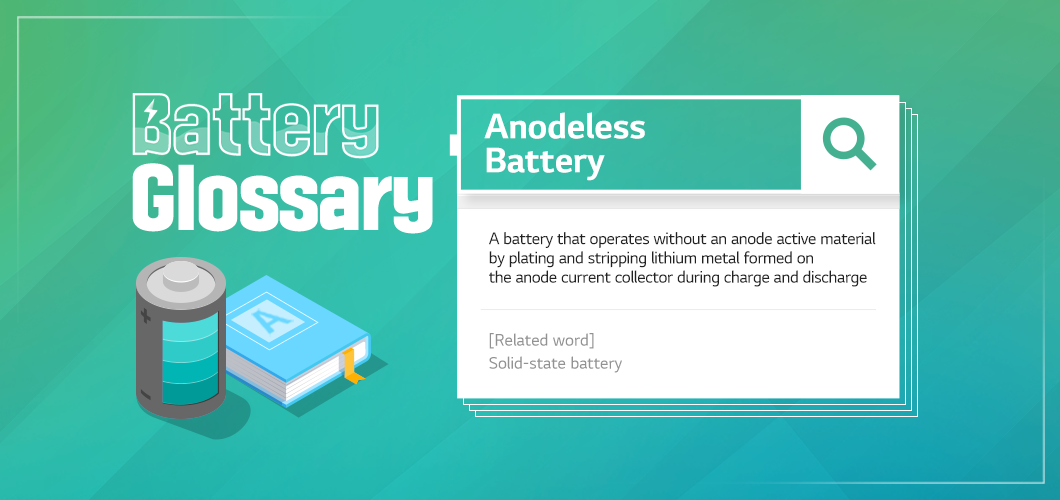
Anodeless refers to a battery structure in which no anode active material exists inside the cell. The absence of an anode material also means there is no host structure for storing lithium ions.
Then how does an anodeless battery charge and discharge without an anode? During charging, lithium ions released from the cathode combine with electrons and are plated in the form of lithium metal on the anode current collector, forming an anode. During discharging, the lithium metal loses electrons and is stripped back into lithium ions, which then move to the cathode. In other words, the cell operates with a structure in which the anode is formed and removed repeatedly, even without a separate lithium metal anode.
Advantages of Anodeless Batteries as a Next-Generation Technology
Anodeless batteries are gaining attention as a next-generation battery option due to several advantages. What are these advantages?
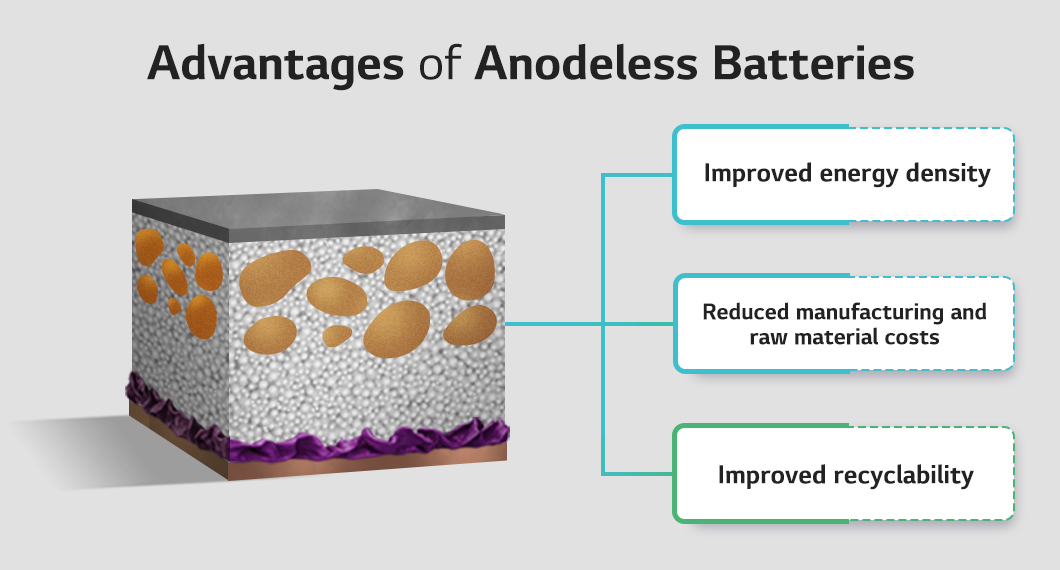
● Improved energy density: Unlike conventional secondary battery structures, anodeless batteries plate lithium ions only during charging. This makes it possible to reduce the initial cell thickness. As a result, space utilization improves, enabling more lithium to be stored within the same volume and increasing volumetric energy density.
● Reduced manufacturing and raw material costs: Because anodeless batteries do not use anode active materials, parts of the anode manufacturing process can be simplified. This leads to reduced manufacturing and raw material costs, as well as improved process efficiency. Lithium metal anodes typically require processing environments equivalent to or more stringent than dry-room conditions to prevent oxidation caused by high chemical reactivity. Anodeless battery manufacturing does not require such environments, which is considered another advantage.
● Improved recyclability: In anodeless batteries, lithium metal is not present in the discharged state. This creates the potential for easier recycling.
Limitations of Anodeless Batteries
In theory, anodeless batteries can be applied to most battery systems. However, several challenges must be addressed before commercialization.
● Reduced Coulombic Efficiency (CE): When an anodeless structure is applied to lithium-ion batteries using liquid electrolytes, reduced Coulombic Efficiency caused by lithium side reactions must be overcome. Coulombic Efficiency is an indicator of how efficiently a battery retains electric charge without loss during charge and discharge cycles.
During cycling, lithium must be plated and then recovered as lithium ions. However, chemical reactions between lithium and liquid electrolytes can prevent full recovery, leading to lithium loss. As a result, implementing an anodeless structure in liquid-electrolyte-based systems may lead to reduced lifespan and performance.
*View Battery Glossary – Coulombic Efficiency (CE)
● Dendrite formation: If the affinity between the anode current collector and lithium is low, lithium may not plate uniformly, resulting in dendrite formation. If dendrites penetrate the separator and reach the cathode, they can cause short circuits and degrade battery performance and safety, making this an issue that must be resolved.
LG Energy Solution’s Application of Anodeless Structure to Solid-state Batteries
To overcome these limitations, LG Energy Solution has applied an anodeless structure to solid-state batteries and introduced specialized process technologies.
Solid-state batteries use solid electrolytes instead of liquid electrolytes, making them relatively more stable and minimizing side reactions. When configured with an anodeless structure, plating and stripping cycles can be repeated more stably, reducing lithium loss and helping maintain performance.
In addition, LG Energy Solution has applied two process technologies to the anode current collector to suppress dendrite formation: lithiophilic material (LPM) coating and oxidation treatment.
LPM coating involves uniformly distributing lithiophilic metal materials such as silver, gold, platinum, zinc, and magnesium across the surface of the current collector. This prevents lithium from concentrating in specific areas. Oxidation treatment is applied to enhance lithium affinity in areas of the anode current collector that are not coated with LPM. Through this approach, it was possible to minimize any reduction in electrical conductivity, which is an essential function of the current collector.
So far, we have explored the concept of anodeless batteries. To learn more about LG Energy Solution’s ongoing research on anodeless batteries, please check out the content below.