Along with the rapid growth of the EV market, battery demands are becoming increasingly diverse. In addition to high energy density for longer driving ranges and fast charging, cost competitiveness is also required to address rising raw material prices and supply chain risks. Amid this trend, a new battery type is gaining attention: the lithium manganese-rich (LMR) battery. In this session, we’ll take a closer look at them.
What Is a Lithium Manganese-Rich (LMR) Battery?
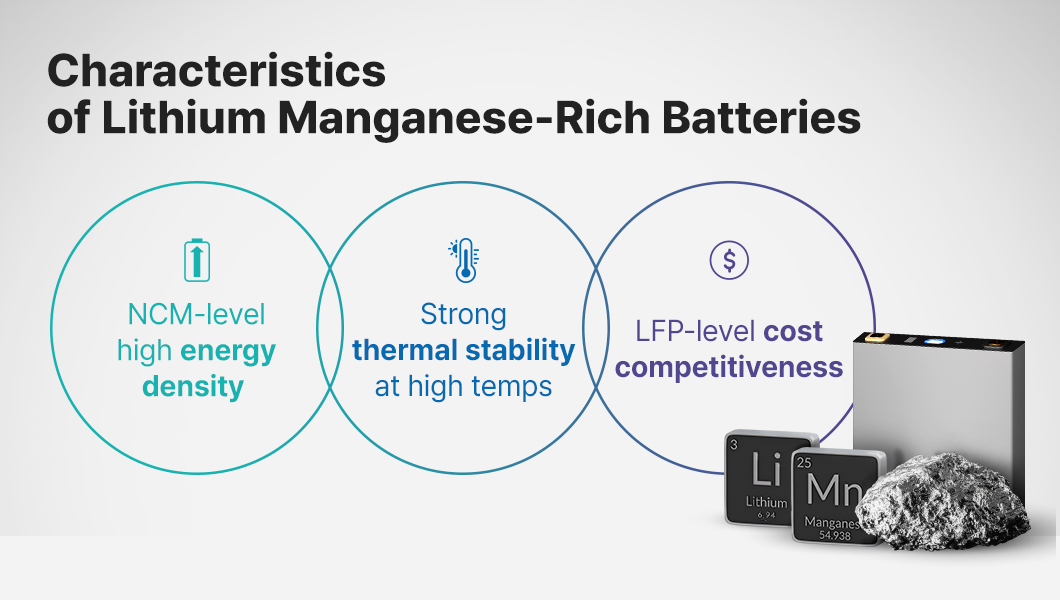
As the name suggests, it is a type of lithium-ion battery whose cathode contains higher proportions of lithium (Li) and manganese (Mn).
Compared with conventional nickel cobalt manganese (NCM) batteries, LG Energy Solution’s LMR batteries increase the manganese content to about 60–65% and pursue a cobalt-free (Co-free) design that uses little or no cobalt, an element associated with significant environmental concerns.
Manganese is abundant, with global reserves of around 1.5 billion tons, making it relatively affordable and ensuring a stable supply of raw materials. As demand for EVs surged recently, cost competitiveness has become a key challenge in battery development. LMR batteries are regarded as a new composition, standing out for their cost efficiency comparable to lithium iron phosphate (LFP) batteries, while offering higher energy density.
* Learn more about NCM batteries
* Learn more about LFP batteries
What Are the Characteristics of LMR Batteries?

The higher lithium content of LMR cathode materials compared to conventional ones enables a high theoretical capacity1 of over 250 mAh/g across the output voltage range, including high voltages. This value is close to conventional ternary (NCM) cathode materials (about 275–280 mAh/g) and approximately 47% higher than LFP (about 170 mAh/g).
Driven by this high capacity, the energy density of LMR batteries is comparable to NCM and about 33% higher than LFP (120–160 Wh/kg).
In addition, LMR cathode materials have a layered structure containing stable Mn4+, which releases little oxygen even at high temperatures, demonstrating excellent thermal stability from the initial state. These advantages improve safety during processes such as assembly, transportation, and storage.
Combining high energy density, structural stability, superior thermal properties, and affordability, LMR batteries are gaining attention as a next-generation technology that balances performance and safety in EV batteries.
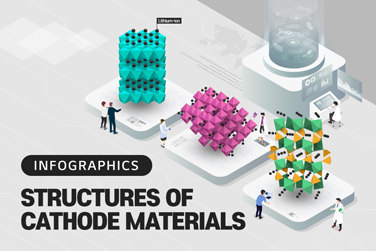
*Learn more about the layered structure of cathode materials.
Sustainability of LMR Batteries for the Eco-Friendly Era
LFP batteries have low recycling efficiency because they are based on iron (Fe), which has a low recovery value, and contain less than 2% lithium, which is costly to extract. In contrast, LMR batteries offer high recycling value, containing around 8% lithium and other rare metals with high economic value, such as nickel and manganese. Additionally, cobalt-free LMR batteries reduce manufacturing costs and improve overall economics by eliminating the use of expensive cobalt. They also help mitigate ethical concerns and environmental damage associated with cobalt mining, contributing to more sustainable battery production. As such, LMR batteries are a sustainable solution—environmentally friendly through raw material recycling and cost-efficient in manufacturing.
What Are the Technological Challenges in Developing LMR Batteries?
While LMR batteries are recognized for their potential as next-generation batteries, several technological challenges remain before commercialization. First, they exhibit low Initial Coulombic Efficiency (ICE), which can cause lithium loss during the first charge and lead to capacity degradation. Another challenge is the gradual decrease in output voltage during repeated charge-discharge cycles, which can affect energy efficiency over time.
To overcome these limitations, researchers across the industry are committed to material and process innovation to enhance structural stability through coating and doping technologies.
Lithium Manganese-Rich (LMR) batteries have emerged as a leading next-generation battery technology, offering a well-balanced combination of price competitiveness, high energy density, safety, and sustainability. Could LMR batteries accelerate the adoption of EVs sooner than expected and reshape the landscape of the battery industry? Look forward to the new possibilities and changes that LMR batteries will bring.
- Theoretical capacity: the maximum electric charge (mAh/g) that 1 g of active material can store and release under ideal conditions. (↔ Reversible capacity: the amount of electric charge that can be repeatedly stored and released during actual charging and discharging.) ↩︎