Two lithium-ion batteries with the same capacity can still have very different prices. Why?
The answer goes beyond raw material prices. Battery cost comes down to a combination of factors: which materials go into the battery, how those materials are sourced, and how the battery is built. Lately, policy has become a fourth factor in that equation. With the energy storage system (ESS) market growing rapidly in North America and the U.S. Inflation Reduction Act (IRA) now in effect, how a company secures raw materials and where it manufactures its batteries have become just as important to cost competitiveness as the materials themselves.
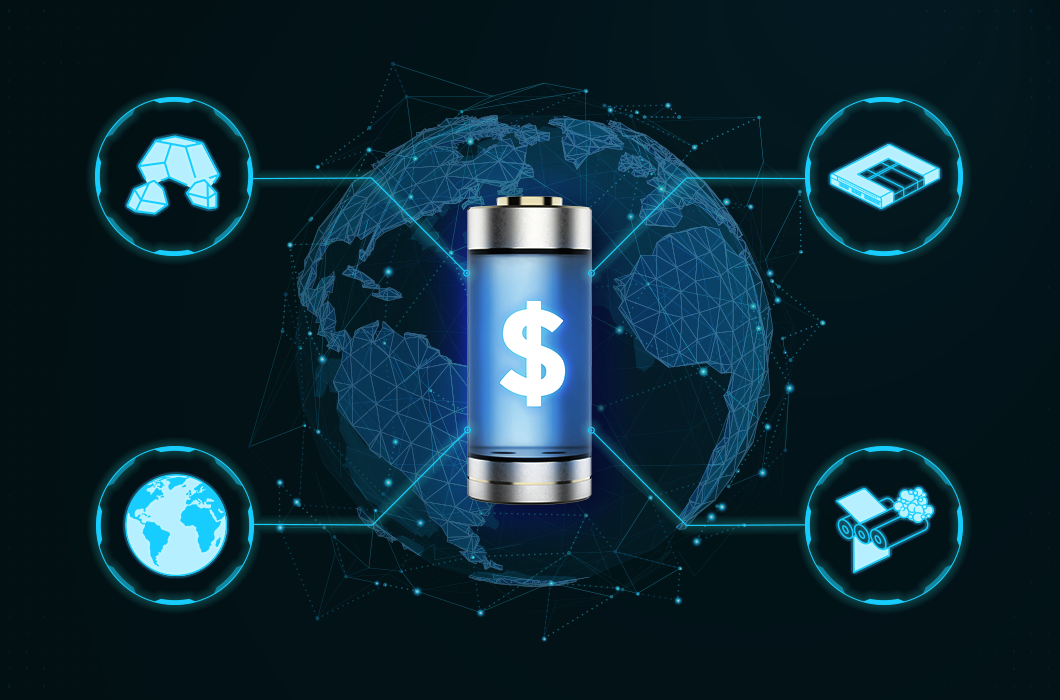
Let’s take a closer look at the three core factors that shape battery pricing: materials, supply chains, and manufacturing technology.
How Do Battery Materials Affect Battery Cost?
The materials used in a battery determine more than just performance—they define its entire cost structure. Among them, the cathode material accounts for the largest share of raw material costs, and the specific mix of elements used has a direct impact on both performance and price.
Cathodes typically draw from a handful of elements: lithium (Li), nickel (Ni), cobalt (Co), manganese (Mn), iron (Fe), and phosphorus (P). LFP (lithium iron phosphate) is built around iron and phosphate, while NCM (nickel-cobalt-manganese) and NCA (nickel-cobalt-aluminum) center on nickel and cobalt combined with other metals. Materials based on iron and phosphate are generally more cost-competitive than those based on nickel or cobalt, which is why LFP and NCM/NCA batteries differ not just in performance characteristics, but in cost structure as well.
Even within the same NCM/NCA family, chemistry matters. Higher nickel content typically increases energy density, but it also drives up material costs depending on the amounts of cobalt and other metals included.
For this reason, choosing a cathode material is not about finding the lowest-cost option—it requires balancing performance and cost for the intended application.
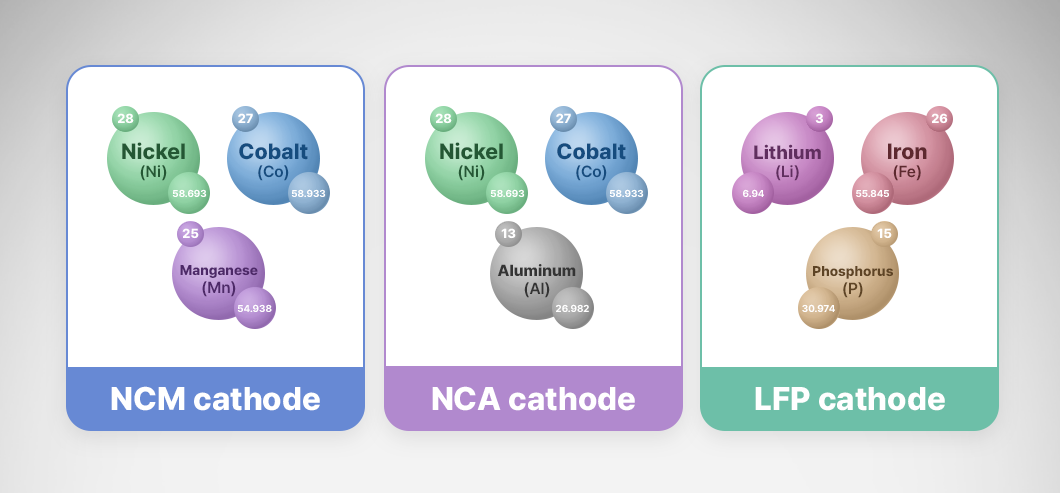
● LFP cathodes use iron and phosphate, which can provide cost and safety advantages. These characteristics make LFP well suited to applications such as ESS and cost-conscious EV segments.
● NCM/NCA cathodes are nickel-based materials combined with other metals to achieve high energy density. They are widely used in high-performance EVs that require long driving range and high power output.
Once a material has been selected, is the price fixed? Not quite. Even with the same material, cost can still differ significantly depending on how that material is sourced.
How the Raw Material Supply Chain Affects Battery Cost
Battery pricing also depends on how reliably a company can secure raw materials. When supply chains are disrupted, sourcing costs rise, leading to higher manufacturing costs and ultimately affecting cost competitiveness.
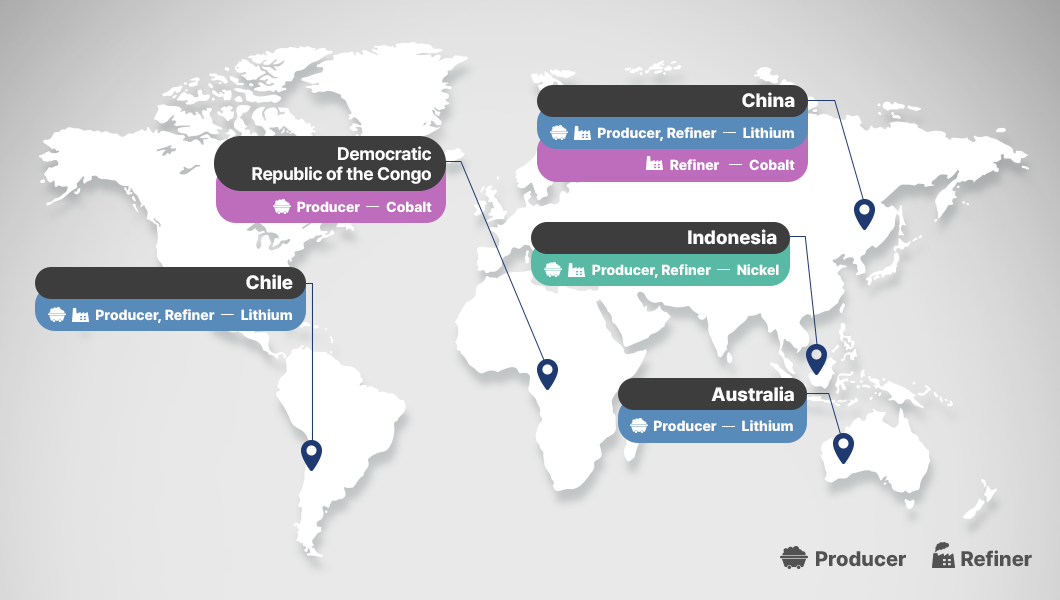
The challenge is that the supply of key minerals is heavily concentrated in just a few regions. Mining and refining capacity for lithium, nickel, and cobalt is limited to a handful of countries, and refining is even more concentrated. China is a major producer and refiner of lithium and refiner of cobalt, while Indonesia both produces and refines nickel. Chile produces and refines lithium as well, the DRC is a leading cobalt producer, and Australia is a major lithium producer. This concentration makes it hard to switch to alternative suppliers quickly. A production disruption, export restriction, or geopolitical event can throw off the entire chain. As a result, instability in raw material supply leads to higher manufacturing costs.
Rather than easing, that concentration is becoming even more pronounced. According to the International Energy Agency (IEA), roughly 90% of the growth in refined output for key minerals between 2020 and 2024 came from a single top-producing country per mineral.1 This has prompted companies to diversify their sourcing and build more resilient supply networks.
Policy has added another layer to this equation. In North America, IRA tax credit requirements and Foreign Entity of Concern (FEOC) rules are now shaping how companies structure their supply chains. The IRA offers tax credits and other incentives to companies and products that meet certain criteria, driving battery production and supply chain investment in the U.S. Meanwhile, FEOC rules are designed to reduce supply chain dependence on specific countries.
As a result, companies are diversifying their supplier base and expanding local production—both to manage supply chain risk and to meet policy requirements. Where materials are sourced and where batteries are manufactured are no longer just logistics decisions; they directly shape manufacturing cost, supply stability, and ultimately how competitively priced the final product can be.
How Does Battery Manufacturing Affect Cost?
Once the materials are secured, the next step is manufacturing the battery—and battery pricing is also influenced by how the battery is manufactured. Simplifying the manufacturing process or optimizing product design can reduce equipment investment, energy use, part count, and assembly steps.
This is why many process and design innovations are being introduced. Two notable examples are the Dry Electrode Process and Cell to Pack (CTP) technology.
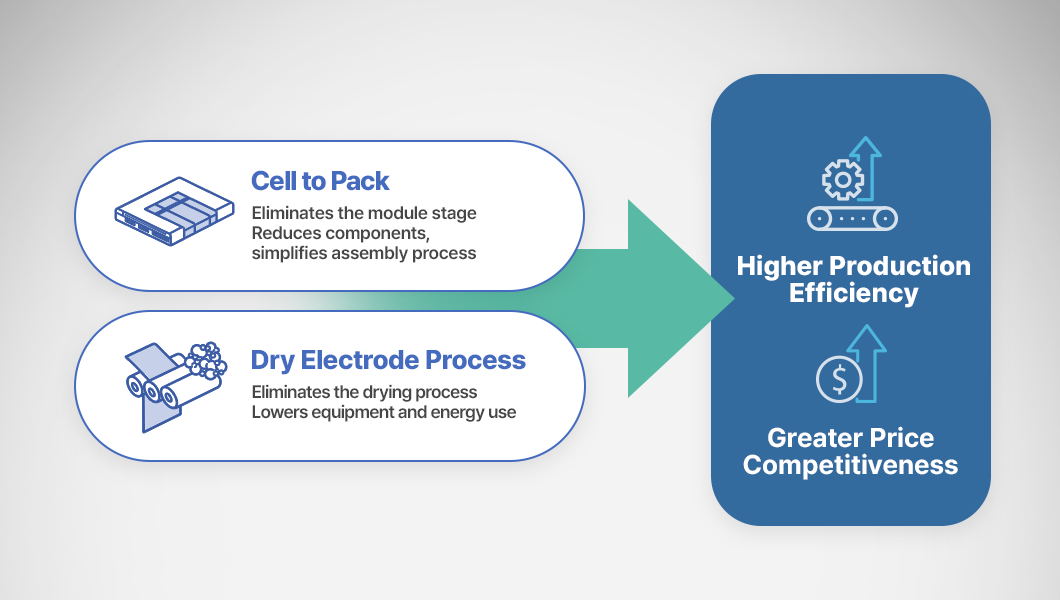
● Dry Electrode Process: Unlike the conventional wet process, which relies on liquid solvents, this method processes electrode materials directly in powder form. Eliminating the drying step and solvent recovery equipment lowers equipment investment and energy use, improving overall manufacturing efficiency.
● Cell to Pack (CTP): Cell to Pack (CTP) eliminates the conventional module stage by placing cells directly into the battery pack. Beyond reducing the number of parts and assembly steps a module would otherwise require, it also uses space inside the pack more efficiently, allowing more cells to fit in the same footprint or increasing energy density.
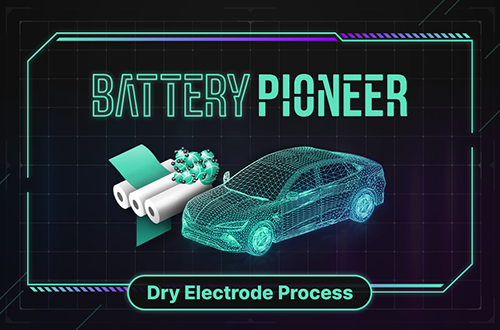
*View: Battery Pioneer – Innovative Cell-to-Pack Technology that Eliminates Modules
*View: A Better Life with Batteries – The Dry Electrode Process: Electrodes Without Drying
How LG Energy Solution Achieves Cost Competitiveness
Materials, supply chains, and manufacturing technology do not operate in isolation. They work together to shape a battery’s entire cost structure. LG Energy Solution takes all three into account to optimize the cost structure of each product and deliver cost-competitive battery solutions.
1) A Product Portfolio Tailored to Each Application
LG Energy Solution offers products tailored to the requirements and performance needs of each industry. As the North American ESS market grows rapidly, the company is expanding its LFP-based ESS lineup while continuing to supply premium NCMA and NCM products for high-performance EVs. Matching the right material to the right application helps balance performance and cost.
2) A Diversified Supply Chain for Core Raw Materials
Securing a stable supply of key materials is an ongoing priority. LG Energy Solution has partnered with global companies like Electra, Snow Lake, Compass Minerals, and Vulcan Energy to establish supply chains for lithium, cobalt, nickel, and other critical minerals. Broadening its sourcing base reduces supply chain risk and mitigates the impact of raw material price fluctuations.
3) Next-Generation Manufacturing Innovation
LG Energy Solution continues to invest in manufacturing innovations such as the Dry Electrode Process and Cell to Pack. The company is also applying AI across various stages of production, including battery design and equipment operation—driving operational efficiency and, in turn, enhancing manufacturing cost competitiveness.
Key Q&A
Q: What determines battery price?
Battery price comes down to a combination of factors—the materials used, target performance, manufacturing process, and supply chain. Not just size or capacity.
Q: Why does cathode material matter for cost competitiveness?
Cathode material is one of the biggest drivers of both cost and performance. The types and proportions of minerals used can affect both the battery’s performance and its cost structure.
Q: Why does the supply chain matter?
The more reliably a company can secure core raw materials, the more stable its supply chain operations become—which directly supports cost competitiveness.
Q: Does manufacturing technology also affect battery price?
Yes. Manufacturing innovations like the Dry Electrode Process and Cell to Pack (CTP) enhance production efficiency and help lower manufacturing costs.
Q: How does LG Energy Solution stay price-competitive?
By integrating materials, supply chain, and manufacturing technology to optimize the cost structure of each product. Through a diverse product portfolio, stable raw material sourcing, and manufacturing innovations such as the Dry Electrode Process and Cell to Pack, LG Energy Solution delivers cost-competitive battery solutions.
So far, we’ve looked at the three factors behind battery pricing: the materials that deliver the performance a product needs, the supply chain that secures those materials, and the manufacturing technology that drives production efficiency—all working together to shape a battery’s cost structure.
As battery applications expand and requirements grow more diverse, the factors driving cost competitiveness will become increasingly complex. LG Energy Solution will continue to leverage a diverse product portfolio, a stable supply chain, and manufacturing innovation to deliver batteries that meet the changing needs of the market and its customers.
- International Energy Agency(IEA). (2025). Global Critical Minerals Outlook 2025. ↩︎