The elements that make up the cathode materials in lithium-ion batteries vary depending on the required performance, which has been continuously evolving through improvements in energy density, for example. However, even if the cathode material generates a large amount of energy, the energy would not be efficiently used when the anode material, which is responsible for storing the energy, cannot support it. Moreover, the better the anode material receives lithium ions, the shorter the charging time becomes, making it a key factor in fast charging. Anode materials play a critical role in battery performance. Let’s explore how anode materials are evolving.
What is an Anode Material
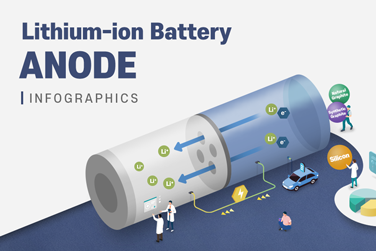
An anode material is a substance in lithium-ion batteries that inserts and releases lithium ions from the cathode (+) to generate electricity. To achieve long battery life, the anode material must be able to repeatedly accommodate the insertion and release of lithium ions. The more stable this process is, the better the battery can maintain its performance over extended charge and discharge cycles.
Graphite, the Most Widely Used Anode Material
Although various anode materials have been researched for lithium-ion batteries, graphite remains the most widely used material in commercial applications. Graphite can be classified into natural graphite and artificial graphite.
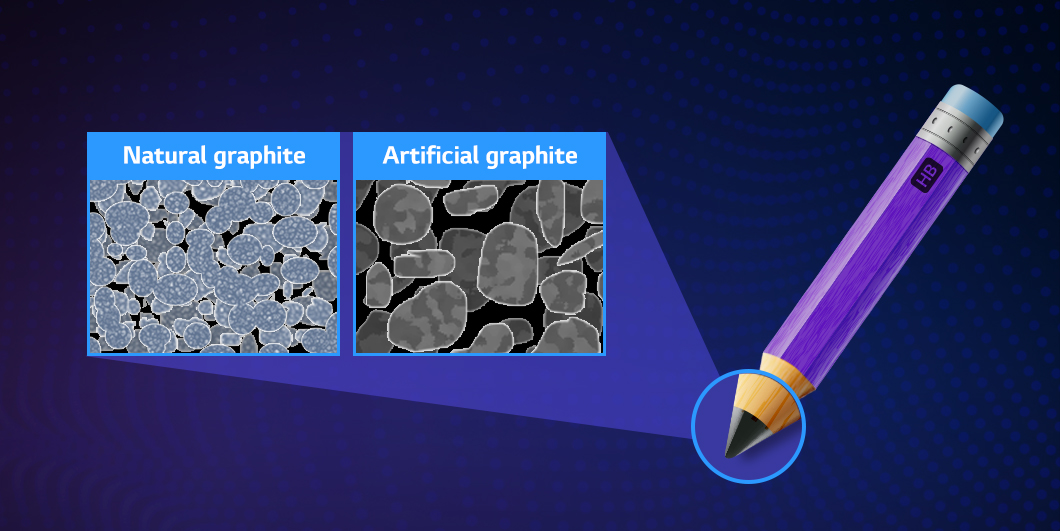
Graphite has a well-ordered layered structure that allows lithium ions to be inserted between its layers. This structure enables stable insertion and release of lithium ions, supporting reliable charge and discharge performance.
However, when lithium ions are inserted, the internal structure of graphite particles expands, and their surface becomes unstable. As a result, the ability to insert and release lithium ions decreases, ultimately shortening battery lifespan.
As battery performance and capacity continue to improve, the need for next-generation anode materials that can store more energy and enable faster charging is growing.
Silicon as a Next-Generation Anode Material
Silicon is emerging as the next-generation anode material to succeed graphite. While graphite can store one lithium ion per six carbon atoms, silicon can store up to 4.4 lithium ions per silicon atom.
This means silicon anodes have a theoretical capacity1 approximately 4 to 10 times higher than that of graphite anodes. This characteristic significantly enhances energy density, helping extend EV driving range, while also offering advantages for fast-charging battery design.
Moreover, silicon is an economical and environmentally friendly material, further solidifying its status as a promising next-generation anode material.
Outlook for the Silicon Anode Market
Experts project that the anode material market for rechargeable batteries would grow as the electric vehicle market expands. The silicon anode market, in particular, is expected to grow significantly./

According to market research, the global silicon anode material market is projected to grow from approximately $600 million in 2023 to $2.1 billion in 2025, $4.5 billion in 2030, and $7.0 billion by 2035.2
Technical Challenges of Silicon Anode Materials
However, there are still looming problems involving silicon anode materials. One of the most significant challenges is volume expansion that occurs during the reaction with lithium ions. Silicon undergoes large volume changes during charge and discharge cycles, which can cause particles to break.
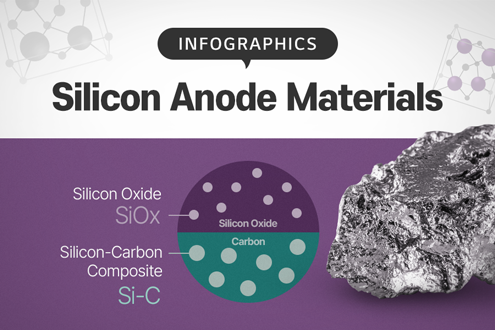
These characteristics can affect electrode structural stability and battery lifespan, leading to active research into various material technologies to address these issues. Recently, diverse material approaches such as silicon oxide (SiOx) and silicon-carbon composites (Si-C) have been actively developed to improve the performance and stability of silicon anodes.
*View: (Infographics #20) Silicon Anode Materials_Silicon Oxide & Silicon-Carbon Composite
Key Q&A
Q. What is an anode material?
An anode material is a key component that stores and releases lithium ions, affecting battery charge and discharge performance as well as lifespan.
Q. What are the characteristics of silicon anode materials?
Silicon anode materials can store significantly more lithium ions than graphite, making them a next-generation anode material that can greatly enhance battery energy density.
Q. What are the latest technology trends in silicon anode materials?
Recently, various types of silicon anode materials, such as silicon oxide (SiOx) and silicon-carbon composites (Si-C), have been actively developed.
LG Energy Solution has been delivering meaningful achievements through its research and development of silicon anode materials. In 2019, LG Energy Solution became the first in the world to apply a 5% silicon anode to a pure electric vehicle. In 2021, the company successfully developed a long-life all-solid-state battery using micro silicon anode materials. In 2024, it secured a technology to mitigate the volume expansion issue of silicon anodes through a high-strength separator design.
In 2019, LG Energy Solution became the first in the world to apply a 5% silicon anode to a pure electric vehicle. In 2021, the company successfully developed a long-life all-solid-state battery using micro silicon anode materials. In 2024, it secured a technology to mitigate the volume expansion issue of silicon anodes through a high-strength separator design.
By overcoming the limitations of silicon anodes, the company continues to drive innovation toward commercialization. We look forward to LG Energy Solution’s continued advancements.
- Theoretical Capacity: The maximum lithium-ion content that can be physically stored within the electrode material. ↩︎
- SNE Research. (2025). The silicon anode material market for lithium-ion batteries is projected to reach 295,000 tons and $7.0 billion by 2035, with a CAGR of 30% from 2020 to 2035. ↩︎