As battery technologies continue to advance, safety technologies are also becoming more sophisticated. Higher energy density in the battery pack means more cells are placed within a limited space, raising the possibility of rapid heat accumulation inside the pack. One key technology designed to address this challenge is TP, or Thermal Propagation prevention technology. In this installment of the Battery Glossary, we take a closer look at TP prevention technology.
How Does Thermal Propagation Occur?
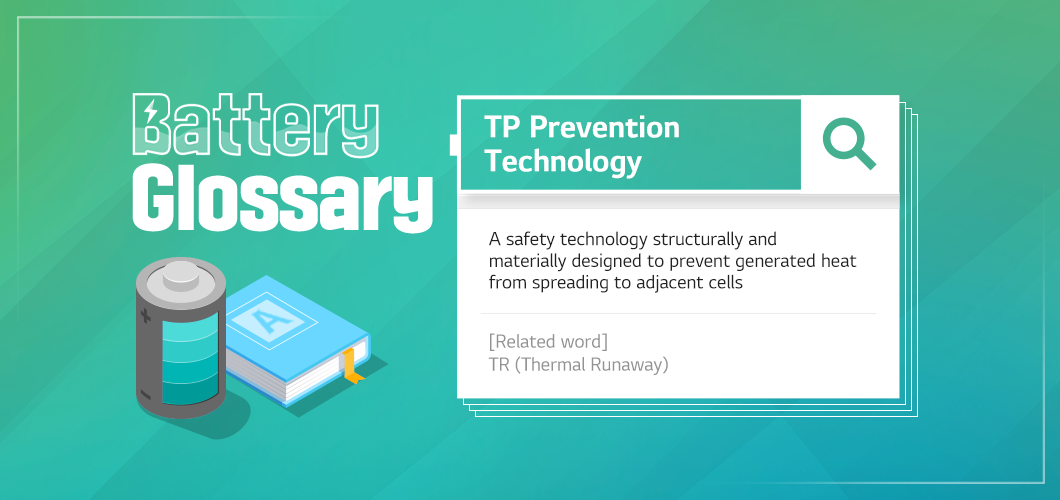
Thermal Propagation (TP) refers to the spread of heat from one cell to adjacent cells. To better understand TP, it is first necessary to examine Thermal Runaway (TR).
TR occurs when the temperature of a battery cell rises to approximately 130°C or higher, triggering exothermic chemical reactions inside the cell. These reactions generate additional heat, causing the temperature to spike. The accumulated heat can lead to chain reactions, and when this heat is transferred to neighboring cells, it can result in TP.
Types of TP Prevention Technologies
Although TR is extremely rare, it can have a significant impact on battery safety when it occurs. For this reason, batteries are designed with multi-layered defense systems. At the first level of defense, predictive and preventive technologies are applied to reduce the likelihood of TR. At the second level, TP prevention technologies are used to prevent already generated heat from spreading to adjacent cells.

TP prevention technology refers to safety technologies that are structurally and materially designed to limit heat transfer between cells. Depending on the application purpose, these technologies can be implemented in various ways.
The first solution set focuses on preventing heat generated in an abnormal cell from spreading to neighboring cells. One approach involves placing thermal barrier materials such as ceramic or silicone pads between cells. This reduces thermal conduction between cells and slows the rate of heat transfer. Another method increases spacing between cells to create air gaps that help limit the spread of radiative heat. In addition, Phase Change Materials (PCM) absorb heat during melting, slowing temperature rise within the battery. Cooling systems that use airflow to dissipate internal heat are also employed, and these technologies are often applied in combination.
Another category focuses on preventing byproducts generated during the TR process from migrating to other cells. It suppresses the spread of thermal reactions by creating venting channels that rapidly release gases and particles outside and by incorporating flame-retardant additives into the electrolyte. Furthermore, cell clustering structures divide cells into separate zones, physically blocking heat from spreading from one zone to another.
LG Energy Solution’s TP Prevention Technologies
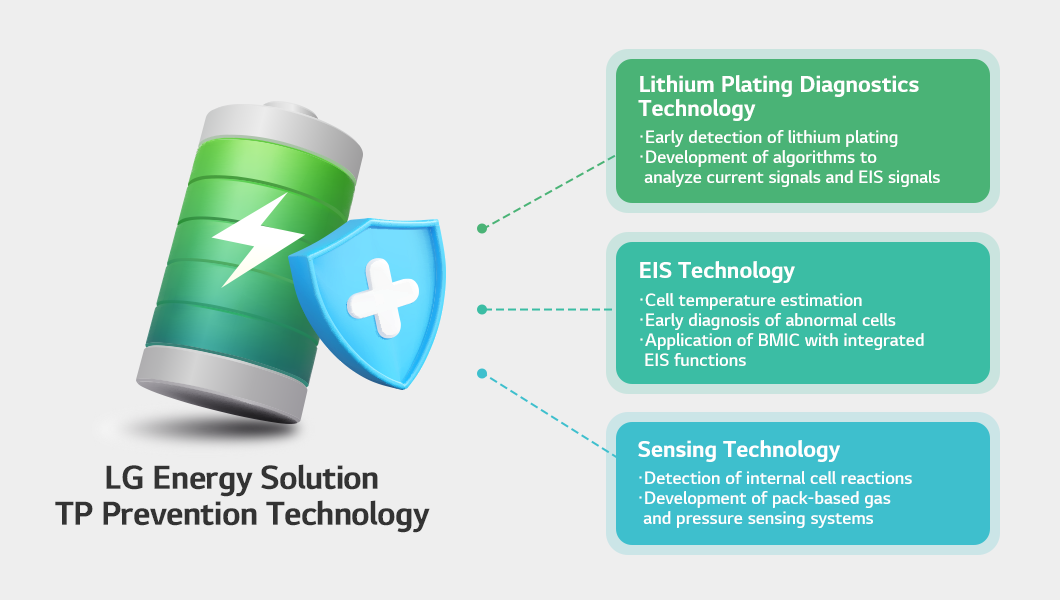
LG Energy Solution is making continuous efforts across multiple areas to advance battery safety technologies. In the field of TP prevention in particular, the company is focusing on the development of diagnostic technologies to proactively detect and prevent TP.
One example is lithium plating diagnostics, which detects lithium plating, one of the key causes of TP, at an early stage. By analyzing pulse current and electrical signals using Electrochemical Impedance Spectroscopy (EIS), internal changes within the cell can be identified in detail.
EIS uses changes in cell impedance to estimate temperature and detect abnormal conditions early. This function is integrated into the Battery Management IC (BMIC), enabling real-time monitoring of cell conditions.
Finally, sensing technologies enhance safety by directly detecting internal cell reactions through gas and pressure sensors.
LG Energy Solution’s TP prevention approaches go beyond simply blocking heat propagation. They are evolving into proactive safety technologies that detect and prevent abnormal conditions in advance.
In the next installment of the Battery Glossary, we will continue to introduce a wide range of battery technologies in a clear and engaging way.