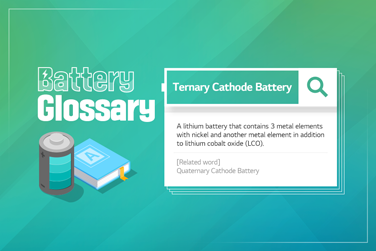
Cathode materials offer space to store lithium ions and are a key component that determines battery capacity and voltage and also affects safety and price. As batteries are becoming increasingly important in various industries, cathodes combining multiple elements have been developed for high performance. Notable examples include NCM, NCA, and NCMA cathode materials. In this infographic, we will explore the characteristics of each cathode type.
Ternary and Quaternary Cathode Batteries by Cathode Composition
In lithium-ion batteries, the most fundamental cathode active material is lithium cobalt oxide (LCO), a lithium metal oxide composed of lithium, cobalt, and oxygen. Over time, cathode materials have evolved by adjusting the ratio of these base elements or by adding other metal elements.
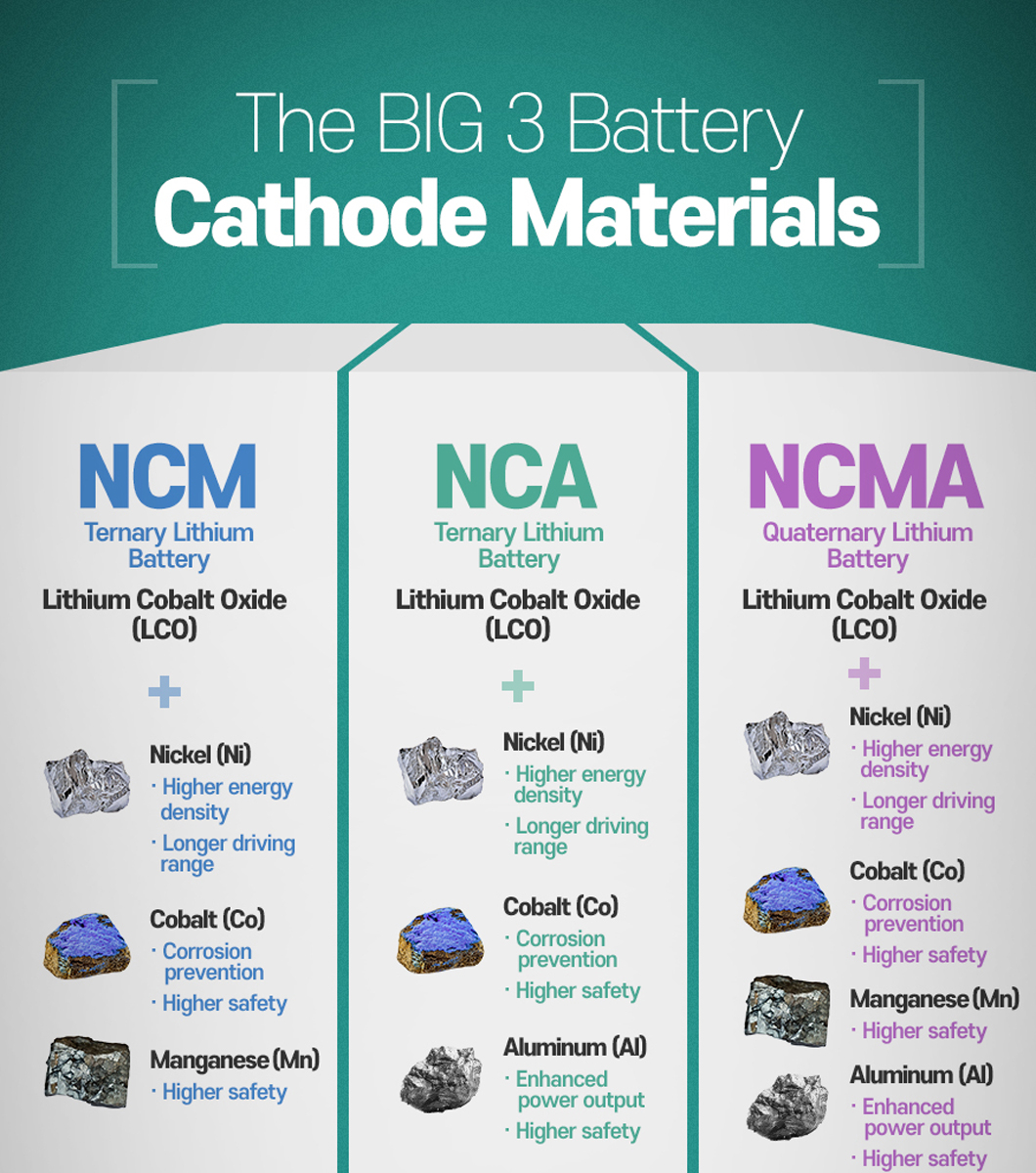
Based on LCO, cathode materials that incorporate three different elements are referred to as ternary cathode batteries, while those that combine four elements are called quaternary cathode batteries. Ternary cathode batteries typically use NCM (nickel-cobalt-manganese) or NCA (nickel-cobalt-aluminum) cathode materials, whereas NCMA (nickel-cobalt-manganese-aluminum) is a common cathode material used in quaternary cathode batteries.
NCM Cathode Materials Offering Diverse Composition Ratios
NCM cathode materials are made by adding nickel (Ni) and manganese (Mn) to LCO. They are classified into various types such as NCM111, NCM523, NCM622, and NCM811, with each number representing the composition ratio in the order of nickel, cobalt, and manganese. They are produced with appropriate ratios depending on the battery application.
Each element in NCM has different characteristics and contributes to enhancing battery performance. Nickel improves energy density. The higher the nickel content is, the higher the energy density becomes, which in turn extends EV driving range on one charge. Cobalt prevents corrosion of the cathode, thereby increasing safety. Manganese also raises battery safety.
Batteries with NCM cathode materials are currently among the most widely used batteries, and are mainly incorporated into EVs, as they may offer higher output and efficiency than other batteries. Nickel plays a key role in enhancing energy density.
Recently, research has focused on increasing nickel content to enhance performance and decrease manufacturing costs or on reducing the content of expensive cobalt. For example, among batteries that use NCM cathode materials, advancement is ongoing in mid-nickel batteries with a nickel content of 40- 60% and high-nickel batteries with a nickel content of 60-90%.
In particular, mid-nickel batteries are being developed to support high voltages. These batteries contain 50-60% nickel and offer improved safety by increasing the manganese content. Their relatively lower energy capacity is compensated for with high-voltage technology, which helps increase energy density.
NCA Cathode Materials with Fundamentally High Nickel Content
NCA is a cathode material composed of nickel, cobalt, and aluminum (Al) added to LCO. It is also composed of three elements and, like NCM, is called a ternary cathode battery. Among its core elements, nickel increases energy density, cobalt enhances battery safety, and aluminum improves battery output and safety. Thanks to these characteristics, NCA is mainly used in the small battery market, especially for power tools.
NCMA Cathode Materials, Combining the Strengths of NCM and NCA
NCMA cathode materials are used in quaternary cathode batteries made of four metal elements, by adding aluminum to NCM (nickel, cobalt, and manganese) cathode materials. As the composition suggests, NCMA has the strengths of NCM and NCA. The proportion of nickel has increased, while the content of costly cobalt has decreased, reducing manufacturing costs. The addition of aluminum helps ensure outstanding safety. Moreover, NCMA cathode materials are suitable for a wide range of areas, as they can be applied to various form factors such as cylindrical, prismatic and pouch-type batteries.
Therefore, NCMA cathode materials are mainly employed in the cathodes of high-performance EV batteries. They are increasingly recognized for improving not only driving range and output, but also battery safety.
We have looked at NCM, NCA, NCMA cathode materials with an infographic. Now, you may be able to recognize the characteristics and applications of the cathode material just by its name!
Next time, we will take a closer look at the types of silicon anode materials through another infographic.